

3.3: Plane Waves
- Page ID
- 1199

\( \newcommand{\vecs}[1]{\overset { \scriptstyle \rightharpoonup} {\mathbf{#1}} } \)
\( \newcommand{\vecd}[1]{\overset{-\!-\!\rightharpoonup}{\vphantom{a}\smash {#1}}} \)
\( \newcommand{\dsum}{\displaystyle\sum\limits} \)
\( \newcommand{\dint}{\displaystyle\int\limits} \)
\( \newcommand{\dlim}{\displaystyle\lim\limits} \)
\( \newcommand{\id}{\mathrm{id}}\) \( \newcommand{\Span}{\mathrm{span}}\)
( \newcommand{\kernel}{\mathrm{null}\,}\) \( \newcommand{\range}{\mathrm{range}\,}\)
\( \newcommand{\RealPart}{\mathrm{Re}}\) \( \newcommand{\ImaginaryPart}{\mathrm{Im}}\)
\( \newcommand{\Argument}{\mathrm{Arg}}\) \( \newcommand{\norm}[1]{\| #1 \|}\)
\( \newcommand{\inner}[2]{\langle #1, #2 \rangle}\)
\( \newcommand{\Span}{\mathrm{span}}\)
\( \newcommand{\id}{\mathrm{id}}\)
\( \newcommand{\Span}{\mathrm{span}}\)
\( \newcommand{\kernel}{\mathrm{null}\,}\)
\( \newcommand{\range}{\mathrm{range}\,}\)
\( \newcommand{\RealPart}{\mathrm{Re}}\)
\( \newcommand{\ImaginaryPart}{\mathrm{Im}}\)
\( \newcommand{\Argument}{\mathrm{Arg}}\)
\( \newcommand{\norm}[1]{\| #1 \|}\)
\( \newcommand{\inner}[2]{\langle #1, #2 \rangle}\)
\( \newcommand{\Span}{\mathrm{span}}\) \( \newcommand{\AA}{\unicode[.8,0]{x212B}}\)
\( \newcommand{\vectorA}[1]{\vec{#1}} % arrow\)
\( \newcommand{\vectorAt}[1]{\vec{\text{#1}}} % arrow\)
\( \newcommand{\vectorB}[1]{\overset { \scriptstyle \rightharpoonup} {\mathbf{#1}} } \)
\( \newcommand{\vectorC}[1]{\textbf{#1}} \)
\( \newcommand{\vectorD}[1]{\overrightarrow{#1}} \)
\( \newcommand{\vectorDt}[1]{\overrightarrow{\text{#1}}} \)
\( \newcommand{\vectE}[1]{\overset{-\!-\!\rightharpoonup}{\vphantom{a}\smash{\mathbf {#1}}}} \)
\( \newcommand{\vecs}[1]{\overset { \scriptstyle \rightharpoonup} {\mathbf{#1}} } \)
\(\newcommand{\longvect}{\overrightarrow}\)
\( \newcommand{\vecd}[1]{\overset{-\!-\!\rightharpoonup}{\vphantom{a}\smash {#1}}} \)
\(\newcommand{\avec}{\mathbf a}\) \(\newcommand{\bvec}{\mathbf b}\) \(\newcommand{\cvec}{\mathbf c}\) \(\newcommand{\dvec}{\mathbf d}\) \(\newcommand{\dtil}{\widetilde{\mathbf d}}\) \(\newcommand{\evec}{\mathbf e}\) \(\newcommand{\fvec}{\mathbf f}\) \(\newcommand{\nvec}{\mathbf n}\) \(\newcommand{\pvec}{\mathbf p}\) \(\newcommand{\qvec}{\mathbf q}\) \(\newcommand{\svec}{\mathbf s}\) \(\newcommand{\tvec}{\mathbf t}\) \(\newcommand{\uvec}{\mathbf u}\) \(\newcommand{\vvec}{\mathbf v}\) \(\newcommand{\wvec}{\mathbf w}\) \(\newcommand{\xvec}{\mathbf x}\) \(\newcommand{\yvec}{\mathbf y}\) \(\newcommand{\zvec}{\mathbf z}\) \(\newcommand{\rvec}{\mathbf r}\) \(\newcommand{\mvec}{\mathbf m}\) \(\newcommand{\zerovec}{\mathbf 0}\) \(\newcommand{\onevec}{\mathbf 1}\) \(\newcommand{\real}{\mathbb R}\) \(\newcommand{\twovec}[2]{\left[\begin{array}{r}#1 \\ #2 \end{array}\right]}\) \(\newcommand{\ctwovec}[2]{\left[\begin{array}{c}#1 \\ #2 \end{array}\right]}\) \(\newcommand{\threevec}[3]{\left[\begin{array}{r}#1 \\ #2 \\ #3 \end{array}\right]}\) \(\newcommand{\cthreevec}[3]{\left[\begin{array}{c}#1 \\ #2 \\ #3 \end{array}\right]}\) \(\newcommand{\fourvec}[4]{\left[\begin{array}{r}#1 \\ #2 \\ #3 \\ #4 \end{array}\right]}\) \(\newcommand{\cfourvec}[4]{\left[\begin{array}{c}#1 \\ #2 \\ #3 \\ #4 \end{array}\right]}\) \(\newcommand{\fivevec}[5]{\left[\begin{array}{r}#1 \\ #2 \\ #3 \\ #4 \\ #5 \\ \end{array}\right]}\) \(\newcommand{\cfivevec}[5]{\left[\begin{array}{c}#1 \\ #2 \\ #3 \\ #4 \\ #5 \\ \end{array}\right]}\) \(\newcommand{\mattwo}[4]{\left[\begin{array}{rr}#1 \amp #2 \\ #3 \amp #4 \\ \end{array}\right]}\) \(\newcommand{\laspan}[1]{\text{Span}\{#1\}}\) \(\newcommand{\bcal}{\cal B}\) \(\newcommand{\ccal}{\cal C}\) \(\newcommand{\scal}{\cal S}\) \(\newcommand{\wcal}{\cal W}\) \(\newcommand{\ecal}{\cal E}\) \(\newcommand{\coords}[2]{\left\{#1\right\}_{#2}}\) \(\newcommand{\gray}[1]{\color{gray}{#1}}\) \(\newcommand{\lgray}[1]{\color{lightgray}{#1}}\) \(\newcommand{\rank}{\operatorname{rank}}\) \(\newcommand{\row}{\text{Row}}\) \(\newcommand{\col}{\text{Col}}\) \(\renewcommand{\row}{\text{Row}}\) \(\newcommand{\nul}{\text{Nul}}\) \(\newcommand{\var}{\text{Var}}\) \(\newcommand{\corr}{\text{corr}}\) \(\newcommand{\len}[1]{\left|#1\right|}\) \(\newcommand{\bbar}{\overline{\bvec}}\) \(\newcommand{\bhat}{\widehat{\bvec}}\) \(\newcommand{\bperp}{\bvec^\perp}\) \(\newcommand{\xhat}{\widehat{\xvec}}\) \(\newcommand{\vhat}{\widehat{\vvec}}\) \(\newcommand{\uhat}{\widehat{\uvec}}\) \(\newcommand{\what}{\widehat{\wvec}}\) \(\newcommand{\Sighat}{\widehat{\Sigma}}\) \(\newcommand{\lt}{<}\) \(\newcommand{\gt}{>}\) \(\newcommand{\amp}{&}\) \(\definecolor{fillinmathshade}{gray}{0.9}\)As we have just seen, a wave of amplitude \(\begin{equation}A\end{equation}\), wavenumber \(\begin{equation}k\end{equation}\), angular frequency \(\begin{equation}\omega\end{equation}\), and phase angle \(\begin{equation}\varphi\end{equation}\), propagating in the positive \(\begin{equation}x\end{equation}\)-direction, is represented by the following wavefunction:
\begin{equation}\psi(x, t)=A \cos (k x-\omega t+\varphi)\end{equation}
Now, the type of wave represented above is conventionally termed a one-dimensional plane wave. It is one-dimensional because its associated wavefunction only depends on the single Cartesian coordinate \(\begin{equation}x\end{equation}\). Furthermore, it is a plane wave because the wave maxima, which are located at
\begin{equation}k x-\omega t+\varphi=j 2 \pi\end{equation}
where \(\begin{equation}j\end{equation}\) is an integer, consist of a series of parallel planes, normal to the \(\begin{equation}x\end{equation}\)-axis, which are equally spaced a distance \(\begin{equation}\lambda=2 \pi / k\end{equation}\) apart, and propagate along the positive  -axis at the velocity \(\begin{equation}v=\omega / k\end{equation}\). These conclusions follow because Eq. (3.3.2) can be re-written in the form
\begin{equation}x=d\end{equation}
where \(\begin{equation}d=(j-\varphi / 2 \pi) \lambda+v t\end{equation}\). Moreover, as is well-known, (3.2.3) is the equation of a plane, normal to the -axis, whose distance of closest approach to the origin is  .
.
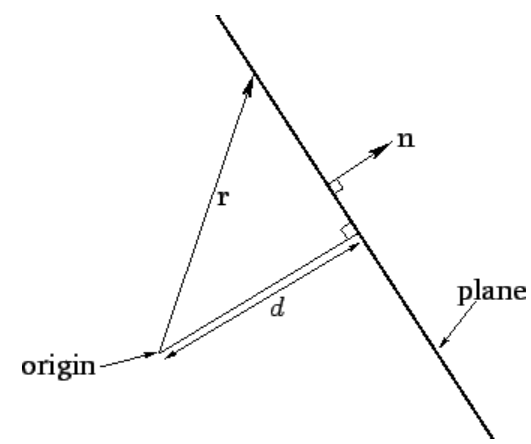
Figure 1: The solution of \(\begin{equation}\mathbf{n} \cdot \mathbf{r}=d\end{equation}\) is a plane.
The previous equation can also be written in the coordinate-free form
\begin{equation}\mathbf{n} \cdot \mathbf{r}=d\end{equation}
where \(\begin{equation}\mathbf{n}=(1,0,0)\end{equation}\) is a unit vector directed along the positive -axis, and \(\begin{equation}\mathbf{r}=(x, y, z)\end{equation}\) represents the vector displacement of a general point from the origin. Since there is nothing special about the -direction, it follows that if  is re-interpreted as a unit vector pointing in an arbitrary direction then (3.3.4) can be re-interpreted as the general equation of a plane. As before, the plane is normal to , and its distance of closest approach to the origin is . See Fig. 1. This observation allows us to write the three-dimensional equivalent to the wavefunction (3.3.1) as
\begin{equation}\psi(x, y, z, t)=A \cos (\mathbf{k} \cdot \mathbf{r}-\omega t+\varphi)\end{equation}
where the constant vector \(\begin{equation}\mathbf{k}=\left(k_{x}, k_{y}, k_{z}\right)=k \mathbf{n}\end{equation}\) is called the wavevector. The wave represented above is conventionally termed a three-dimensional plane wave. It is three-dimensional because its wavefunction, \(\begin{equation}\psi(x, y, z, t)\end{equation}\), depends on all three Cartesian coordinates. Moreover, it is a plane wave because the wave maxima are located at
\begin{equation}\mathbf{k} \cdot \mathbf{r}-\omega t+\varphi=j 2 \pi\end{equation}
or
\begin{equation}\mathbf{n} \cdot \mathbf{r}=(j-\varphi / 2 \pi) \lambda+v t\end{equation}
where \(\begin{equation}\lambda=2 \pi / k, \text { and } v=\omega / k\end{equation}\). Note that the wavenumber, \(\begin{equation}k\end{equation}\), is the magnitude of the wavevector, \(\begin{equation}\mathbf{k}: \text { i.e.}, k \equiv|\mathbf{k}|\end{equation}\). It follows, by comparison with Eq. (3.3.4), that the wave maxima consist of a series of parallel planes, normal to the wavevector, which are equally spaced a distance \(\begin{equation}\lambda\end{equation}\) apart, and which propagate in the \(\begin{equation}\mathbf{k}\end{equation}\)-direction at the velocity  . See Fig. 2. Hence, the direction of the wavevector specifies the wave propagation direction, whereas its magnitude determines the wavenumber,
  , and, thus, the wavelength, \(\begin{equation}\lambda=2 \pi / k\end{equation}\)
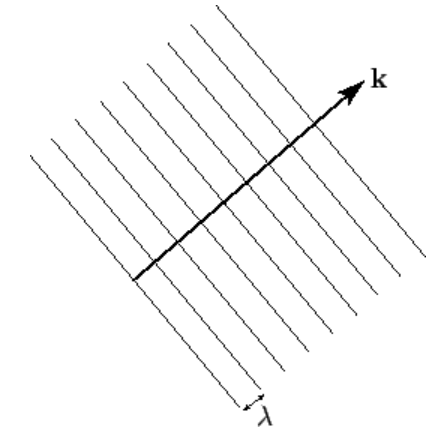
Figure 2: Wave maxima associated with a three-dimensional plane wave.
Contributors
Richard Fitzpatrick (Professor of Physics, The University of Texas at Austin)
\( \newcommand {\ltapp} {\stackrel {_{\normalsize<}}{_{\normalsize \sim}}}\) \(\newcommand {\gtapp} {\stackrel {_{\normalsize>}}{_{\normalsize \sim}}}\) \(\newcommand {\btau}{\mbox{\boldmath$\tau$}}\) \(\newcommand {\bmu}{\mbox{\boldmath$\mu$}}\) \(\newcommand {\bsigma}{\mbox{\boldmath$\sigma$}}\) \(\newcommand {\bOmega}{\mbox{\boldmath$\Omega$}}\) \(\newcommand {\bomega}{\mbox{\boldmath$\omega$}}\) \(\newcommand {\bepsilon}{\mbox{\boldmath$\epsilon$}}\)