

12.2: An Invariant Measure of Length
- Page ID
- 17439

\( \newcommand{\vecs}[1]{\overset { \scriptstyle \rightharpoonup} {\mathbf{#1}} } \)
\( \newcommand{\vecd}[1]{\overset{-\!-\!\rightharpoonup}{\vphantom{a}\smash {#1}}} \)
\( \newcommand{\dsum}{\displaystyle\sum\limits} \)
\( \newcommand{\dint}{\displaystyle\int\limits} \)
\( \newcommand{\dlim}{\displaystyle\lim\limits} \)
\( \newcommand{\id}{\mathrm{id}}\) \( \newcommand{\Span}{\mathrm{span}}\)
( \newcommand{\kernel}{\mathrm{null}\,}\) \( \newcommand{\range}{\mathrm{range}\,}\)
\( \newcommand{\RealPart}{\mathrm{Re}}\) \( \newcommand{\ImaginaryPart}{\mathrm{Im}}\)
\( \newcommand{\Argument}{\mathrm{Arg}}\) \( \newcommand{\norm}[1]{\| #1 \|}\)
\( \newcommand{\inner}[2]{\langle #1, #2 \rangle}\)
\( \newcommand{\Span}{\mathrm{span}}\)
\( \newcommand{\id}{\mathrm{id}}\)
\( \newcommand{\Span}{\mathrm{span}}\)
\( \newcommand{\kernel}{\mathrm{null}\,}\)
\( \newcommand{\range}{\mathrm{range}\,}\)
\( \newcommand{\RealPart}{\mathrm{Re}}\)
\( \newcommand{\ImaginaryPart}{\mathrm{Im}}\)
\( \newcommand{\Argument}{\mathrm{Arg}}\)
\( \newcommand{\norm}[1]{\| #1 \|}\)
\( \newcommand{\inner}[2]{\langle #1, #2 \rangle}\)
\( \newcommand{\Span}{\mathrm{span}}\) \( \newcommand{\AA}{\unicode[.8,0]{x212B}}\)
\( \newcommand{\vectorA}[1]{\vec{#1}} % arrow\)
\( \newcommand{\vectorAt}[1]{\vec{\text{#1}}} % arrow\)
\( \newcommand{\vectorB}[1]{\overset { \scriptstyle \rightharpoonup} {\mathbf{#1}} } \)
\( \newcommand{\vectorC}[1]{\textbf{#1}} \)
\( \newcommand{\vectorD}[1]{\overrightarrow{#1}} \)
\( \newcommand{\vectorDt}[1]{\overrightarrow{\text{#1}}} \)
\( \newcommand{\vectE}[1]{\overset{-\!-\!\rightharpoonup}{\vphantom{a}\smash{\mathbf {#1}}}} \)
\( \newcommand{\vecs}[1]{\overset { \scriptstyle \rightharpoonup} {\mathbf{#1}} } \)
\(\newcommand{\longvect}{\overrightarrow}\)
\( \newcommand{\vecd}[1]{\overset{-\!-\!\rightharpoonup}{\vphantom{a}\smash {#1}}} \)
\(\newcommand{\avec}{\mathbf a}\) \(\newcommand{\bvec}{\mathbf b}\) \(\newcommand{\cvec}{\mathbf c}\) \(\newcommand{\dvec}{\mathbf d}\) \(\newcommand{\dtil}{\widetilde{\mathbf d}}\) \(\newcommand{\evec}{\mathbf e}\) \(\newcommand{\fvec}{\mathbf f}\) \(\newcommand{\nvec}{\mathbf n}\) \(\newcommand{\pvec}{\mathbf p}\) \(\newcommand{\qvec}{\mathbf q}\) \(\newcommand{\svec}{\mathbf s}\) \(\newcommand{\tvec}{\mathbf t}\) \(\newcommand{\uvec}{\mathbf u}\) \(\newcommand{\vvec}{\mathbf v}\) \(\newcommand{\wvec}{\mathbf w}\) \(\newcommand{\xvec}{\mathbf x}\) \(\newcommand{\yvec}{\mathbf y}\) \(\newcommand{\zvec}{\mathbf z}\) \(\newcommand{\rvec}{\mathbf r}\) \(\newcommand{\mvec}{\mathbf m}\) \(\newcommand{\zerovec}{\mathbf 0}\) \(\newcommand{\onevec}{\mathbf 1}\) \(\newcommand{\real}{\mathbb R}\) \(\newcommand{\twovec}[2]{\left[\begin{array}{r}#1 \\ #2 \end{array}\right]}\) \(\newcommand{\ctwovec}[2]{\left[\begin{array}{c}#1 \\ #2 \end{array}\right]}\) \(\newcommand{\threevec}[3]{\left[\begin{array}{r}#1 \\ #2 \\ #3 \end{array}\right]}\) \(\newcommand{\cthreevec}[3]{\left[\begin{array}{c}#1 \\ #2 \\ #3 \end{array}\right]}\) \(\newcommand{\fourvec}[4]{\left[\begin{array}{r}#1 \\ #2 \\ #3 \\ #4 \end{array}\right]}\) \(\newcommand{\cfourvec}[4]{\left[\begin{array}{c}#1 \\ #2 \\ #3 \\ #4 \end{array}\right]}\) \(\newcommand{\fivevec}[5]{\left[\begin{array}{r}#1 \\ #2 \\ #3 \\ #4 \\ #5 \\ \end{array}\right]}\) \(\newcommand{\cfivevec}[5]{\left[\begin{array}{c}#1 \\ #2 \\ #3 \\ #4 \\ #5 \\ \end{array}\right]}\) \(\newcommand{\mattwo}[4]{\left[\begin{array}{rr}#1 \amp #2 \\ #3 \amp #4 \\ \end{array}\right]}\) \(\newcommand{\laspan}[1]{\text{Span}\{#1\}}\) \(\newcommand{\bcal}{\cal B}\) \(\newcommand{\ccal}{\cal C}\) \(\newcommand{\scal}{\cal S}\) \(\newcommand{\wcal}{\cal W}\) \(\newcommand{\ecal}{\cal E}\) \(\newcommand{\coords}[2]{\left\{#1\right\}_{#2}}\) \(\newcommand{\gray}[1]{\color{gray}{#1}}\) \(\newcommand{\lgray}[1]{\color{lightgray}{#1}}\) \(\newcommand{\rank}{\operatorname{rank}}\) \(\newcommand{\row}{\text{Row}}\) \(\newcommand{\col}{\text{Col}}\) \(\renewcommand{\row}{\text{Row}}\) \(\newcommand{\nul}{\text{Nul}}\) \(\newcommand{\var}{\text{Var}}\) \(\newcommand{\corr}{\text{corr}}\) \(\newcommand{\len}[1]{\left|#1\right|}\) \(\newcommand{\bbar}{\overline{\bvec}}\) \(\newcommand{\bhat}{\widehat{\bvec}}\) \(\newcommand{\bperp}{\bvec^\perp}\) \(\newcommand{\xhat}{\widehat{\xvec}}\) \(\newcommand{\vhat}{\widehat{\vvec}}\) \(\newcommand{\uhat}{\widehat{\uvec}}\) \(\newcommand{\what}{\widehat{\wvec}}\) \(\newcommand{\Sighat}{\widehat{\Sigma}}\) \(\newcommand{\lt}{<}\) \(\newcommand{\gt}{>}\) \(\newcommand{\amp}{&}\) \(\definecolor{fillinmathshade}{gray}{0.9}\)As we've seen in the previous section, measures of length and time intervals become relative in the new reality that is created by the light postulate. That's not very convenient: we'd like to be able to agree on the value of quantities independent of which inertial reference frame we use to measure them in. In ordinary space, the method we use to write down vectors presents us with a similar problem: we write our vector components with respect to a basis or coordinate system, and so choosing a different set of coordinates changes the numerical value of the components of the vector. Of course, the actual vector doesn't change - a physical quantity like a velocity or a force really doesn't care what specific coordinates you use to measure it. However, if you and your collaborator use different coordinates, you might run into misunderstandings when comparing notes. Fortunately, vectors have properties whose value are independent of the coordinate system used to determine their components. The most important one is their magnitude, which we sometimes also refer to as their length. If you know a vector's components, calculating its magnitude is easy: its simply the square
root of the dot product with itself:
\[
x=|\boldsymbol{x}|=\sqrt{\boldsymbol{x} \cdot \boldsymbol{x}}
\]
Similarly, although measures of both length and time change between inertial reference frame in relativity theory, there is a combination of the two whose value is independent of which reference frame you measure it in:
\[
(\Delta s)^2=(c \Delta t)^2-(\Delta \boldsymbol{x}) \cdot(\Delta \boldsymbol{x})=(c \Delta t)^2-(\Delta x)^2-(\Delta y)^2-(\Delta z)^2 \text {. }
\]
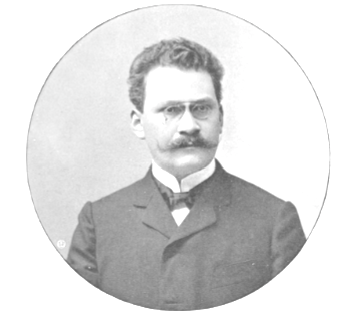
Hermann Minkowski (1864-1909) was a German mathematician, who used geometrical methods to address problems both in number theory and in (mathematical) physics. Born in Russia, Minkowski's Jewish family emigrated to Prussia (in present-day Germany) to avoid persecution. He worked at various universities in the German-speaking world, including ETH in Zürich, where he was one of Einstein's teachers. In 1907, Minkowski realized that the theory of relativity as introduced by Einstein two years earlier could most easily be understood in a four-dimensional spacetime in which lengths can be calculated with equation (12.4). He also developed the graphical representation named after him (figure 12.1). In September 1908, Minkowski gave a lecture titled 'Space and time' in which he laid out these ideas, starting with a now famous quote: "The views of space and time which I wish to lay before you have sprung from the soil of experimental physics, and therein lies their strength. They are radical. Henceforth space by itself, and time by itself, are doomed to fade away into mere shadows, and only a kind of union of the two will preserve an independent reality." Einstein built on Minkowski's geometrical representation to extend the special theory of relativity to the general one in the 1910's. Sadly, Minkowski did not live to see this, as he died of appendicitis at age 44 .Hermann Minkowski (1864-1909) was a German mathematician, who used geometrical methods to address problems both in number theory and in (mathematical) physics. Born in Russia, Minkowski's Jewish family emigrated to Prussia (in present-day Germany) to avoid persecution. He worked at various universities in the German-speaking world, including ETH in Zürich, where he was one of Einstein's teachers. In 1907, Minkowski realized that the theory of relativity as introduced by Einstein two years earlier could most easily be understood in a four-dimensional spacetime in which lengths can be calculated with equation (12.4). He also developed the graphical representation named after him (figure 12.1). In September 1908, Minkowski gave a lecture titled 'Space and time' in which he laid out these ideas, starting with a now famous quote: "The views of space and time which I wish to lay before you have sprung from the soil of experimental physics, and therein lies their strength. They are radical. Henceforth space by itself, and time by itself, are doomed to fade away into mere shadows, and only a kind of union of the two will preserve an independent reality." Einstein built on Minkowski's geometrical representation to extend the special theory of relativity to the general one in the 1910's. Sadly, Minkowski did not live to see this, as he died of appendicitis at age 44 .
Again, we see that time and space are mixed! Checking that the 'length' \(\Delta s\) is indeed invariant when you go from one inertial frame to another (i.e., when you apply a Lorentz transformation) is a straightforward exercise. You may wonder where the idea for equation (12.4) came from, and the answer is the same as always in relativity: from the light postulate. What both you and your collaborator will agree on is the speed of light, which (as it is a constant), you can measure in your own coordinate system as \(c=(\Delta r) /(\Delta t)\), where \(\Delta r=\sqrt{(\Delta x)^2-(\Delta y)^2-(\Delta z)^2}\) is the distance covered by a light beam, and \(\Delta t\) the time it took. Rewriting, you get \(0=(c \Delta t)^2-(\Delta x)^2-(\Delta y)^2-(\Delta z)^2\), which won't depend on the coordinate system you used - so your collaborator gets the same answer \({ }^2\).
In contrast to the length of an ordinary vector, the length of the invariant interval \((\Delta s)^2\) can become zero or even negative! As we've seen above, the interval is always zero for the path taken by a light beam (or anything traveling at the speed of light). If you travel at speeds slower than light (including standing still), the length of your interval will come out positive. A negative length would correspond to a trajectory that has a speed faster than that of light, which, as we've seen in section 10.1 , is impossible. There can therefore be no communication between any two points in spacetime that are separated by an interval with negative length. In other words, they cannot be causally connected: it is impossible for an event at one such location to influence the other \({ }^3\). We call events separated by an interval with negative length spacelike connected; those connected by a positive interval are timelike connected (and can be causally linked), and if the interval is zero, the connection is called lightlike. Lightlike events can still be causally linked, as information can be send from one to another using a light signal. The timelike, lightlike, and spacelike regions correspond to the \(v<c, v=c\) and \(v>c\) regions in figure 12.1c. Together, the lightlike and timelike regions make up the light cone.

Figure \(\PageIndex{1}2\): Spacetime diagrams showing the three events of the worked example in section 12.2. Events 1, 2 and 3 are indicated withblack dots; the light cone of point 1 is shown in blue, that of point 3 in red. We can immediately read off that point 2 is inside the lightcone of point 1 (so 1 & 2 are timelike connected), point 2 is on the edge of the light cone of point 3 (so 2 & 3 are lightlike connected) andpoint 3 is outside the lightcone of point 1 (so 1 & 3 are spacelike connected).
CAUSAL CONNECTIONS
Consider three events, occurring at spacetime coordinates \((1)(c t, x)=(1,2),(2)(c t, x)=(5,4)\), and \((3)(c t, x)= (3,6)\). Which of these events can be causally connected?
Solution
Solution
Method 1: We calculate the length of the invariant interval (12.4) for all three pairs:
- \(\left(1\right.\) \& 2): \((\Delta s)^2=(c \Delta t)^2-(\Delta x)^2=(1-5)^2-(2-4)^2=12>0\) so this interval is timelike.
- \(\left(1\right.\) \& 3): \((\Delta s)^2=(c \Delta t)^2-(\Delta x)^2=(1-3)^2-(2-6)^2=-12<0\) so this interval is spacelike.
- \((2 \& 3):(\Delta s)^2=(c \Delta t)^2-(\Delta x)^2=(5-3)^2-(4-6)^2=0\) so this interval is lightlike.
We conclude that events ( \(1 \& 2\) ) and events ( \(2 \& 3\) ) can be causally connected, but events ( \(1 \& 3\) ) cannot.
Method 2: We draw a spacetime diagram with the three events, and their (past and future) light cones, see figure 12.4. We can immediately read off that events ( \(1 \& 2\) ) and events ( \(2 \& 3\) ) can be causally connected (as they are in or on each other's light cone), but events (1 \& 3) cannot, as they are outside each other's light cone.
THE INVARIANT INTERVAL AND THE ORDERING OF EVENTS
We've already seen in section 10.2 that moving and stationary observers will only agree on whether two things happen simultaneously if they happen at the same point in space and time. Suppose now that we have two events that according to a stationary observer happen in a certain order. Would a moving observer at least agree to that ordering? The answer is, in general, no: if the two events are separated by a spacelike interval, there is a finite speed (less than \(c\) ) at which an observer has to move for the events to occur at the same time on their clock - and if they move faster, the ordering is reversed! Calculating this speed is straightforward: if the separation intervals in the stationary observer's frame are \(c \Delta t\) and \(\Delta x\), we simply find the velocity \(u\) for which the Lorentz transformed time equals \(c \Delta t^{\prime}=\gamma(u)(c \Delta t-(u / c) \Delta x)=0\), so
\[
u=(c \Delta t / \Delta x) c .
\]

Figure \(\PageIndex{1}\): Spacetime diagrams showing hyperbolas of invariant \((\Delta s)^2\) in both the stationary (black frame, \(S\) ) and moving (blue frame, \(S^{\prime}\) ) coordinates. By finding the points where a hyperbola intersects the time or space axis of the moving frame, we can graphically construct the units in that frame, given the units in the stationary frame. Note that for any value of \((\Delta s)^2\), the hyperbola has the light cone, with \((\Delta s)^2=0\), as its asymptote.
If the separation between the two events is lightlike, equation (12.5) tells us that we'd have to move at the speed of light for them to occur at equal times at our clock. For timelike separations, we'd need to move even faster than light - so then we're forced to agree on the temporal order of events. However, once again space and time show their dual nature: for a timelike separation, there may not be a speed at which the events occur at the same time for a moving observer, but there is one for which they occur at the same location. Unsurprisingly, that speed is simply \(\Delta x / \Delta t\) - this specific result holds in classical mechanics as well \({ }^4\).
UNITS IN SPACETIME DIAGRAMS REVISITED
We can use the invariance of the length of the interval \((\Delta s)^2\) to graphically construct the units of time and space in a spacetime diagram that has undergone a Lorentz transformation, see figure 12.5. For fixed value of \((\Delta s)^2\), the line given by equation (12.4) becomes a hyperbola in a Minkowski diagram. For \((\Delta s)^2=0\), we get the straight line with a \(45^{\circ}\) angle describing the path of a ray of light (dashed black line in figure 12.5). For positive values of \((\Delta s)^2\), we get hyperbolas that intersect the \(c t\) axis at \(c \Delta t=\Delta s\), while asymptotically approaching the \((\Delta s)^2=0\) line for large values of \(\Delta x\). These lines thus also intersect the \(c t^{\prime}\) axis, at which point \(c \Delta t^{\prime}=\Delta s\). Likewise, for negative values of \((\Delta s)^2\), we can map points on the \(x\) axis to points on the \(x^{\prime}\) axis.
_____________________________________________________________________
\({ }^2\) In fact, there is an alternative derivation of the Lorentz transformations, that starts from the observation that due to the light postulate, we must have \((\Delta s)^2=0\) for a light beam. Additionally, space must be homogeneous (the same at every point) and isotropic (looking the same in every direction). Together with the statement that the transformations have to be linear due to the principle of relativity, you can determine the components of the transformation matrix from these observations as well.
\({ }^3\) Note that we are talking about events in spacetime here: at a specific point in space and time. You can of course send out a signal to a specific location, but if that point is connected to the present you through a spacelike interval, you cannot influence it (or be influenced by it) at that moment, you can only influence its future. A teacher lecturing a class can thus only influence the future students, and the students in turn can only influence the future teacher, which is perhaps one reason why special relativity sometimes leads to confusion.
\({ }^4\) As you can verify next time you're on a train: from your stationary point of view, the platforms you encounter will all pass through the same point next to you.