

1.4: Earth's Address
- Page ID
- 128560
\( \newcommand{\vecs}[1]{\overset { \scriptstyle \rightharpoonup} {\mathbf{#1}} } \)
\( \newcommand{\vecd}[1]{\overset{-\!-\!\rightharpoonup}{\vphantom{a}\smash {#1}}} \)
\( \newcommand{\dsum}{\displaystyle\sum\limits} \)
\( \newcommand{\dint}{\displaystyle\int\limits} \)
\( \newcommand{\dlim}{\displaystyle\lim\limits} \)
\( \newcommand{\id}{\mathrm{id}}\) \( \newcommand{\Span}{\mathrm{span}}\)
( \newcommand{\kernel}{\mathrm{null}\,}\) \( \newcommand{\range}{\mathrm{range}\,}\)
\( \newcommand{\RealPart}{\mathrm{Re}}\) \( \newcommand{\ImaginaryPart}{\mathrm{Im}}\)
\( \newcommand{\Argument}{\mathrm{Arg}}\) \( \newcommand{\norm}[1]{\| #1 \|}\)
\( \newcommand{\inner}[2]{\langle #1, #2 \rangle}\)
\( \newcommand{\Span}{\mathrm{span}}\)
\( \newcommand{\id}{\mathrm{id}}\)
\( \newcommand{\Span}{\mathrm{span}}\)
\( \newcommand{\kernel}{\mathrm{null}\,}\)
\( \newcommand{\range}{\mathrm{range}\,}\)
\( \newcommand{\RealPart}{\mathrm{Re}}\)
\( \newcommand{\ImaginaryPart}{\mathrm{Im}}\)
\( \newcommand{\Argument}{\mathrm{Arg}}\)
\( \newcommand{\norm}[1]{\| #1 \|}\)
\( \newcommand{\inner}[2]{\langle #1, #2 \rangle}\)
\( \newcommand{\Span}{\mathrm{span}}\) \( \newcommand{\AA}{\unicode[.8,0]{x212B}}\)
\( \newcommand{\vectorA}[1]{\vec{#1}} % arrow\)
\( \newcommand{\vectorAt}[1]{\vec{\text{#1}}} % arrow\)
\( \newcommand{\vectorB}[1]{\overset { \scriptstyle \rightharpoonup} {\mathbf{#1}} } \)
\( \newcommand{\vectorC}[1]{\textbf{#1}} \)
\( \newcommand{\vectorD}[1]{\overrightarrow{#1}} \)
\( \newcommand{\vectorDt}[1]{\overrightarrow{\text{#1}}} \)
\( \newcommand{\vectE}[1]{\overset{-\!-\!\rightharpoonup}{\vphantom{a}\smash{\mathbf {#1}}}} \)
\( \newcommand{\vecs}[1]{\overset { \scriptstyle \rightharpoonup} {\mathbf{#1}} } \)
\(\newcommand{\longvect}{\overrightarrow}\)
\( \newcommand{\vecd}[1]{\overset{-\!-\!\rightharpoonup}{\vphantom{a}\smash {#1}}} \)
\(\newcommand{\ket}[1]{\left| #1 \right>}\)
\(\newcommand{\bra}[1]{\left< #1 \right|}\)
\(\newcommand{\braket}[2]{\left< #1 \vphantom{#2} \right| \left. #2 \vphantom{#1} \right>}\)
\(\newcommand{\braopket}[3]{\left< #1 \vphantom{#2}\vphantom{#3} \right| #2 \vphantom{#1}\vphantom{#3} \left| #3 \vphantom{#1}\vphantom{#2} \right>}\)
\(\newcommand{\qmvec}[1]{\mathbf{\vec{#1}}}\)
\(\newcommand{\op}[1]{\hat{\mathbf{#1}}}\)
\(\newcommand{\expect}[1]{\langle #1 \rangle}\)
\(\newcommand{\dfn}[1]{\emph{\textbf{#1}}}\)
Earth's Address
Address
- Example for US: number, street, city, state, country
- Earth
- 13,000 km diameter
- Moon 380,000 km away - review scientific notation = 3.8 x 10⁵.
- Solar System
- Sun, planets, small bodies
- sun - star
- Sun-Earth distance: 1.5 x10⁸ km, 1 au, 8 light-minutes
- Sun-Neptune: 4 light-hours
- planetary system - any star with planets
- Milky Way Galaxy
- spiral galaxy- stars, gas, dust
- Milky Way - observable from surface
- we are in one of the spiral arms
- estimate of number of stars???
- Local Group
- Universe?
- clusters/superclusters
- filaments & voids
Questions
- Compare personal scale of travel to scales in universe
- order from largest to smallest: planetary system, galaxy, Universe
- Discuss the components of each one: planetary system, galaxy, Universe
Making Sense of Scale
Once the notion of Earth orbiting the Sun was settled in most arenas, scientists turned in earnest to distances between these bodies. Some of the early notions pictured the stars on glass spheres which turned around Earth; stars beyond the Sun were not pictured to be that far away.

The distance between Earth and the Moon is about 238,855 miles. You might know someone who has put 235,000 miles on their car; perhaps you have done that yourself. So, imagining 235,000 miles isn’t too much a stretch, even though it is a big number. Yet, consider the distance from Earth to the Sun: an average of about 93,000,000 miles. That is 93 million miles – about 400 times further than the distance from Earth to the Moon. Many of us have a bit more of a challenge imagining 93,000,000 miles.
So how far is 93,000,000 miles? Light travels at 186,000 miles per second , the fastest speed possible. Our fastest spacecraft are around 75,000 miles per hour . Sunlight reflected from the Moon to us seeing it here on Earth takes about 1 ¼ second. When light and energy leave the Sun and heads toward Earth, it takes 8 minutes and 20 seconds to get here. And remember the Sun is the closest star. The next closest? Proxima Centauri — and it takes around 4 ¼ years for the light from Proxima Centauri to get to Earth. The term space is very appropriate when talking about the distances between the stars, between galaxies, and yes, even between the planets in our own Solar System. (1)

- Authored by: Florida State College at Jacksonville. License: CC BY: Attribution
To Scale
Scaling the sizes of the planets can also be dizzying. Let’s call Earth a nice round figure: 8,000 miles in diameter. Comparing Earth to Jupiter, the largest planet in the Solar System, is fairly easy: Jupiter is about 11 times Earth’s diameter, or about 88,000 miles. All of the other Solar System planets would fit inside Jupiter. The Sun is about 865,000 miles in diameter, about 10× Jupiter’s diameter. And the Sun is an average-sized star — at best!

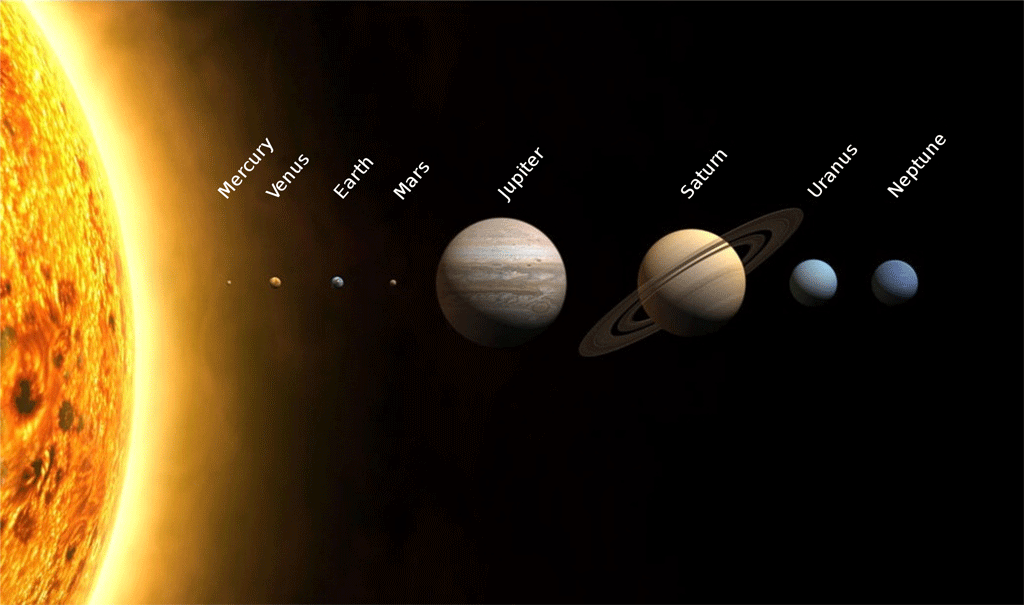
Add in to all of this the dizzying concepts of distant galaxies, objects in motion, and an expanding Universe and you can see why we call these numbers astronomical. Even when expressing distances in power of ten, such as the speed of light as 1.86 × 10 5 miles per second or the distance to Proxima Centauri is 2.4961 × 10 13 miles; that is 24,961,000,000,000 miles.
We best see the consequences of the Universe in motion here on Earth through experiencing the seasons due to the revolution of Earth around the Sun. With the rotation of Earth, we have our day and night. And, the revolution of the Moon around Earth allows us to watch the Moon go through its phases. (1)
- Authored by: Florida State College at Jacksonville. License: CC BY: Attribution
A Tour of the Universe
We can now take a brief introductory tour of the universe as astronomers understand it today to get acquainted with the types of objects and distances you will encounter throughout the text. We begin at home with Earth, a nearly spherical planet about 13,000 kilometers in diameter (Figure 1.6). A space traveler entering our planetary system would easily distinguish Earth from the other planets in our solar system by the large amount of liquid water that covers some two thirds of its crust. If the traveler had equipment to receive radio or television signals, or came close enough to see the lights of our cities at night, she would soon find signs that this watery planet has sentient life.
Our nearest astronomical neighbor is Earth’s satellite, commonly called the Moon. Figure 1.7 shows Earth and the Moon drawn to scale on the same diagram. Notice how small we have to make these bodies to fit them on the page with the right scale. The Moon’s distance from Earth is about 30 times Earth’s diameter, or approximately 384,000 kilometers, and it takes about a month for the Moon to revolve around Earth. The Moon’s diameter is 3476 kilometers, about one fourth the size of Earth.
Light (or radio waves) takes 1.3 seconds to travel between Earth and the Moon. If you’ve seen videos of the Apollo flights to the Moon, you may recall that there was a delay of about 3 seconds between the time Mission Control asked a question and the time the astronauts responded. This was not because the astronauts were thinking slowly, but rather because it took the radio waves almost 3 seconds to make the round trip.
Earth revolves around our star, the Sun, which is about 150 million kilometers away—approximately 400 times as far away from us as the Moon. We call the average Earth–Sun distance an astronomical unit (AU) because, in the early days of astronomy, it was the most important measuring standard. Light takes slightly more than 8 minutes to travel 1 astronomical unit, which means the latest news we receive from the Sun is always 8 minutes old. The diameter of the Sun is about 1.5 million kilometers; Earth could fit comfortably inside one of the minor eruptions that occurs on the surface of our star. If the Sun were reduced to the size of a basketball, Earth would be a small apple seed about 30 meters from the ball.
It takes Earth 1 year ( seconds) to go around the Sun at our distance; to make it around, we must travel at approximately 110,000 kilometers per hour. (If you, like many students, still prefer miles to kilometers, you might find the following trick helpful. To convert kilometers to miles, just multiply kilometers by 0.6. Thus, 110,000 kilometers per hour becomes 66,000 miles per hour.) Because gravity holds us firmly to Earth and there is no resistance to Earth’s motion in the vacuum of space, we participate in this extremely fast-moving trip without being aware of it day to day.
Earth is only one of eight planets that revolve around the Sun. These planets, along with their moons and swarms of smaller bodies such as dwarf planets, make up the solar system (Figure 1.8). A planet is defined as a body of significant size that orbits a star and does not produce its own light. (If a large body consistently produces its own light, it is then called a star.) Later in the book this definition will be modified a bit, but it is perfectly fine for now as you begin your voyage.
We are able to see the nearby planets in our skies only because they reflect the light of our local star, the Sun. If the planets were much farther away, the tiny amount of light they reflect would usually not be visible to us. The planets we have so far discovered orbiting other stars were found from the pull their gravity exerts on their parent stars, or from the light they block from their stars when they pass in front of them. We can’t see most of these planets directly, although a few are now being imaged directly.
The Sun is our local star, and all the other stars are also enormous balls of glowing gas that generate vast amounts of energy by nuclear reactions deep within. We will discuss the processes that cause stars to shine in more detail later in the book. The other stars look faint only because they are so very far away. If we continue our basketball analogy, Proxima Centauri, the nearest star beyond the Sun, which is 4.3 light-years away, would be almost 7000 kilometers from the basketball.
When you look up at a star-filled sky on a clear night, all the stars visible to the unaided eye are part of a single collection of stars we call the Milky Way Galaxy, or simply the Galaxy. (When referring to the Milky Way, we capitalize Galaxy; when talking about other galaxies of stars, we use lowercase galaxy.) The Sun is one of hundreds of billions of stars that make up the Galaxy; its extent, as we will see, staggers the human imagination. Within a sphere 10 light-years in radius centered on the Sun, we find roughly ten stars. Within a sphere 100 light-years in radius, there are roughly 10,000 stars—far too many to count or name—but we have still traversed only a tiny part of the Milky Way Galaxy. Within a 1000-light-year sphere, we find some ten million stars; within a sphere of 100,000 light-years, we finally encompass the entire Milky Way Galaxy.
Our Galaxy looks like a giant disk with a small ball in the middle. If we could move outside our Galaxy and look down on the disk of the Milky Way from above, it would probably resemble the galaxy in Figure 1.9, with its spiral structure outlined by the blue light of hot adolescent stars.
The Sun is somewhat less than 30,000 light-years from the center of the Galaxy, in a location with nothing much to distinguish it. From our position inside the Milky Way Galaxy, we cannot see through to its far rim (at least not with ordinary light) because the space between the stars is not completely empty. It contains a sparse distribution of gas (mostly the simplest element, hydrogen) intermixed with tiny solid particles that we call interstellar dust. This gas and dust collect into enormous clouds in many places in the Galaxy, becoming the raw material for future generations of stars. Figure 1.10 shows an image of the disk of the Galaxy as seen from our vantage point.
Typically, the interstellar material is so extremely sparse that the space between stars is a much better vacuum than anything we can produce in terrestrial laboratories. Yet, the dust in space, building up over thousands of light-years, can block the light of more distant stars. Like the distant buildings that disappear from our view on a smoggy day in Los Angeles, the more distant regions of the Milky Way cannot be seen behind the layers of interstellar smog. Luckily, astronomers have found that stars and raw material shine with various forms of light, some of which do penetrate the smog, and so we have been able to develop a pretty good map of the Galaxy.
Recent observations, however, have also revealed a rather surprising and disturbing fact. There appears to be more—much more—to the Galaxy than meets the eye (or the telescope). From various investigations, we have evidence that much of our Galaxy is made of material we cannot currently observe directly with our instruments. We therefore call this component of the Galaxy dark matter. We know the dark matter is there by the pull its gravity exerts on the stars and raw material we can observe, but what this dark matter is made of and how much of it exists remain a mystery. Furthermore, this dark matter is not confined to our Galaxy; it appears to be an important part of other star groupings as well.
By the way, not all stars live by themselves, as the Sun does. Many are born in double or triple systems with two, three, or more stars revolving about each other. Because the stars influence each other in such close systems, multiple stars allow us to measure characteristics that we cannot discern from observing single stars. In a number of places, enough stars have formed together that we recognized them as star clusters (Figure 1.11). Some of the largest of the star clusters that astronomers have cataloged contain hundreds of thousands of stars and take up volumes of space hundreds of light-years across.
You may hear stars referred to as “eternal,” but in fact no star can last forever. Since the “business” of stars is making energy, and energy production requires some sort of fuel to be used up, eventually all stars run out of fuel. This news should not cause you to panic, though, because our Sun still has at least 5 or 6 billion years to go. Ultimately, the Sun and all stars will die, and it is in their death throes that some of the most intriguing and important processes of the universe are revealed. For example, we now know that many of the atoms in our bodies were once inside stars. These stars exploded at the ends of their lives, recycling their material back into the reservoir of the Galaxy. In this sense, all of us are literally made of recycled “star dust.”
Galactic Groups
Galaxies appear to assimilate in groups throughout the Universe. For example, the Milky Way and Andromeda galaxies are members of The Local Group, more than 54 gravitationally bound galaxies, most are dwarf galaxies. Smaller galactic groups are a part of galaxy superclusters. The Local Group is part of the Virgo Supercluster, composed of at least 100 galaxy groups and clusters.
Space and Time
In a very rough sense, you could think of the solar system as your house or apartment and the Galaxy as your town, made up of many houses and buildings. In the twentieth century, astronomers were able to show that, just as our world is made up of many, many towns, so the universe is made up of enormous numbers of galaxies. (We define the universe to be everything that exists that is accessible to our observations.) Galaxies stretch as far into space as our telescopes can see, many billions of them within the reach of modern instruments. When they were first discovered, some astronomers called galaxies island universes, and the term is aptly descriptive; galaxies do look like islands of stars in the vast, dark seas of intergalactic space.
The nearest galaxy, discovered in 1993, is a small one that lies 70,000 light-years from the Sun in the direction of the constellation Sagittarius, where the smog in our own Galaxy makes it especially difficult to discern. (A constellation, we should note, is one of the 88 sections into which astronomers divide the sky, each named after a prominent star pattern within it.) Beyond this Sagittarius dwarf galaxy lie two other small galaxies, about 160,000 light-years away. First recorded by Magellan’s crew as he sailed around the world, these are called the Magellanic Clouds (Figure 1.12). All three of these small galaxies are satellites of the Milky Way Galaxy, interacting with it through the force of gravity. Ultimately, all three may even be swallowed by our much larger Galaxy, as other small galaxies have been over the course of cosmic time.
The nearest large galaxy is a spiral quite similar to our own, located in the constellation of Andromeda, and is thus called the Andromeda galaxy; it is also known by one of its catalog numbers, M31 (Figure 1.13). M31 is a little more than 2 million light-years away and, along with the Milky Way, is part of a small cluster of more than 50 galaxies referred to as the Local Group.
At distances of 10 to 15 million light-years, we find other small galaxy groups, and then at about 50 million light-years there are more impressive systems with thousands of member galaxies. We have discovered that galaxies occur mostly in clusters, both large and small (Figure 1.14).
Some of the clusters themselves form into larger groups called superclusters. The Local Group is part of a supercluster of galaxies, called the Virgo Supercluster, which stretches over a diameter of 110 million light-years. We are just beginning to explore the structure of the universe at these enormous scales and are already encountering some unexpected findings.
At even greater distances, where many ordinary galaxies are too dim to see, we find quasars. These are brilliant centers of galaxies, glowing with the light of an extraordinarily energetic process. The enormous energy of the quasars is produced by gas that is heated to a temperature of millions of degrees as it falls toward a massive black hole and swirls around it. The brilliance of quasars makes them the most distant beacons we can see in the dark oceans of space. They allow us to probe the universe 10 billion light-years away or more, and thus 10 billion years or more in the past.
With quasars we can see way back close to the Big Bang explosion that marks the beginning of time. Beyond the quasars and the most distant visible galaxies, we have detected the feeble glow of the explosion itself, filling the universe and thus coming to us from all directions in space. The discovery of this “afterglow of creation” is considered to be one of the most significant events in twentieth-century science, and we are still exploring the many things it has to tell us about the earliest times of the universe.
Measurements of the properties of galaxies and quasars in remote locations require large telescopes, sophisticated light-amplifying devices, and painstaking labor. Every clear night, at observatories around the world, astronomers and students are at work on such mysteries as the birth of new stars and the large-scale structure of the universe, fitting their results into the tapestry of our understanding.
If you are new to astronomy, you have probably reached the end of our brief tour in this chapter with mixed emotions. On the one hand, you may be fascinated by some of the new ideas you’ve read about and you may be eager to learn more. On the other hand, you may be feeling a bit overwhelmed by the number of topics we have covered, and the number of new words and ideas we have introduced. Learning astronomy is a little like learning a new language: at first it seems there are so many new expressions that you’ll never master them all, but with practice, you soon develop facility with them.
At this point you may also feel a bit small and insignificant, dwarfed by the cosmic scales of distance and time. But, there is another way to look at what you have learned from our first glimpses of the cosmos. Let us consider the history of the universe from the Big Bang to today and compress it, for easy reference, into a single year. (We have borrowed this idea from Carl Sagan’s 1977 Pulitzer Prize-winning book, The Dragons of Eden.)
On this scale, the Big Bang happened at the first moment of January 1, and this moment, when you are reading this chapter would be the end of the very last second of December 31. When did other events in the development of the universe happen in this “cosmic year?” Our solar system formed around September 10, and the oldest rocks we can date on Earth go back to the third week in September (Figure 1.15).
Where does the origin of human beings fall during the course of this cosmic year? The answer turns out to be the evening of December 31. The invention of the alphabet doesn’t occur until the fiftieth second of 11:59 p.m. on December 31. And the beginnings of modern astronomy are a mere fraction of a second before the New Year. Seen in a cosmic context, the amount of time we have had to study the stars is minute, and our success in piecing together as much of the story as we have is remarkable.
Certainly our attempts to understand the universe are not complete. As new technologies and new ideas allow us to gather more and better data about the cosmos, our present picture of astronomy will very likely undergo many changes. Still, as you read our current progress report on the exploration of the universe, take a few minutes every once in a while just to savor how much you have already learned.
The Speed of Light
Light Years
The closest star? The Sun. After the Sun is Proxima Centauri, part of the three-star Alpha Centauri (α Cen) star system. Proxima Centauri is about 25,219,301,250,000 miles or 40,586,533,727,000 kilometers away. So let’s look at this in other ways. A 50-mile high stack of toilet paper stretched out on 1 sheet = 1 million miles scale. Alpha Centauri is often listed as the second closest star to Earth, this is incorrect . Proxima Centauri is the second-closest star and orbits Alpha Centauri.
Light Travel Time
There is another reason the speed of light is such a natural unit of distance for astronomers. Information about the universe comes to us almost exclusively through various forms of light, and all such light travels at the speed of light—that is, 1 light-year every year. This sets a limit on how quickly we can learn about events in the universe. If a star is 100 light-years away, the light we see from it tonight left that star 100 years ago and is just now arriving in our neighborhood. The soonest we can learn about any changes in that star is 100 years after the fact. For a star 500 light-years away, the light we detect tonight left 500 years ago and is carrying 500-year-old news.
Because many of us are accustomed to instant news from the Internet, some might find this frustrating.
“You mean, when I see that star up there,” you ask, “I won’t know what’s actually happening there for another 500 years?”
But this isn’t the most helpful way to think about the situation. For astronomers, now is when the light reaches us here on Earth. There is no way for us to know anything about that star (or other object) until its light reaches us.
But what at first may seem a great frustration is actually a tremendous benefit in disguise. If astronomers really want to piece together what has happened in the universe since its beginning, they must find evidence about each epoch (or period of time) of the past. Where can we find evidence today about cosmic events that occurred billions of years ago?
The delay in the arrival of light provides an answer to this question. The farther out in space we look, the longer the light has taken to get here, and the longer ago it left its place of origin. By looking billions of light-years out into space, astronomers are actually seeing billions of years into the past. In this way, we can reconstruct the history of the cosmos and get a sense of how it has evolved over time.
This is one reason why astronomers strive to build telescopes that can collect more and more of the faint light in the universe. The more light we collect, the fainter the objects we can observe. On average, fainter objects are farther away and can, therefore, tell us about periods of time even deeper in the past. Instruments such as the Hubble Space Telescope (Figure 1.5) and the Very Large Telescope in Chile (which you will learn about in the chapter on Astronomical Instruments), are giving astronomers views of deep space and deep time better than any we have had before.
Attributions
https://phys.libretexts.org/Workbenc...3A_Light-Years
https://phys.libretexts.org/Bookshel...3%3A_Sizing_Up
https://phys.libretexts.org/Bookshel...04%3A_To_Scale
https://phys.libretexts.org/Bookshel...ht_Travel_Time
https://phys.libretexts.org/Bookshel...f_the_Universe
https://phys.libretexts.org/Bookshel...he_Large_Scale