

5.1: Sorting Galaxies by Shape
- Page ID
- 164200

\( \newcommand{\vecs}[1]{\overset { \scriptstyle \rightharpoonup} {\mathbf{#1}} } \)
\( \newcommand{\vecd}[1]{\overset{-\!-\!\rightharpoonup}{\vphantom{a}\smash {#1}}} \)
\( \newcommand{\dsum}{\displaystyle\sum\limits} \)
\( \newcommand{\dint}{\displaystyle\int\limits} \)
\( \newcommand{\dlim}{\displaystyle\lim\limits} \)
\( \newcommand{\id}{\mathrm{id}}\) \( \newcommand{\Span}{\mathrm{span}}\)
( \newcommand{\kernel}{\mathrm{null}\,}\) \( \newcommand{\range}{\mathrm{range}\,}\)
\( \newcommand{\RealPart}{\mathrm{Re}}\) \( \newcommand{\ImaginaryPart}{\mathrm{Im}}\)
\( \newcommand{\Argument}{\mathrm{Arg}}\) \( \newcommand{\norm}[1]{\| #1 \|}\)
\( \newcommand{\inner}[2]{\langle #1, #2 \rangle}\)
\( \newcommand{\Span}{\mathrm{span}}\)
\( \newcommand{\id}{\mathrm{id}}\)
\( \newcommand{\Span}{\mathrm{span}}\)
\( \newcommand{\kernel}{\mathrm{null}\,}\)
\( \newcommand{\range}{\mathrm{range}\,}\)
\( \newcommand{\RealPart}{\mathrm{Re}}\)
\( \newcommand{\ImaginaryPart}{\mathrm{Im}}\)
\( \newcommand{\Argument}{\mathrm{Arg}}\)
\( \newcommand{\norm}[1]{\| #1 \|}\)
\( \newcommand{\inner}[2]{\langle #1, #2 \rangle}\)
\( \newcommand{\Span}{\mathrm{span}}\) \( \newcommand{\AA}{\unicode[.8,0]{x212B}}\)
\( \newcommand{\vectorA}[1]{\vec{#1}} % arrow\)
\( \newcommand{\vectorAt}[1]{\vec{\text{#1}}} % arrow\)
\( \newcommand{\vectorB}[1]{\overset { \scriptstyle \rightharpoonup} {\mathbf{#1}} } \)
\( \newcommand{\vectorC}[1]{\textbf{#1}} \)
\( \newcommand{\vectorD}[1]{\overrightarrow{#1}} \)
\( \newcommand{\vectorDt}[1]{\overrightarrow{\text{#1}}} \)
\( \newcommand{\vectE}[1]{\overset{-\!-\!\rightharpoonup}{\vphantom{a}\smash{\mathbf {#1}}}} \)
\( \newcommand{\vecs}[1]{\overset { \scriptstyle \rightharpoonup} {\mathbf{#1}} } \)
\(\newcommand{\longvect}{\overrightarrow}\)
\( \newcommand{\vecd}[1]{\overset{-\!-\!\rightharpoonup}{\vphantom{a}\smash {#1}}} \)
\(\newcommand{\ket}[1]{\left| #1 \right>}\)
\(\newcommand{\bra}[1]{\left< #1 \right|}\)
\(\newcommand{\braket}[2]{\left< #1 \vphantom{#2} \right| \left. #2 \vphantom{#1} \right>}\)
\(\newcommand{\braopket}[3]{\left< #1 \vphantom{#2}\vphantom{#3} \right| #2 \vphantom{#1}\vphantom{#3} \left| #3 \vphantom{#1}\vphantom{#2} \right>}\)
\(\newcommand{\qmvec}[1]{\mathbf{\vec{#1}}}\)
\(\newcommand{\op}[1]{\hat{\mathbf{#1}}}\)
\(\newcommand{\expect}[1]{\langle #1 \rangle}\)
\(\newcommand{\dfn}[1]{\emph{\textbf{#1}}}\)
A galaxy is a huge system of billions of stars, along with gas and dust, held together by gravity. Astronomers sort galaxies into types by their shapes. Before you learn the official system, your group will invent your own.
If your instructor gives you a set of printed cards, the card numbers match the numbers on this page. The pictures are not to scale: some of these galaxies are much larger than others.
Sorting Galaxies
 Model
Model 1: Nine galaxies. Each card shows one galaxy photographed by the Hubble Space Telescope.


 Explore
- Look at all nine cards. List at least three features that differ from one galaxy to another. For example, how round is the outline?
- Sort the nine cards into exactly three groups. Every card must go in a group. Give each group a name and write the rule that decides which cards belong in it.
Your name for the group Card numbers Rule: what do all the cards in this group share? Group 1 Group 2 Group 3 - Compare your groups with another group's groups. Did you sort the cards the same way? Which card was hardest to place, and why?
 Critical thinking & Concept Invention
Model 2: Ten more galaxies.


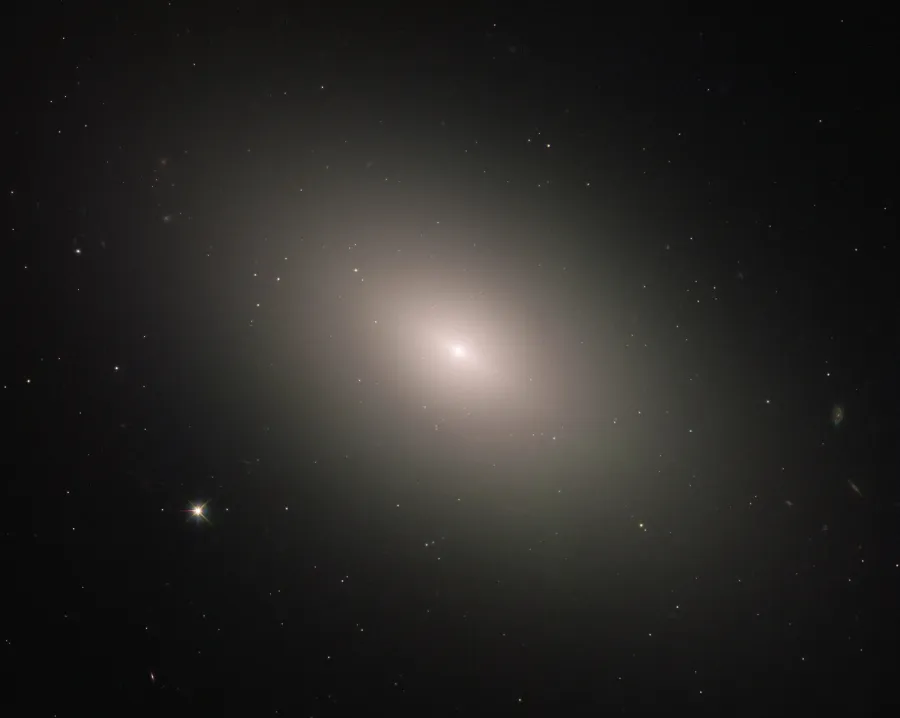


- Place each new card (10 to 19) into one of your three groups, if it fits. Put any card that does not fit into a "doesn't fit" pile.
Group New cards added Group 1 Group 2 Group 3 Doesn't fit - The galaxies inside one group are not identical. For each group, choose one feature that changes gradually from galaxy to galaxy. Then use all of the cards (1 to 19) in that group and put them in order from one end of the scale to the other.
Group Feature that changes Card numbers in order Group 1 Group 2 Group 3 - Look at your "doesn't fit" pile. Can you split it into smaller groups? Describe each smaller group and explain why its cards do not fit your three main groups.
 Summary
- Write a short rule your class could use to put any galaxy into one of your three main groups.
- Complete the sentences. Galaxies in Group 1 differ mostly in . Galaxies in Groups 2 and 3 differ mostly in and .
 Apply
- Our own galaxy, the Milky Way, is a barred spiral. Sketch how it might look to an astronomer in another galaxy who sees it (a) face-on and (b) edge-on.
(a) Face-on (b) Edge-on
The Hubble Tuning Fork
Model
Model 3: Hubble's classification. Starting in 1926, the astronomer Edwin Hubble sorted galaxies by shape. He later drew his system as a diagram called the "tuning fork" because of its shape.

- E means elliptical. The number tells how stretched the galaxy looks. E0 looks round. E7 looks the most stretched.
- S0 means lenticular (lens-shaped). It has a flat disk and a bright central bulge, but no spiral arms.
- S means spiral, and SB means barred spiral. The letter a, b, or c describes the arms and the central bulge. Type a has a large bulge and tightly wound arms. Type c has a small bulge and loose, open arms.
- Irr means irregular. These galaxies have no regular shape, so they are not on the fork.
Explore
- Match each of your three groups from Model 1 to one of Hubble's main types.
Your group name Hubble's type (E, S, or SB) - Write the number of each card (1 to 19) in the box where it fits best. Use the two dashed boxes for cards that you cannot place on the fork.

Blank tuning fork for your cards. - How do the scales you made in question 5 compare with Hubble's? Which of your features match Hubble's E numbers, and which match his letters a, b, and c?
Critical thinking & Concept Invention
Model 4: Viewing angle. We see each galaxy from only one direction.

- Views A, B, and C show the same spiral galaxy. If you could see only view C, what Hubble type would you give it? What information is lost?
- Views D and E show the same galaxy. What E number would an astronomer give it from view D? From view E?
- Card 2 looks round, so it is labeled E0. Does that prove it is a round ball of stars? Explain.
- Cards 14 and 16 are both seen edge-on. One is a lenticular (S0) and one is a spiral. You cannot see arms in either one. Besides arms, what else could you look for to tell them apart? Invent a test.
Summary
- Complete the sentences. Hubble's main types are elliptical (E), (S0), spiral (S), (SB), and (Irr). The number after E describes . The letters a, b, and c describe and . How a galaxy looks also depends on .
Apply

- Astronomers think these two neighboring galaxies are very similar spirals. Give each one a Hubble type based only on how it looks. Then explain why they look so different.
Image credits
Galaxy photos are from the Hubble Space Telescope. Diagrams are original to this workbook.
- Card 1: NGC 1300. Credit: NASA, ESA, and The Hubble Heritage Team (STScI/AURA); Acknowledgment: P. Knezek (WIYN). Source
- Card 2: Messier 87. Credit: NASA and The Hubble Heritage Team (STScI/AURA). Source
- Card 3: Messier 74. Credit: NASA, ESA, and the Hubble Heritage (STScI/AURA)-ESA/Hubble Collaboration; Acknowledgment: R. Chandar and J. Miller. Source
- Card 4: NGC 1132. Credit: NASA, ESA, and the Hubble Heritage (STScI/AURA)-ESA/Hubble Collaboration; Acknowledgment: M. West (ESO, Chile). Source
- Card 5: NGC 1672. Credit: NASA, ESA, and The Hubble Heritage Team (STScI/AURA)-ESA/Hubble Collaboration. Source
- Card 6: Messier 101. Credit: NASA, ESA, K. Kuntz (JHU), F. Bresolin (University of Hawaii), J. Trauger (JPL), J. Mould (NOAO), Y.-H. Chu (University of Illinois, Urbana), and STScI; CFHT and NOAO ground-based data. Source
- Card 7: ESO 325-G004. Credit: NASA, ESA, and The Hubble Heritage Team (STScI/AURA); Acknowledgment: J. Blakeslee (Washington State University). Source
- Card 8: NGC 1073. Credit: NASA and ESA. Source
- Card 9: NGC 1309. Credit: NASA, ESA, The Hubble Heritage Team (STScI/AURA), and A. Riess (STScI). Source
- Card 10: Messier 81. Credit: NASA, ESA, and The Hubble Heritage Team (STScI/AURA); Acknowledgment: A. Zezas and J. Huchra (CfA). Source
- Card 11: NGC 4449. Credit: NASA, ESA, A. Aloisi (STScI/ESA), and The Hubble Heritage (STScI/AURA)-ESA/Hubble Collaboration. Source
- Card 12: Messier 59. Credit: ESA/Hubble & NASA, P. Cote (CC BY 4.0). Source
- Card 13: NGC 1015. Credit: ESA/Hubble & NASA, A. Riess (STScI/JHU) (CC BY 4.0). Source
- Card 14: NGC 5866. Credit: NASA, ESA, and The Hubble Heritage Team (STScI/AURA); Acknowledgment: W. Keel (University of Alabama). Source
- Card 15: Messier 64. Credit: NASA, CSA, ESA, F. Belfiore, J. Lee, A. Leroy, and D. Thilker; Processing: Gladys Kober. Source
- Card 16: NGC 4217. Credit: ESA/Hubble & NASA, Acknowledgement: R. Schoofs (CC BY 4.0). Source
- Card 17: NGC 3384. Credit: ESA/Hubble & NASA/B. Lehmer et al. (CC BY 4.0). Source
- Card 18: NGC 1427A. Credit: NASA, ESA, and The Hubble Heritage Team (STScI/AURA); Acknowledgment: M. Gregg. Source
- Card 19: Messier 104 (Sombrero). Credit: NASA and The Hubble Heritage Team (STScI/AURA). Source
- Two neighbors: NGC 4302 (left) and NGC 4298 (right). Credit: NASA, ESA, and M. Mutchler (STScI). Source