

4.1: Angular Momentum Conservation
- Page ID
- 148020

\( \newcommand{\vecs}[1]{\overset { \scriptstyle \rightharpoonup} {\mathbf{#1}} } \)
\( \newcommand{\vecd}[1]{\overset{-\!-\!\rightharpoonup}{\vphantom{a}\smash {#1}}} \)
\( \newcommand{\dsum}{\displaystyle\sum\limits} \)
\( \newcommand{\dint}{\displaystyle\int\limits} \)
\( \newcommand{\dlim}{\displaystyle\lim\limits} \)
\( \newcommand{\id}{\mathrm{id}}\) \( \newcommand{\Span}{\mathrm{span}}\)
( \newcommand{\kernel}{\mathrm{null}\,}\) \( \newcommand{\range}{\mathrm{range}\,}\)
\( \newcommand{\RealPart}{\mathrm{Re}}\) \( \newcommand{\ImaginaryPart}{\mathrm{Im}}\)
\( \newcommand{\Argument}{\mathrm{Arg}}\) \( \newcommand{\norm}[1]{\| #1 \|}\)
\( \newcommand{\inner}[2]{\langle #1, #2 \rangle}\)
\( \newcommand{\Span}{\mathrm{span}}\)
\( \newcommand{\id}{\mathrm{id}}\)
\( \newcommand{\Span}{\mathrm{span}}\)
\( \newcommand{\kernel}{\mathrm{null}\,}\)
\( \newcommand{\range}{\mathrm{range}\,}\)
\( \newcommand{\RealPart}{\mathrm{Re}}\)
\( \newcommand{\ImaginaryPart}{\mathrm{Im}}\)
\( \newcommand{\Argument}{\mathrm{Arg}}\)
\( \newcommand{\norm}[1]{\| #1 \|}\)
\( \newcommand{\inner}[2]{\langle #1, #2 \rangle}\)
\( \newcommand{\Span}{\mathrm{span}}\) \( \newcommand{\AA}{\unicode[.8,0]{x212B}}\)
\( \newcommand{\vectorA}[1]{\vec{#1}} % arrow\)
\( \newcommand{\vectorAt}[1]{\vec{\text{#1}}} % arrow\)
\( \newcommand{\vectorB}[1]{\overset { \scriptstyle \rightharpoonup} {\mathbf{#1}} } \)
\( \newcommand{\vectorC}[1]{\textbf{#1}} \)
\( \newcommand{\vectorD}[1]{\overrightarrow{#1}} \)
\( \newcommand{\vectorDt}[1]{\overrightarrow{\text{#1}}} \)
\( \newcommand{\vectE}[1]{\overset{-\!-\!\rightharpoonup}{\vphantom{a}\smash{\mathbf {#1}}}} \)
\( \newcommand{\vecs}[1]{\overset { \scriptstyle \rightharpoonup} {\mathbf{#1}} } \)
\(\newcommand{\longvect}{\overrightarrow}\)
\( \newcommand{\vecd}[1]{\overset{-\!-\!\rightharpoonup}{\vphantom{a}\smash {#1}}} \)
\(\newcommand{\ket}[1]{\left| #1 \right>}\)
\(\newcommand{\bra}[1]{\left< #1 \right|}\)
\(\newcommand{\braket}[2]{\left< #1 \vphantom{#2} \right| \left. #2 \vphantom{#1} \right>}\)
\(\newcommand{\braopket}[3]{\left< #1 \vphantom{#2}\vphantom{#3} \right| #2 \vphantom{#1}\vphantom{#3} \left| #3 \vphantom{#1}\vphantom{#2} \right>}\)
\(\newcommand{\qmvec}[1]{\mathbf{\vec{#1}}}\)
\(\newcommand{\op}[1]{\hat{\mathbf{#1}}}\)
\(\newcommand{\expect}[1]{\langle #1 \rangle}\)
\(\newcommand{\dfn}[1]{\emph{\textbf{#1}}}\)
Angular Momentum Conservation
1.1 Flipping a Bike Wheel
Model
A person stands on a platform that can rotate. The person initially holds a spinning wheel and then flips the wheel upside down. Next to the person is a chart that identifies Angular Momentum (\(\vec{L}\)) at each of the three moments in time.


Explore
- Tell a Physical Story about the rotation of objects and their angular velocity vectors. Be sure to comment on the direction of the angular velocity (spin).
- At time 1, the wheel is ____ and the person is ____.
- At time 2, the wheel is ____ and the person is ____.
- The person is spinning (faster/slower) than the wheel.
- At time 3, the wheel is ____ and the person is ____.
- Tell an Angular Momentum Story about the same objects. Refer to the L-Chart.
- At time 1, the wheel ____ and the person ____.
- At time 2, the wheel ____ and the person ____.
- The person has (greater/lesser) angular momentum than the wheel.
- At time 3, the wheel ____ and the person ____.
- For all three moments in time, the total angular momentum is ____.
Critical Thinking & Concept Invention
- Is the wheel changing its position? If so, what direction?
- Is the wheel moving? If so, what direction? Why might this be tricky to identify?
- Does the wheel have momentum? If so, draw a momentum vector next to the wheel in each image on the diagram.
- Make a Connection: How is this similar to momentum conservation problems, such as colliding carts?
- Complete the Change in Angular Momentum columns of the two L-Charts.
- Use the charts to construct Claim-Evidence-Reasoning responses:
- For which systems (Person, Wheel, and Person + Wheel) would you say that angular momentum was always conserved?
Claim:
Evidence:
Reasoning: - For which systems (Person, Wheel, and Person + Wheel) would you say that angular momentum was not always conserved?
Claim:
Evidence:
Reasoning: - Why does the magnitude of the angular momentum for the person have to be greater than the wheel at time 2?
Claim:
Evidence:
Reasoning:
- For which systems (Person, Wheel, and Person + Wheel) would you say that angular momentum was always conserved?
Apply
Jill stands on a merry-go-round. Initially, both Jill and the merry-go-round are at rest. Then, Jill begins to walk around the merry-go-round counterclockwise from above. What will the merry-go-round do? Make a momentum table to justify your response.

Summary
The Angular Momentum Principle is represented by:
\(\Delta \vec{L}_{system}=\sum \vec{\tau}\)
“The total change in angular momentum of a system” = “The net Twirl acting on the system.”
For closed systems:
\(\sum \vec{\tau}=0\)
which means angular momentum is conserved.
Angular momentum depends on the chosen origin, pivot point, or rotation axis.
1.2 Angular Momentum Variables and Models
Model
Below is a top-down view of a person who spins on a platform while holding out two weights. The radius changes because the person brings their arms in to half the previous radius. We can consider this a closed system.

Explore
- Mark up the bottom diagrams (L for Left and R for Right):
- Draw vectors \(\vec r_0\) and \(\vec r_1\).
- Label arc lengths \(\Delta s_L\) and \(\Delta s_R\).
- Label angle changes \(\Delta \theta_L\) and \(\Delta \theta_R\).
- Compare the following quantities.
Quantity Left Image (L) Right Image (R) Radius (\(r\)) Angular Speed \(\left(\omega=\frac{\Delta\theta}{\Delta t}\right)\) Linear Speed \(\left(v=\frac{\Delta s}{\Delta t}\right)\)
Critical Thinking & Concept Invention
- Is there an external interaction with the person + weight system? Should angular momentum change?
- Was either \(\vec{\omega}\) or \(\vec{v}\) conserved? Could \(\vec{L}\) be based solely on either quantity?
- Given:
- \(\Delta s=r\Delta\theta\)
- \(\Delta A=\frac{1{}}2 r\Delta s\)
L R Arc Length (\(\Delta s\)) Area Rate \(\left(\frac{\Delta A}{\Delta t}\right)\) - What quantity might be the best model for angular momentum?
Summary
Angular motion that best represents angular momentum is related to area swept out per unit time. Like linear momentum (\(\vec p\)), angular momentum also depends on mass.
Initial model:
\(L=\)
1.3 Quantifying Angular Momentum: Moment Arm
Model
This phenomenon involves a ball that was attached to the end of a rope that is initially rotating with angular speed \(\omega\). Assume the rope is massless, and therefore cannot have linear or angular momentum. At time t = 0s, the ball is released. Assume there are no external interactions, even in the process of releasing the ball from the rope.
Explore
- Mark up the diagram
- Draw a vector from the origin (center of the circle) to the dots at each second. Label those vectors \(\vec{r}_1\), (\vec{r}_2\), (\vec{r}_3\), etc.
- Highlight the displacement between subsequent dots. Since the time-intervals are one second long, those displacements are also scaled velocity vectors. Draw a vector between dots and label them (\vec{r}_0\), (\vec{r}_1\), (\vec{r}_2\), etc with the subscript matching the initial dot in the pair.
- Draw a curve near the origin between each position vector to show the change in angle for each wedge. Label them \(\Delta \theta_01\), \(\Delta \theta_02\), \(\Delta \theta_03\), etc.
- Identify if each quantity increases, decreases, or remains constant.
| \[r\] | \[\Delta s\] | \[\Delta \theta\] | \[\Delta A\] |
Critical Thinking & Concept Invention
- Make a claim and provide evidence an reasoning for the following questions:
- Should Linear Momentum \(\vec{p}\) be conserved?
- Should Angular Momentum \(\vec{L}\) be conserved?
- Construct an equation for wedge area \(\Delta A\). Recall the area of a triangle is \(A = \frac{1}{2}base\times height\). Consider:
- What is the "base" of each triangle?
- What is the "height" of each triangle?
- We said before that \(L=2m\frac{\Delta A}{\Delta t}\). Construct an equation for \(L\) in terms of \(p\). Recall that \(v=\frac{\Delta s {\Delta t}\) and \(p=mv\)
\[L=\]
Summary
For circular motion:
\(L=r_{\perp}p\)
or
\(L=rp\sin\theta\)
where \(\theta\) is the angle between \(\vec r\) and \(\vec p\). Different choices of origin result in different \(/vec{r}\) vectors, so the origin choice affects the rest of the models. Any choice is fine, but some are easier or more useful than others.
1.4 Quantifying Angular Momentum: Parallel and Perpendicular Components
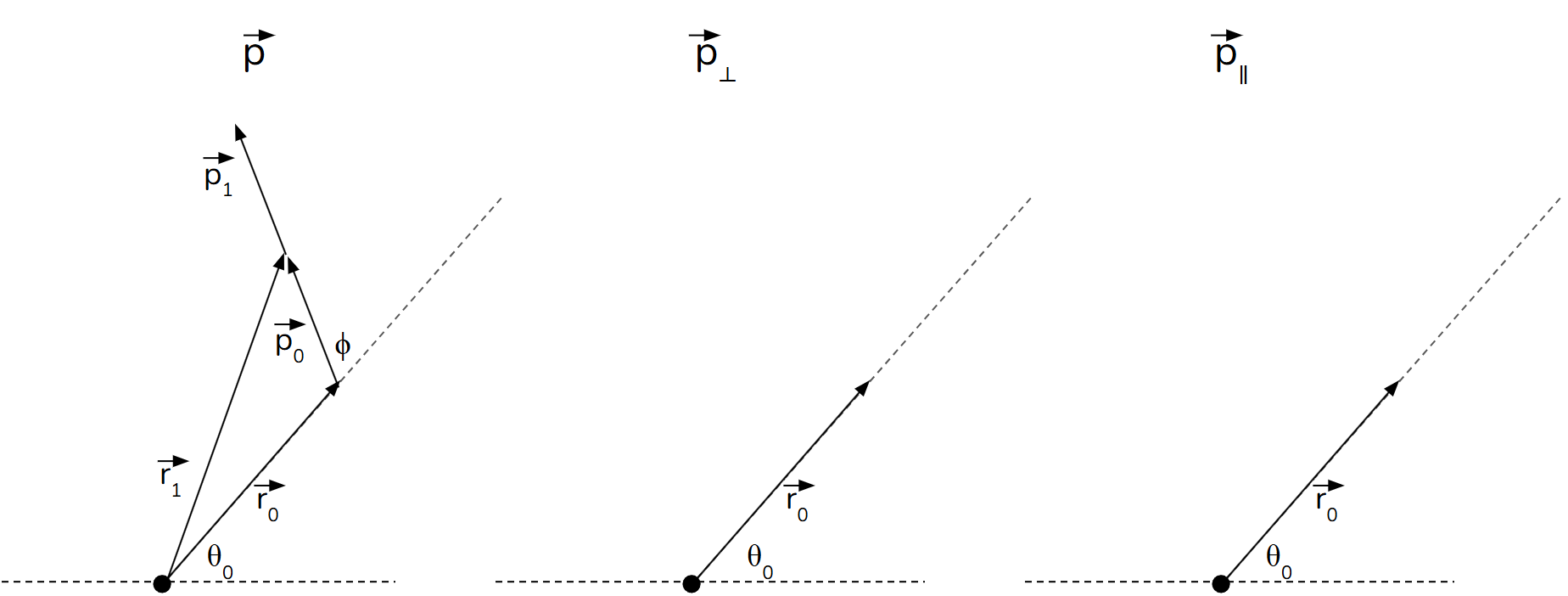
Explore
- Mark up the model under \(\vec{p}\) with the following:
- Draw an arc to show the change in angle \(\Delta\theta\) between \(\vec{r}_1\) and \(\vec{r}_2\).
- Turn the vector \(\vec{p}_0\) into a right triangle where one side is along the dashed extension of \(\vec{r}_0\) and the other is perpendicular to that line.
- Label the side of the momentum triangle \(\vec{p}_{||}\) and \(\vec{p}_{\perp}\).
- Mark up the model under \(\vec{p}_{\perp}\) with the following:
- Copy your \(\vec{p}_{\perp}\) vector onto the end of \(\vec{r}_0\) on the \(\vec{p}_{\perp}\) model.
- Draw a position vector to the end of the momentum vector and label it \(\vec{r}_1\)
- Draw an arc to show the change in angle \(\Delta\theta\) between \(\vec{r}_1\) and \(\vec{r}_2\) or write \(\Delta\theta = 0\).
- Mark up the model under \(\vec{p}_{||}\) with the following:
- Copy your \(\vec{p}_{||}\) vector onto the end of \(\vec{r}_0\) on the \(\vec{p}_{||}\) model.
- Draw a position vector to the end of the momentum vector and label it \(\vec{r}_1\)
- Draw an arc to show the change in angle \(\Delta\theta\) between \(\vec{r}_1\) and \(\vec{r}_2\) or write \(\Delta\theta = 0\).
Critical Thinking & Concept Invention
- Which component of momentum (\(\vec{p}_{\perp}\) or \(\vec{p}_{||}\)) seems to be most related to angular motion?
- Construct equations related each component to \(\vec{p}\), \(\vec{r}\), and \(\phi\).
\(p_{||} =\)
\(p_{\perp} =\) - You can turn the equations above into vectors by identify a unit vector for the direction. Add either \(\hat{r}\) or \(\hat{\theta}\) to the end of the equations above.
Apply
Ball C has mass M and moves towards a massless rod with radius \(R\) from a pivot point that it is free to rotate around. Identify the angular momentum of Ball C with respect to this pivot point (in terms of variables given). Hint: it might help to redraw the figure for the moment that Ball C is at the end of the rod, extend the lines in the direction of \(\vec{v}\) and \(\vec{r}\), and carefully examine all angles.

Summary
Angular motion is based on the perpendicular components of the position and motion vectors. Any two vectors can be organized into parallel and perpendicular components. Angular Momentum is the perpendicular product of position and linear momentum:
\(L = r_{\perp}\, p\) \(L = r\, p_{\perp}\) \(L = r\, p\, \sin\phi\)
The angle \(\phi\) is the angle between the vectors \(\vec{r}\) and \(\vec{p}\). This perpendicular product of vectors is called the vector cross product:
\(\vec{L} \equiv \vec{r} \times \vec{p}\)
Angular momentum is defined based on the vector cross product, which will provide a vector from the calculation. Alternatively, you can find the magnitude of the angular momentum vector using the perpendicular components of the vector, then determine the direction of the angular momentum vector is based on the Right Hand Rule (RHR):
Right-hand rule diagrams showing angular momentum direction from cross product.
Note: These relationships that we have developed so far apply to objects that are modeled as point particles. We will learn how to determine the angular momentum of extended objects in the next lesson.