

7.2: Geology of the Moon
- Page ID
- 110487
\( \newcommand{\vecs}[1]{\overset { \scriptstyle \rightharpoonup} {\mathbf{#1}} } \)
\( \newcommand{\vecd}[1]{\overset{-\!-\!\rightharpoonup}{\vphantom{a}\smash {#1}}} \)
\( \newcommand{\dsum}{\displaystyle\sum\limits} \)
\( \newcommand{\dint}{\displaystyle\int\limits} \)
\( \newcommand{\dlim}{\displaystyle\lim\limits} \)
\( \newcommand{\id}{\mathrm{id}}\) \( \newcommand{\Span}{\mathrm{span}}\)
( \newcommand{\kernel}{\mathrm{null}\,}\) \( \newcommand{\range}{\mathrm{range}\,}\)
\( \newcommand{\RealPart}{\mathrm{Re}}\) \( \newcommand{\ImaginaryPart}{\mathrm{Im}}\)
\( \newcommand{\Argument}{\mathrm{Arg}}\) \( \newcommand{\norm}[1]{\| #1 \|}\)
\( \newcommand{\inner}[2]{\langle #1, #2 \rangle}\)
\( \newcommand{\Span}{\mathrm{span}}\)
\( \newcommand{\id}{\mathrm{id}}\)
\( \newcommand{\Span}{\mathrm{span}}\)
\( \newcommand{\kernel}{\mathrm{null}\,}\)
\( \newcommand{\range}{\mathrm{range}\,}\)
\( \newcommand{\RealPart}{\mathrm{Re}}\)
\( \newcommand{\ImaginaryPart}{\mathrm{Im}}\)
\( \newcommand{\Argument}{\mathrm{Arg}}\)
\( \newcommand{\norm}[1]{\| #1 \|}\)
\( \newcommand{\inner}[2]{\langle #1, #2 \rangle}\)
\( \newcommand{\Span}{\mathrm{span}}\) \( \newcommand{\AA}{\unicode[.8,0]{x212B}}\)
\( \newcommand{\vectorA}[1]{\vec{#1}} % arrow\)
\( \newcommand{\vectorAt}[1]{\vec{\text{#1}}} % arrow\)
\( \newcommand{\vectorB}[1]{\overset { \scriptstyle \rightharpoonup} {\mathbf{#1}} } \)
\( \newcommand{\vectorC}[1]{\textbf{#1}} \)
\( \newcommand{\vectorD}[1]{\overrightarrow{#1}} \)
\( \newcommand{\vectorDt}[1]{\overrightarrow{\text{#1}}} \)
\( \newcommand{\vectE}[1]{\overset{-\!-\!\rightharpoonup}{\vphantom{a}\smash{\mathbf {#1}}}} \)
\( \newcommand{\vecs}[1]{\overset { \scriptstyle \rightharpoonup} {\mathbf{#1}} } \)
\(\newcommand{\longvect}{\overrightarrow}\)
\( \newcommand{\vecd}[1]{\overset{-\!-\!\rightharpoonup}{\vphantom{a}\smash {#1}}} \)
\(\newcommand{\ket}[1]{\left| #1 \right>}\)
\(\newcommand{\bra}[1]{\left< #1 \right|}\)
\(\newcommand{\braket}[2]{\left< #1 \vphantom{#2} \right| \left. #2 \vphantom{#1} \right>}\)
\(\newcommand{\braopket}[3]{\left< #1 \vphantom{#2}\vphantom{#3} \right| #2 \vphantom{#1}\vphantom{#3} \left| #3 \vphantom{#1}\vphantom{#2} \right>}\)
\(\newcommand{\qmvec}[1]{\mathbf{\vec{#1}}}\)
\(\newcommand{\op}[1]{\hat{\mathbf{#1}}}\)
\(\newcommand{\expect}[1]{\langle #1 \rangle}\)
\(\newcommand{\dfn}[1]{\emph{\textbf{#1}}}\)
Selenology?
Processes must be very different from Earth due to lack of atmosphere, plate tectonics, etc.
We know today that the resemblance of lunar features to terrestrial ones is superficial. Even when they look somewhat similar, the origins of lunar features such as craters and mountains are very different from their terrestrial counterparts. The Moon’s relative lack of internal activity, together with the absence of air and water, make most of its geological history unlike anything we know on Earth.
- highlands - a lot more of it on the far side, 3km higher than lowlands, heavily cratered
- lowlands - smooth plains, mostly on near side (is there any on far?)
Highlands
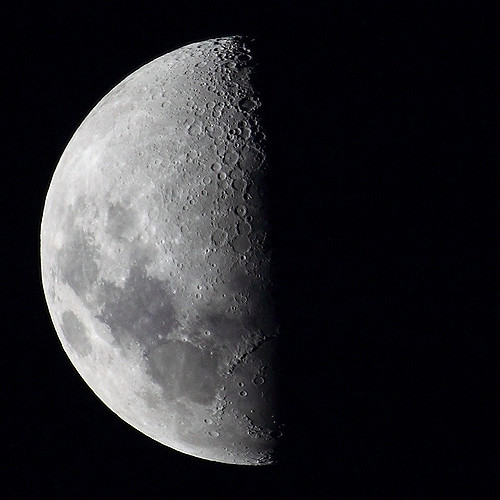
Most of the crust of the Moon (83%) consists of silicate rocks called anorthosites; these regions are known as the lunar highlands. They are made of relatively low-density rock that solidified on the cooling Moon like slag floating on the top of a smelter. Because they formed so early in lunar history (between 4.1 and 4.4 billion years ago), the highlands are also extremely heavily cratered, bearing the scars of all those billions of years of impacts by interplanetary debris (Figure 9.7).
Unlike the mountains on Earth, the Moon’s highlands do not have any sharp folds in their ranges. The highlands have low, rounded profiles that resemble the oldest, most eroded mountains on Earth (Figure 9.8). Because there is no atmosphere or water on the Moon, there has been no wind, water, or ice to carve them into cliffs and sharp peaks, the way we have seen them shaped on Earth. Their smooth features are attributed to gradual erosion, mostly due to impact cratering.
Lowlands
maria
The maria are much less cratered than the highlands, and cover just 17% of the lunar surface, mostly on the side of the Moon that faces Earth (Figure 9.9).
Today, we know that the maria consist mostly of dark-colored basalt (volcanic lava) laid down in volcanic eruptions billions of years ago. Eventually, these lava flows partly filled the huge depressions called impact basins, which had been produced by collisions of large chunks of material with the Moon relatively early in its history. The basalt on the Moon (Figure 9.10) is very similar in composition to the crust under the oceans of Earth or to the lavas erupted by many terrestrial volcanoes. The youngest of the lunar impact basins is Mare Orientale, shown in Figure 9.11.
Volcanic activity may have begun very early in the Moon’s history, although most evidence of the first half billion years is lost. What we do know is that the major mare volcanism, which involved the release of lava from hundreds of kilometers below the surface, ended about 3.3 billion years ago. After that, the Moon’s interior cooled, and volcanic activity was limited to a very few small areas. The primary forces altering the surface come from the outside, not the interior.
Apollo Samples
All igneous
Very dry - Earth rocks 1-2% water
Lunar maria
Dark basalts
Iron, manganese, titanium dark color
Vesicular – trapped gas bubbles – extrusive, solidified on surface, not under pressure
2-4 byo – after the end of the late heavy bombardment
Highlands
Low density rocks
Ca- Al, oxygen rich – float to the top of a melt.
Some are Anorthosite – light color of highlands
4-4.5 byo
Breccia – fractured rocks fused together – repeated cratering impacts
Regolith –
layer of powdered rock and framents
Maria – 10 m deep, highlands 100 md eep
1 % is fragments of meteorites
Cratering
Volcanic Versus Impact Origin of Craters
The Moon provides an important benchmark for understanding the history of our planetary system. Most solid worlds show the effects of impacts, often extending back to the era when a great deal of debris from our system’s formation process was still present. On Earth, this long history has been erased by our active geology. On the Moon, in contrast, most of the impact history is preserved. If we can understand what has happened on the Moon, we may be able to apply this knowledge to other worlds. The Moon is especially interesting because it is not just any moon, but our Moon—a nearby world that has shared the history of Earth for more than 4 billion years and preserved a record that, for Earth, has been destroyed by our active geology.
Until the middle of the twentieth century, scientists did not generally recognize that lunar craters were the result of impacts. Since impact craters are extremely rare on Earth, geologists did not expect them to be the major feature of lunar geology. They reasoned (perhaps unconsciously) that since the craters we have on Earth are volcanic, the lunar craters must have a similar origin.
One of the first geologists to propose that lunar craters were the result of impacts was Grove K. Gilbert, a scientist with the US Geological Survey in the 1890s. He pointed out that the large lunar craters—mountain-rimmed, circular features with floors generally below the level of the surrounding plains—are larger and have different shapes from known volcanic craters on Earth. Terrestrial volcanic craters are smaller and deeper and almost always occur at the tops of volcanic mountains (Figure 9.13). The only alternative to explain the Moon’s craters was an impact origin. His careful reasoning, although not accepted at the time, laid the foundations for the modern science of lunar geology.
Gilbert concluded that the lunar craters were produced by impacts, but he didn’t understand why all of them were circular and not oval. The reason lies in the escape velocity, the minimum speed that a body must reach to permanently break away from the gravity of another body; it is also the minimum speed that a projectile approaching Earth or the Moon will hit with. Attracted by the gravity of the larger body, the incoming chunk strikes with at least escape velocity, which is 11 kilometers per second for Earth and 2.4 kilometers per second (5400 miles per hour) for the Moon. To this escape velocity is added whatever speed the projectile already had with respect to Earth or Moon, typically 10 kilometers per second or more.
At these speeds, the energy of impact produces a violent explosion that excavates a large volume of material in a symmetrical way. Photographs of bomb and shell craters on Earth confirm that explosion craters are always essentially circular. Only following World War I did scientists recognize the similarity between impact craters and explosion craters, but, sadly, Gilbert did not live to see his impact hypothesis widely accepted.
The Cratering Process
Let’s consider how an impact at these high speeds produces a crater. When such a fast projectile strikes a planet, it penetrates two or three times its own diameter before stopping. During these few seconds, its energy of motion is transferred into a shock wave (which spreads through the target body) and into heat (which vaporizes most of the projectile and some of the surrounding target). The shock wave fractures the rock of the target, while the expanding silicate vapor generates an explosion similar to that of a nuclear bomb detonated at ground level (Figure 9.14). The size of the excavated crater depends primarily on the speed of impact, but generally it is 10 to 15 times the diameter of the projectile.
An impact explosion of the sort described above leads to a characteristic kind of crater, as shown in Figure 9.15. The central cavity is initially bowl-shaped (the word “crater” comes from the Greek word for “bowl”), but the rebound of the crust partially fills it in, producing a flat floor and sometimes creating a central peak. Around the rim, landslides create a series of terraces.
The rim of the crater is turned up by the force of the explosion, so it rises above both the floor and the adjacent terrain. Surrounding the rim is an ejecta blanket consisting of material thrown out by the explosion. This debris falls back to create a rough, hilly region, typically about as wide as the crater diameter. Additional, higher-speed ejecta fall at greater distances from the crater, often digging small secondary craters where they strike the surface (Figure 9.9).
Some of these streams of ejecta can extend for hundreds or even thousands of kilometers from the crater, creating the bright crater rays that are prominent in lunar photos taken near full phase. The brightest lunar crater rays are associated with large young craters such as Kepler and Tycho.
- impact cratering
- crater saturation - any new crater disrupts and old one.
- summarize observational understanding before Apollo/space race
- Figure out a good way to break up cratering.
- anatomy of a crater
- crater formation
- basins? micrometeorites?
Notes
Impact Cratering
-
Steps
-
High velocity object coming at target
-
Hits surface – meorite is heated and can be melted or vaporized – gnerally destroyed if not slowed down by atmosphere
-
Object explodes – excavating bowl shape, ejecta blasted out
-
Rebound creates central peak
-
some eject falls back in – can contribute to central peak?
-
For larger craters – slumping of sides creates rings
-
Secondary craters – created by eject of large impacts
-
Rays – bright streaks radiating out from crater – trails left by flying boulders
-
Sign of “youth”
-
Rays are disrupted by micrometeorite impacts, and darkened by sunlight
-
Example Tycho is only about 100 million years old
-
Micrometeorites – small craters created by microscopic size meteorites
-
Multi-ringed basins – very large crater with multiple ridges – example Mare Orientale
-
Crater diameter ~10x diameter of object
-
Have not seen a lot of impacts, very littls change in surface since first telescope observations
-
Crater ages 1 - relative ages vs absolute ages
-
Erosion?
In addition to landing on the lunar surface and studying it at close range, the Apollo missions accomplished three objectives of major importance for lunar science. First, the astronauts collected nearly 400 kilograms of samples for detailed laboratory analysis on Earth (Figure 9.4). These samples have revealed as much about the Moon and its history as all other lunar studies combined. Second, each Apollo landing after the first one deployed an Apollo Lunar Surface Experiment Package (ALSEP), which continued to operate for years after the astronauts departed. Third, the orbiting Apollo command modules carried a wide range of instruments to photograph and analyze the lunar surface from above.
Lunar Meteorites
Where Are the Craters on Earth?
It is not possible that Earth escaped being struck by the interplanetary debris that has pockmarked the Moon. From a cosmic perspective, the Moon is almost next door. Our atmosphere does make small pieces of cosmic debris burn up (which we see as meteors—commonly called shooting stars). But, the layers of our air provide no shield against the large impacts that form craters several kilometers in diameter and are common on the Moon.
In the course of its history, Earth must therefore have been impacted as heavily as the Moon. The difference is that, on Earth, these craters are destroyed by our active geology before they can accumulate. As plate tectonics constantly renews our crust, evidence of past cratering events is slowly erased. Only in the past few decades have geologists succeeded in identifying the eroded remnants of many impact craters (Figure 8.19). Even more recent is our realization that, over the history of Earth, these impacts have had an important influence on the evolution of life.
Impacts and Cratering
A crater is a bowl-shaped depression; the word crater comes from the Greek for bowl. Craters can form in a number of ways: at the top or side of a volcano, the top of a geyser, from a large impacting meteorite, or even a bomb. For this lab, we will focus on meteorite craters.
Craters are found on every solid Solar System body. If one examines the Moon, many craters are easily visible, even with binoculars. The Moon has no atmosphere, so there is nothing to burn up or slow down the meteoroid, asteroid, or comet.
Crater sizes can go from microscopic to well over one hundred miles across! On the Moon, and other bodies, we observe craters within craters. Occasionally, material is splashed out during an impact, forming what is called rays.
Cratering = Erosion
“The surface is fine and powdery. I can pick it up loosely with my toe. But I can see the footprints of my boots and the treads in the fine sandy particles.” —Neil Armstrong, Apollo 11 astronaut, immediately after stepping onto the Moon for the first time.
The surface of the Moon is buried under a fine-grained soil of tiny, shattered rock fragments. The dark basaltic dust of the lunar maria was kicked up by every astronaut footstep, and thus eventually worked its way into all of the astronauts’ equipment. The upper layers of the surface are porous, consisting of loosely packed dust into which their boots sank several centimeters (Figure 9.12). This lunar dust, like so much else on the Moon, is the product of impacts. Each cratering event, large or small, breaks up the rock of the lunar surface and scatters the fragments. Ultimately, billions of years of impacts have reduced much of the surface layer to particles about the size of dust or sand.
In the absence of any air, the lunar surface experiences much greater temperature extremes than the surface of Earth, even though Earth is virtually the same distance from the Sun. Near local noon, when the Sun is highest in the sky, the temperature of the dark lunar soil rises above the boiling point of water. During the long lunar night (which, like the lunar day, lasts two Earth weeks1), the temperature drops to about 100 K (–173 °C). The extreme cooling is a result not only of the absence of air but also of the porous nature of the Moon’s dusty soil, which cools more rapidly than solid rock would.
Learn how the moon’s craters and maria were formed by watching a video produced by NASA’s Lunar Reconnaissance Orbiter (LRO) team about the evolution of the Moon, tracing it from its origin about 4.5 billion years ago to the Moon we see today. See a simulation of how the Moon’s craters and maria were formed through periods of impact, volcanic activity, and heavy bombardment.
One characteristic we will find throughout the Solar System is bodies that have solid surfaces and exhibit impact or craters. Craters are depressions and scars on a Solar System body’s surface. The word crater comes from the Greek for bowl; these are bowl-like features. Most cratering is due to impacts by space debris, called Minor Bodies. This includes asteroids, comets, and smaller debris. Planets and satellites can also have craters due to volcanic activity. Crater sizes can span from microscopic to hundreds of miles across. Occasionally an impact not only produces a crater, it produces a ray. Rays are impact “splash;” imagine dropping a rock into flour.
How do we know the age of the surfaces we see on planets and moons? If a world has a surface (as opposed to being mostly gas and liquid), astronomers have developed some techniques for estimating how long ago that surface solidified. Note that the age of these surfaces is not necessarily the age of the planet as a whole. On geologically active objects (including Earth), vast outpourings of molten rock or the erosive effects of water and ice, which we call planet weathering, have erased evidence of earlier epochs and present us with only a relatively young surface for investigation.
Interior of the Moon
Don't have a lot of seismometers on the Moon - how can we tell what the interior is like - gravity anomalies
Gravity
Isaac Newton was the first to calculate the total mass of the earth. This gives us an important constraint on what the earth is made of, because, by dividing the mass of the earth by the volume of the earth, we know the average density of the earth. Whatever the earth is made of, it must add up to the correct amount of mass. Gravity measurements, and the earth’s mass, tell us that the interior of the earth must be denser than the crust, because the average density of earth is much higher than the density of the crust.
Because different parts of the crust, mantle, and core have different thicknesses and densities, the strength of gravity over particular points on earth varies slightly. These variations from the average strength of earth’s gravity are called gravity anomalies. Mapping and analyzing gravity anomalies, in some cases by using satellites, and also be measuring the effect of gravity anomalies on the surface shape of the ocean, has given us much insight into subduction zones, mid-ocean spreading ridges, and mountain ranges, including constraints on the depths of their roots.
Moment of Inertia
The earth’s gravity tells us how much total mass the earth has, but does not tell us how the mass is distributed within the earth. A property known as moment of inertia, which is the resistance (inertia) of an object to changes in its spin (rotation), is determined by exactly how matter is distributed in a spinning object, from its core to its surface. The earth’s moment of inertia is measured by its effect on other objects with which it interacts gravitationally, including the Moon, and satellites. Knowing the earth’s moment of inertia provides a way of checking and refining our understanding of the mass and density of each of the earth’s internal layers.
THE STRUCTURE OF THE MOON
The Moon, our fellow-traveler in space, has a diameter half that of the Earth’s core, and it revolves around the Earth, as all the planets revolve around the Sun, under the force of gravity. Moonquakes of very low energy are caused by land tides produced by the pull of Earth’s gravity, and, from analysis of moonquake data, scientists believe the Moon has two layers: a crust, from the surface to 65 kilometers depth, and an inner, more dense mantle from the crust to the center at 3,700 kilometers. The crust is presumed to be com- posed primarily of rocks containing feldspar, calcium aluminum silicate, and lesser pyroxene, iron and magnesium silicate; the crust also contains basalt in the mares, which contains less iron and more titanium than earth basalt. The mantle is thought to be made up of calcic peridotite, containing both pyroxene and feldspar.
Attributions
https://geo.libretexts.org/Bookshelv..._Simple_Layers
https://geo.libretexts.org/Bookshelv...r_of_the_Earth
https://phys.libretexts.org/Bookshel...es_of_the_Moon
https://phys.libretexts.org/Bookshel....04%3A_Craters
https://phys.libretexts.org/Bookshel..._and_Cratering
https://phys.libretexts.org/Bookshel...ution_of_Earth