

14.2: Meteorites
- Page ID
- 133613
\( \newcommand{\vecs}[1]{\overset { \scriptstyle \rightharpoonup} {\mathbf{#1}} } \)
\( \newcommand{\vecd}[1]{\overset{-\!-\!\rightharpoonup}{\vphantom{a}\smash {#1}}} \)
\( \newcommand{\dsum}{\displaystyle\sum\limits} \)
\( \newcommand{\dint}{\displaystyle\int\limits} \)
\( \newcommand{\dlim}{\displaystyle\lim\limits} \)
\( \newcommand{\id}{\mathrm{id}}\) \( \newcommand{\Span}{\mathrm{span}}\)
( \newcommand{\kernel}{\mathrm{null}\,}\) \( \newcommand{\range}{\mathrm{range}\,}\)
\( \newcommand{\RealPart}{\mathrm{Re}}\) \( \newcommand{\ImaginaryPart}{\mathrm{Im}}\)
\( \newcommand{\Argument}{\mathrm{Arg}}\) \( \newcommand{\norm}[1]{\| #1 \|}\)
\( \newcommand{\inner}[2]{\langle #1, #2 \rangle}\)
\( \newcommand{\Span}{\mathrm{span}}\)
\( \newcommand{\id}{\mathrm{id}}\)
\( \newcommand{\Span}{\mathrm{span}}\)
\( \newcommand{\kernel}{\mathrm{null}\,}\)
\( \newcommand{\range}{\mathrm{range}\,}\)
\( \newcommand{\RealPart}{\mathrm{Re}}\)
\( \newcommand{\ImaginaryPart}{\mathrm{Im}}\)
\( \newcommand{\Argument}{\mathrm{Arg}}\)
\( \newcommand{\norm}[1]{\| #1 \|}\)
\( \newcommand{\inner}[2]{\langle #1, #2 \rangle}\)
\( \newcommand{\Span}{\mathrm{span}}\) \( \newcommand{\AA}{\unicode[.8,0]{x212B}}\)
\( \newcommand{\vectorA}[1]{\vec{#1}} % arrow\)
\( \newcommand{\vectorAt}[1]{\vec{\text{#1}}} % arrow\)
\( \newcommand{\vectorB}[1]{\overset { \scriptstyle \rightharpoonup} {\mathbf{#1}} } \)
\( \newcommand{\vectorC}[1]{\textbf{#1}} \)
\( \newcommand{\vectorD}[1]{\overrightarrow{#1}} \)
\( \newcommand{\vectorDt}[1]{\overrightarrow{\text{#1}}} \)
\( \newcommand{\vectE}[1]{\overset{-\!-\!\rightharpoonup}{\vphantom{a}\smash{\mathbf {#1}}}} \)
\( \newcommand{\vecs}[1]{\overset { \scriptstyle \rightharpoonup} {\mathbf{#1}} } \)
\(\newcommand{\longvect}{\overrightarrow}\)
\( \newcommand{\vecd}[1]{\overset{-\!-\!\rightharpoonup}{\vphantom{a}\smash {#1}}} \)
\(\newcommand{\ket}[1]{\left| #1 \right>}\)
\(\newcommand{\bra}[1]{\left< #1 \right|}\)
\(\newcommand{\braket}[2]{\left< #1 \vphantom{#2} \right| \left. #2 \vphantom{#1} \right>}\)
\(\newcommand{\braopket}[3]{\left< #1 \vphantom{#2}\vphantom{#3} \right| #2 \vphantom{#1}\vphantom{#3} \left| #3 \vphantom{#1}\vphantom{#2} \right>}\)
\(\newcommand{\qmvec}[1]{\mathbf{\vec{#1}}}\)
\(\newcommand{\op}[1]{\hat{\mathbf{#1}}}\)
\(\newcommand{\expect}[1]{\langle #1 \rangle}\)
\(\newcommand{\dfn}[1]{\emph{\textbf{#1}}}\)
By the end of this section, you will be able to:
- Explain what a meteor is and why it is visible in the night sky
- Describe the origins of meteor showers
As we saw in Comets and Asteroids: Debris of the Solar System, the ices in comets evaporate when they get close to the Sun, together spraying millions of tons of rock and dust into the inner solar system. There is also dust from asteroids that have collided and broken up. Earth is surrounded by this material. As each of the larger dust or rock particles enters Earth’s atmosphere, it creates a brief fiery trail; this is often called a shooting star, but it is properly known as a meteor.
Observing Meteors
Meteors are created as tiny solid particles that enter Earth’s atmosphere from interplanetary space. Since the particles move at speeds of many kilometers per second, friction with the air vaporizes them at altitudes between 80 and 130 kilometers. The resulting flashes of light fade out within a few seconds. These “shooting stars” got their name because at night their luminous vapors look like stars moving rapidly across the sky. To be visible, a meteor must be within about 200 kilometers of the observer. On a typical dark, moonless night, an alert observer can see half a dozen meteors per hour. These sporadic meteors—those not associated with a meteor shower (explained in the next section)—are random occurrences. Over the entire Earth, the total number of meteors bright enough to be visible totals about 25 million per day.
The typical meteor is produced by a particle with a mass of less than 1 gram—no larger than a pea. How can we see such a small particle? The light you see comes from the much larger region of heated, glowing gas surrounding this little grain of interplanetary material. Because of its high speed, the energy in a pea-sized meteor is as great as that of an artillery shell fired on Earth, but this energy is dispersed high in Earth’s atmosphere. (When these tiny projectiles hit an airless body like the Moon, they do make small craters and generally pulverize the surface.)
If a particle the size of a golf ball strikes our atmosphere, it produces a much brighter trail called a fireball (Figure 14.2). A piece as large as a bowling ball has a fair chance of surviving its fiery entry if its approach speed is not too high. The total mass of meteoric material entering Earth’s atmosphere is estimated to be about 100 tons per day (which seems like a lot if you imagine it all falling in one place, but remember it is spread out all over our planet’s surface).
While it is difficult to capture images of fireballs and other meteors with still photography, it’s easy to capture the movement of these objects on video. The American Meteor Society maintains a website on which their members can share such videos.
Meteor Showers
Many—perhaps most—of the meteors that strike Earth are associated with specific comets. Some of these periodic comets still return to our view; others have long ago fallen apart, leaving only a trail of dust behind them. The dust particles from a given comet retain approximately the orbit of their parent, continuing to move together through space but spreading out over the orbit with time. When Earth, in its travels around the Sun, crosses such a dust stream, we see a sudden burst of meteor activity that usually lasts several hours; such an event is called a meteor shower.
The dust particles and pebbles that produce meteor showers are moving together in space before they encounter Earth. Thus, as we look up at the atmosphere, their parallel paths seem to come toward us from a place in the sky called the radiant. This is the direction in space from which the meteor stream seems to be diverging, just as long railroad tracks seem to diverge from a single spot on the horizon (Figure 14.3). Meteor showers are often designated by the constellation in which this radiant is located: for example, the Perseid meteor shower has its radiant in the constellation of Perseus. But you are likely to see shower meteors anywhere in the sky, not just in the constellation of the radiant. The characteristics of some of the more famous meteor showers are summarized in Table 14.1.
| Shower Name | Date of Maximum | Associated Parent Object | Comet’s Period (years) |
|---|---|---|---|
| Quadrantid | January 3–4 | 2003EH (asteroid) | — |
| Lyrid | April 22 | Comet Thatcher | 415 |
| Eta Aquarid | May 4–5 | Comet Halley | 76 |
| Delta Aquarid | July 29–30 | Comet Machholz | — |
| Perseid | August 11–12 | Comet Swift-Tuttle | 133 |
| Orionid | October 20–21 | Comet Halley | 76 |
| Southern Taurid | October 31 | Comet Encke | 3 |
| Leonid | November 16–17 | Comet Tempel-Tuttle | 33 |
| Geminid | December 13 | Phaethon (asteroid) | 1.4 |
The meteoric dust is not always evenly distributed along the orbit of the comet, so during some years more meteors are seen when Earth intersects the dust stream, and in other years fewer. For example, a very clumpy distribution is associated with the Leonid meteors, which in 1833 and again in 1866 (after an interval of 33 years—the period of the comet) yielded the most spectacular showers (sometimes called meteor storms) ever recorded (Figure 14.4). During the Leonid storm on November 17, 1866, up to a hundred meteors were observed per second in some locations. The Leonid shower of 2001 was not this intense, but it peaked at nearly a thousand meteors per hour—one every few seconds—observable from any dark viewing site.
The most dependable annual meteor display is the Perseid shower, which appears each year for about three nights near August 11. In the absence of bright moonlight, you can see one meteor every few minutes during a typical Perseid shower. Astronomers estimate that the total combined mass of the particles in the Perseid swarm is nearly a billion tons; the comet that gave rise to the particles in that swarm, called Swift-Tuttle, must originally have had at least that much mass. However, if its initial mass were comparable to the mass measured for Comet Halley, then Swift-Tuttle would have contained several hundred billion tons, suggesting that only a very small fraction of the original cometary material survives in the meteor stream.
The California Academy of Sciences has a short animated guide on “How to Observe a Meteor Shower.”
No shower meteor has ever survived its flight through the atmosphere and been recovered for laboratory analysis. However, there are other ways to investigate the nature of these particles and thereby gain additional insight into the comets from which they are derived. Analysis of the flight paths of meteors shows that most of them are very light or porous, with densities typically less than 1.0 g/cm3. If you placed a fist-sized lump of meteor material on a table in Earth’s gravity, it might well fall apart under its own weight.
Such light particles break up very easily in the atmosphere, accounting for the failure of even relatively large shower meteors to reach the ground. Comet dust is apparently fluffy, rather inconsequential stuff. NASA’s Stardust mission used a special substance, called aerogel, to collect these particles. We can also infer this from the tiny comet particles recovered in Earth’s atmosphere with high-flying aircraft (see Figure 13.19). This fluff, by its very nature, cannot reach Earth’s surface intact. However, more substantial fragments from asteroids do make it into our laboratories, as we will see in the next section.
Observing a meteor shower is one of the easiest and most enjoyable astronomy activities for beginners (Figure 14.5). The best thing about it is that you don’t need a telescope or binoculars—in fact, they would positively get in your way. What you do need is a site far from city lights, with an unobstructed view of as much sky as possible. While the short bright lines in the sky made by individual meteors could, in theory, be traced back to a radiant point (as shown in Figure 14.3), the quick blips of light that represent the end of the meteor could happen anywhere above you.
The key to observing meteor showers is not to restrict your field of view, but to lie back and scan the sky alertly. Try to select a good shower (see the list in Table 14.1) and a night when the Moon will not be bright at the time you are observing. The Moon, street lights, vehicle headlights, bright flashlights, and cell phone and tablet screens will all get in the way of your seeing the faint meteor streaks.
You will see more meteors after midnight, when you are on the hemisphere of Earth that faces forward—in the direction of Earth’s revolution around the Sun. Before midnight, you are observing from the “back side” of Earth, and the only meteors you see will be those that traveled fast enough to catch up with Earth’s orbital motion.
When you’ve gotten away from all the lights, give your eyes about 15 minutes to get “dark adapted”—that is, for the pupils of your eyes to open up as much as possible. (This adaptation is the same thing that happens in a dark movie theater. When you first enter, you can’t see a thing, but eventually, as your pupils open wider, you can see pretty clearly by the faint light of the screen—and notice all that spilled popcorn on the floor.)
Seasoned meteor observers find a hill or open field and make sure to bring warm clothing, a blanket, and a thermos of hot coffee or chocolate with them. (It’s also nice to take along someone with whom you enjoy sitting in the dark.) Don’t expect to see fireworks or a laser show: meteor showers are subtle phenomena, best approached with a patience that reflects the fact that some of the dust you are watching burn up may first have been gathered into its parent comet more than 4.5 billion years ago, as the solar system was just forming.
Falling Stars
Three terms that are often mistakenly used interchangeably are meteoroids, meteors, and meteorites. Meteoroids are materials orbiting in space and are smaller than asteroids.
Meteors are the streaks we see in the sky, commonly called shooting or falling stars ; also can be fireballs and/or bolides. Most meteor showers are comet “dust” left behind as a comet orbits the sun that Earth runs into this trail of dust as we orbit the sun.
Meteorites are materials that makes it to the surface of a planet, satellite, etc.
Space Vagabonds
Many of us have looked up at night and seen what is commonly called a falling or shooting star. These usually-fast flashes are particles entering the Earth’s atmosphere at tremendous speeds. We see the particle ionize as it travels through the atmosphere, leaving the streak of light. During a meteor shower — such as the Perseids in August and the Leonids in November — Earth passes through dust left behind as comets orbit the Sun. These meteor showers can produce around a hundred falling stars an hour, if conditions are just right.
Occasionally, these space vagabonds make it to the surface of Earth (or other Solar System body). They are now called meteorites. As a review of terms:
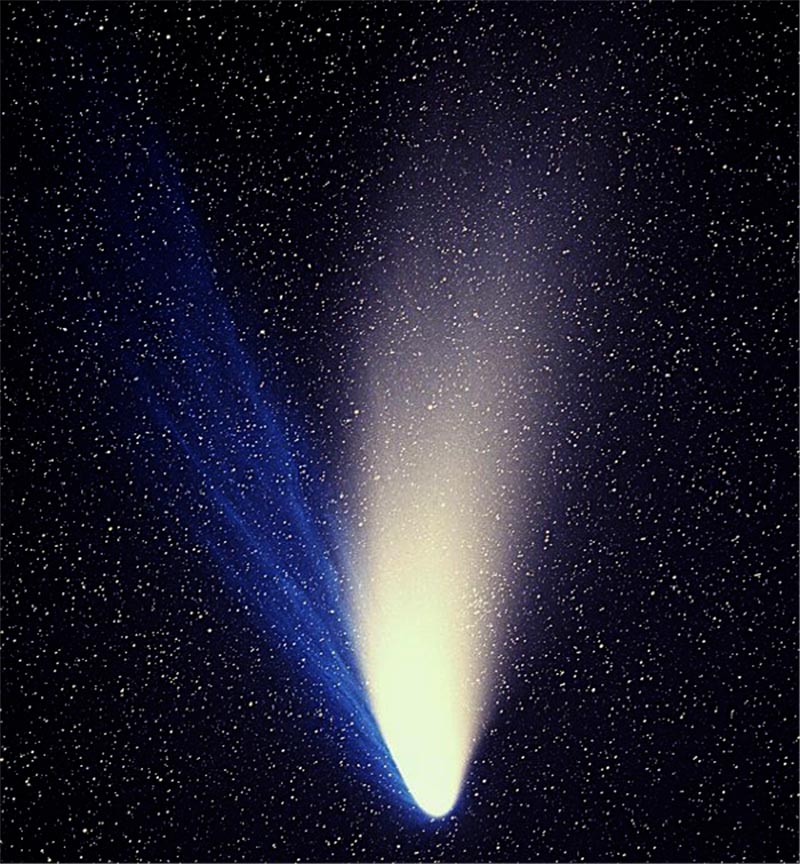
Comets are best described as snowy dirtballs. They are composed of ices, silicated materials, carbon, and other compounds such as ammonium hydroxide. When a comet approaches the Sun, it can form a tail of gas, dust, or both.
Asteroids are a group of the Solar System’s minor bodies that are much like the Rocky Planets in composition: carbon-rich, silicate materials (rock) and/or metal (primarily iron and nickel).

Meteoroids are also materials orbiting in space, and are smaller than asteroids.
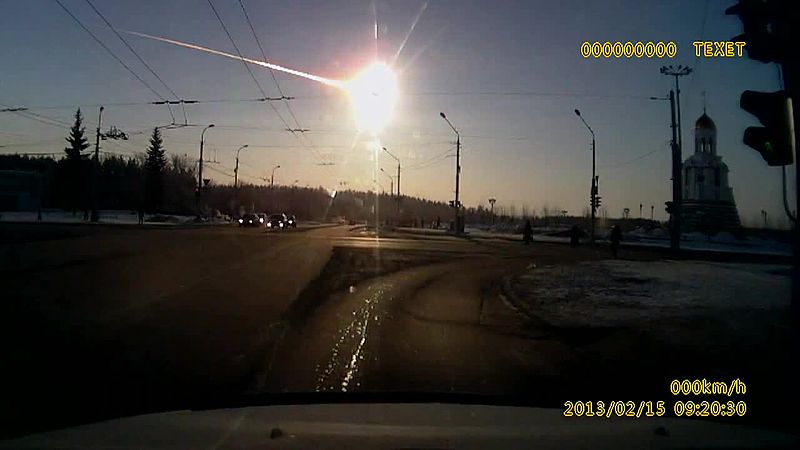
Meteors are the streaks we see in the sky, commonly called shooting or falling stars ; also, can be fireballs and/or bolides. The root word meteor is derived from the Greek word meteōros , which means high in the air . Most meteor showers are comet dust particles left behind as a comet orbits the Sun. Earth runs into this trail of dust as we orbit the Sun.

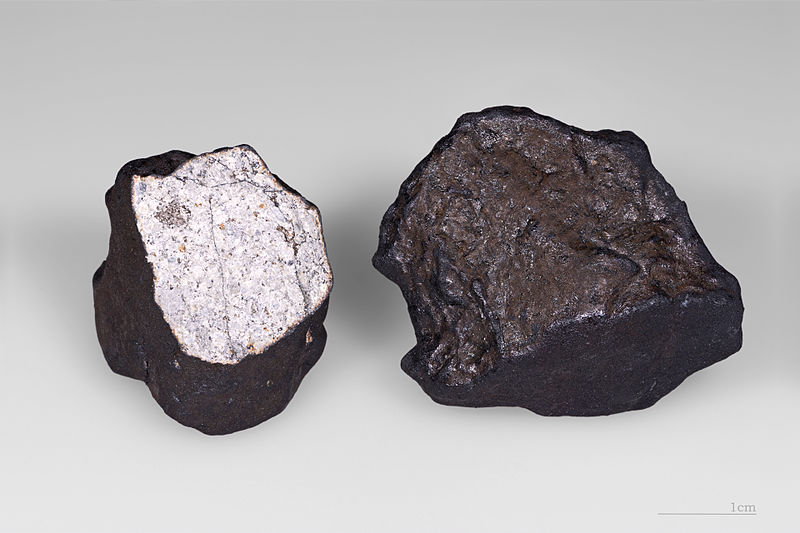
Meteorites are materials that makes it to the surface of a planet, satellite, etc. There are three major groups or classes of meteorites, based on their make-up.
Recent Impacts
The collision of interplanetary debris with Earth is not a hypothetical idea. Evidence of relatively recent impacts can be found on our planet’s surface. One well-studied historic collision took place on June 30, 1908, near the Tunguska River in Siberia. In this desolate region, there was a remarkable explosion in the atmosphere about 8 kilometers above the surface. The shock wave flattened more than a thousand square kilometers of forest (Figure 8.20). Herds of reindeer and other animals were killed, and a man at a trading post 80 kilometers from the blast was thrown from his chair and knocked unconscious. The blast wave spread around the world, as recorded by instruments designed to measure changes in atmospheric pressure.
Despite this violence, no craters were formed by the Tunguska explosion. Shattered by atmospheric pressure, the stony projectile with a diameter of approximately 60 meters disintegrated above our planet’s surface to create a blast equivalent to a 10-megaton nuclear bomb. Had it been smaller or more fragile, the impacting body would have dissipated its energy at high altitude and probably attracted no attention. Today, such high-altitude atmospheric explosions are monitored regularly by military surveillance systems.
If it had been larger or made of stronger material (such as metal), the Tunguska projectile would have penetrated all the way to the surface of Earth and exploded to form a crater. Instead, only the heat and shock of the atmospheric explosion reached the surface, but the devastation it left behind in Siberia bore witness to the power of such impacts. Imagine if the same rocky impactor had exploded over New York City in 1908; history books might today record it as one of the most deadly events in human history.
Tens of thousands of people witnessed directly the explosion of a smaller (20-meter) projectile over the Russian city of Chelyabinsk on an early winter morning in 2013. It exploded at a height of 21 kilometers in a burst of light brighter than the Sun, and the shockwave of the 0.5-megaton explosion broke tens of thousands of windows and sent hundreds of people to the hospital. Rock fragments (meteorites) were easily collected by people in the area after the blast because they landed on fresh snow.
Dr. David Morrison, one of the original authors of this textbook, provides a nontechnical talk about the Chelyabinsk explosion, and impacts in general.
The best-known recent crater on Earth was formed about 50,000 years ago in Arizona. The projectile in this case was a lump of iron about 40 meters in diameter. Now called Meteor Crater and a major tourist attraction on the way to the Grand Canyon, the crater is about a mile across and has all the features associated with similar-size lunar impact craters (Figure 8.21). Meteor Crater is one of the few impact features on Earth that remains relatively intact; some older craters are so eroded that only a trained eye can distinguish them. Nevertheless, more than 150 have been identified. (See the list of suggested online sites at the end of this chapter if you want to find out more about these other impact scars.)
Meteorites can cause damage upon impact, from minor to significant. Examples of three major impacts causing significant damage in the last 100 years are included below.
Tunguska
Place
- Tunguska, Krasnoyarsk | Krai, Russia
Date
- June 30, 1908
The Impact
- An air burst comet or asteroid impact damaging over some 2,150 square kilometers or 830 square miles of forested area. No meteorites were ever recovered.
Sikote-Alin
Place
- Sikhote-Alin, Primorye | Russia
Date
- February 12, 1947
The Impact
- A brighter-than-the-sun fireball announced the arrival of an air burst impactor, showering some 28 tons of meteoritic iron shrapnel on the Sikhote-Alin Mountains.
Chelyabinsk Oblast
Place
- Chelyabinsk Oblast | Russia
Date
- February 15, 2013
The Impact
- 1,491 people were injured and over 7,200 buildings damaged by the air burst from this impactor, estimated to weigh 10,000 tons; numerous stone meteorites were found.
Impacts in Our Future?
The impacts by asteroids and comets that have had such a major influence on life are not necessarily a thing of the past. In the full scope of planetary history, 65 million years ago was just yesterday. Earth actually orbits the Sun within a sort of cosmic shooting gallery, and although major impacts are rare, they are by no means over. Humanity could suffer the same fate as the dinosaurs, or lose a city to the much more frequent impacts like the one over Tunguska, unless we figure out a way to predict the next big impact and to protect our planet. The fact that our solar system is home to some very large planets in outer orbits may be beneficial to us; the gravitational fields of those planets can be very effective at pulling in cosmic debris and shielding us from larger, more frequent impacts.
Beginning in the 1990s, a few astronomers began to analyze the cosmic impact hazard and to persuade the government to support a search for potentially hazardous asteroids. Several small but sophisticated wide-field telescopes are now used for this search, which is called the NASA Spaceguard Survey. Already we know that there are currently no asteroids on a collision course with Earth that are as big (10–15 kilometers) as the one that killed the dinosaurs. The Spaceguard Survey now concentrates on finding smaller potential impactors. By 2021, the search had netted more than 98 percent of the hazardous near-Earth asteroids larger than 1 kilometer. The Spaceguard Survey will soon be augmented by the Vera Rubin Telescope that will scan the full sky on a regular basis, and an orbiting search telescope is under development by NASA. Of course, we cannot make a similar statement about the asteroids that have not yet been discovered, but these will be found and evaluated one by one for their potential hazard. These asteroid surveys are one of the few really life-and-death projects carried out by astronomers, with a potential to help to save our planet from future major impacts. Scientists are now studying how we could protect ourselves from an impact if a large asteroid were discovered on a collision course. The NASA spacecraft called DART (Double Asteroid Redirection Test), launched in late 2021, will demonstrate one example of such technology by crashing into the small asteroid Diomorphos to slightly alter its orbit.
The Torino Impact Hazard Scale is a method for categorizing the impact hazard associated with near-Earth objects such as asteroids and comets. It is a communication tool for astronomers and the public to assess the seriousness of collision predictions by combining probability statistics and known kinetic damage potentials into a single threat value.
Purdue University’s “Impact: Earth” calculator lets you input the characteristics of an approaching asteroid to determine the effect of its impact on our planet.
Observing a Meteor Shower
Perhaps one of the easiest and most-exciting astronomy activities is observing a meteor shower. All you need is a lawn chair and your eyes. However, your conditions need to be just right: little street lighting, a clear view of the sky (from trees, buildings, and clouds), and a moonless night. Moonlight can quickly extinguish your view of fainter meteors.
Meteor showers are named after the constellation they appear to come from, called the radiant. For example, the famous August Perseids appear to radiate from the constellation Perseus. There are a couple of showers that do not follow this rule; for example, the Quadrantids are an older constellation that is no longer recognized, yet the shower name is still used.
Major Northern Hemisphere Meteor Showers
Each Meteor Shower Constellation for Date Range, Zenithal Hourly Rate, and Parent Body.
Quadrantids: Boötes the Bear Driver
Date Range : 12/28 — 1/12
Zenithal Hourly Rate (ZHR) : 120
Parent Body : Asteroid 2003 EH1 and/or Comet C/1490 Y1
Shower appears to come from the constellation Boötes, short shower maximum and usually difficult to observe
Lyrids: Lyra the Harp
Date Range : 4/16 — 4/25
Zenithal Hourly Rate (ZHR) : 18 — 20
Parent Body : Comet Thatcher
Relatively bright meteors
Eta Aquarids: Aquarius
Date Range : 4/19 — 5/28
Zenithal Hourly Rate (ZHR) : 50
Parent Body : Comet Halley
Fast, bright meteors; famous as the source of this shower is Halley’s Comet
Southern Delta Aquarids: Aquarius
Date Range : 7/12 — 8/23
Zenithal Hourly Rate (ZHR) : 25
Parent Body : N/A
Relatively bright meteors
Perseids: Perseus
Date Range : 7/17 — 8/24
Zenithal Hourly Rate (ZHR) : 150
Parent Body : Comet Swift-Tuttle
One of the most-famous showers; can produce a bright and magnificent display around the shower’s maximum, usually around August 12
Orionids: Orion the Hunter
Date Range : 10/2 — 11/7
Zenithal Hourly Rate (ZHR) : 15
Parent Body : Comet Halley
Not a large number per hour yet very bright and fast meteors. Another shower which is due to Halley’s Comet.
Leonids: Leo the Lion
Date Range : 11/6 — 11/30
Zenithal Hourly Rate (ZHR) : 15
Parent Body : Comet Temple-Tuttle
Perhaps one of the fastest of the regular showers; very bright meteors. The Leonids have produced strong storms in the past, with rates up to an incredible 100,000 an hour.
Geminids: Gemini the Twins
Date Range : 12/4 — 12/17
Zenithal Hourly Rate (ZHR) : 120
Parent Body : Asteroid 3200 Phaethon
This shower produces relatively-slow meteors; it’s source is unusual in that it is an asteroid, rather than a comet
Ursids: Ursa Major
Date Range : 12/17 — 12/26
Zenithal Hourly Rate (ZHR) : 10
Parent Body : Comet Tuttle
Slow and medium brightness meteors; included because you might see some of these meteors when watching for the Geminids
The date range of the showers are when members of the shower can be seen. The maximum usually occurs on a specific date and time. The ZHR , or Zenithal Hourly Rate, is the expected number of meteors at maximum if the radiant is overhead or at the zenith; if it is towards the horizon, expect to see fewer meteors. And, the Parent Body is the source of the meteor shower; most are comets but at least the Geminids are attributed to Asteroid 3200 Phaethon.
Occasionally, you will see a random meteor, called a sporadic. These are usually not associated with any shower. Sometimes that meteor will be very bright, called a fireball. And, occasionally, these fireballs will break up, called a bolide.
By the end of this section, you will be able to:
- Explain the origin of meteorites and the difference between a meteor and a meteorite
- Describe how most meteorites have been found
- Explain how primitive stone meteorites are significantly different from other types
- Explain how the study of meteorites informs our understanding of the age of the solar system.
Any fragment of interplanetary debris that survives its fiery plunge through Earth’s atmosphere is called a meteorite. Meteorites fall only very rarely in any one locality, but over the entire Earth thousands fall each year. Some meteorites are loners, but many are fragments from the breakup in the atmosphere of a single larger object. These rocks from the sky carry a remarkable record of the formation and early history of the solar system.
Extraterrestrial Origin of Meteorites
Occasional meteorites have been found throughout history, but their extraterrestrial origin was not accepted by scientists until the beginning of the nineteenth century. Before that, these strange stones were either ignored or considered to have a supernatural origin.
The falls of the earliest recovered meteorites are lost in the fog of mythology. A number of religious texts speak of stones from heaven, which sometimes arrived at opportune moments to smite the enemies of the authors of those texts. At least one sacred meteorite has apparently survived in the form of the Ka’aba, the holy black stone in Mecca that is revered by Islam as a relic from the time of the Patriarchs—although understandably, no chip from this sacred stone has been subject to detailed chemical analysis.
The modern scientific history of the meteorites begins in the late eighteenth century, when a few scientists suggested that some strange-looking stones had such peculiar composition and structure that they were probably not of terrestrial origin. The idea that indeed “stones fall from the sky” was generally accepted only after a scientific team led by French physicist Jean-Baptiste Biot investigated a well-observed fall in 1803.
Meteorites sometimes fall in groups or showers. Such a fall occurs when a single larger object breaks up during its violent passage through the atmosphere. It is important to remember that such a shower of meteorites has nothing to do with a meteor shower. No meteorites have ever been recovered in association with meteor showers. Whatever the ultimate source of the meteorites, they do not appear to come from the comets or their associated particle streams.
Meteorite Falls and Finds
Meteorites are found in two ways. First, sometimes bright meteors (fireballs) are observed to penetrate the atmosphere to low altitudes. If we search the area beneath the point where the fireball burned out, we may find one or more remnants that reached the ground. Observed meteorite falls, in other words, may lead to the recovery of fallen meteorites. (A few meteorites have even hit buildings or, very rarely, people; see Making Connections: Some Striking Meteorites). The 2013 Chelyabinsk fireball, which we discussed in the chapter on Comets and Asteroids: Debris of the Solar System, produced tens of thousands of small meteorites, many of them easy to find because these dark stones fell on snow.
There are, however, many false alarms about meteorite falls. Most observers of a bright fireball conclude that part of it hit the ground, but that is rarely the case. Every few months news outlets report that a meteorite has been implicated in the start of a fire. Such stories have always proved to be wrong. The meteorite is ice-cold in space, and most of its interior remains cold even after its brief fiery plunge through the atmosphere. A freshly fallen meteorite is more likely to acquire a coating of frost than to start a fire.
People sometimes discover unusual-looking rocks that turn out to be meteoritic; these rocks are termed meteorite finds. Now that the public has become meteorite-conscious, many unusual fragments, not all of which turn out to be from space, are sent to experts each year. Some scientists divide these objects into two categories: “meteorites” and “meteorwrongs.” Outside Antarctica (see the next paragraph), genuine meteorites turn up at an average rate of 25 or so per year. Most of these end up in natural history museums or specialized meteoritical laboratories throughout the world, although there is a growing group of private collectors interested in them as well. (Figure 14.6)
Since the 1980s, sources in the Antarctic have dramatically increased our knowledge of meteorites. More than ten thousand meteorites have been recovered from the Antarctic as a result of the motion of the ice in some parts of that continent (Figure 14.7). Meteorites that fall in regions where ice accumulates are buried and then carried slowly to other areas where the ice is gradually worn away. After thousands of years, the rock again finds itself on the surface, along with other meteorites carried to these same locations. The ice thus concentrates the meteorites that have fallen both over a large area and over a long period of time. Once on the surface, the rocks stand out in contrast to the ice and are thus easier to spot than in other places on our rocky planet.
Although meteorites fall regularly onto Earth’s surface, few of them have much of an impact on human civilization. There is so much water and uninhabited land on our planet that rocks from space typically fall where no one even sees them come down. But given the number of meteorites that land each year, you may not be surprised that a few have struck buildings, cars, and even people. In September 1938, for example, a meteorite plunged through the roof of Edward McCain’s garage, where it became embedded in the seat of his Pontiac Coupe (Figure 14.8).
In November 1982, Robert and Wanda Donahue of Wethersfield, Connecticut, were watching M*A*S*H* on television when a 6-pound meteorite came thundering through their roof, making a hole in the living room ceiling. After bouncing, it finally came to rest under their dining room table.
Eighteen-year-old Michelle Knapp of Peekskill, New York, got quite a surprise one morning in October 1992. She had just purchased her very first car, her grandmother’s 1980 Chevy Malibu. But she awoke to find its rear end mangled and a crater in the family driveway—thanks to a 3-pound meteorite. Michelle was not sure whether to be devastated by the loss of her car or thrilled by all the media attention.
In June 1994, Jose Martin and his wife were driving from Madrid, Spain, to a golfing vacation when a fist-sized meteorite crashed through the windshield of their car, bounced off the dashboard, broke Jose’s little finger, and then landed in the back seat. Before Martin, the most recent person known to have been struck by a meteorite was Annie Hodges of Sylacauga, Alabama. In November 1954, she was napping on a couch when a meteorite came through the roof, bounced off a large radio set, and hit her first on the arm and then on the leg.
The fireball that exploded at an altitude of about 20 kilometers near the Russian city of Chelyabinsk on February 15, 2013, produced a very large meteorite shower, and quite a few of the small rocks hit buildings. None is known to have hit people, however, and the individual meteorites were so small that they did not do much damage—much less than the shockwave from the exploding fireball, which broke the glass in thousands of windows.
Meteorite Classification
The meteorites in our collections have a wide range of compositions and histories, but traditionally they have been placed into three broad classes. First are the irons, composed of nearly pure metallic nickel-iron. Second are the stones, the term used for any silicate or rocky meteorite. Third are the rarer stony-irons, made (as the name implies) of mixtures of stone and metallic iron (Figure 14.9).
Of these three types, the irons and stony-irons are the most obviously extraterrestrial because of their metallic content. Pure iron almost never occurs naturally on Earth; it is generally found here as an oxide (chemically combined with oxygen) or other mineral ore. Therefore, if you ever come across a chunk of metallic iron, it is sure to be either human-made or a meteorite.
The stones are much more common than the irons but more difficult to recognize. Often laboratory analysis is required to demonstrate that a particular sample is really of extraterrestrial origin, especially if it has lain on the ground for some time and been subject to weathering. The most scientifically valuable stones are those collected immediately after they fall, or the Antarctic samples preserved in a nearly pristine state by ice.
Table 14.2 summarizes the frequencies of occurrence of the different classes of meteorites among the fall, find, and Antarctic categories.
| Class | Falls (%) | Finds (%) | Antarctic (%) |
|---|---|---|---|
| Primitive stones | 88 | 51 | 85 |
| Differentiated stones | 8 | 2 | 12 |
| Irons | 3 | 42 | 2 |
| Stony-irons | 1 | 5 | 1 |
Ages and Compositions of Meteorites
It was not until the ages of meteorites were measured and their compositions analyzed in detail that scientists appreciated their true significance. The meteorites include the oldest and most primitive materials available for direct study in the laboratory. The ages of stony meteorites can be determined from the careful measurement of radioactive isotopes and their decay products. Almost all meteorites have radioactive ages between 4.50 and 4.56 billion years, as old as any ages we have measured in the solar system. The few younger exceptions are igneous rocks that have been ejected from cratering events on the Moon or Mars (and have made their way to Earth).
The average age for the most primitive meteorites, calculated using the most accurate values now available for radioactive half-lives, is 4.56 billion years, with an uncertainty of less than 0.01 billion years. This value (which we round off to 4.5 billion years in this book) is taken to represent the age of the solar system—the time since the first solids condensed and began to form into larger bodies.
The traditional classification of meteorites into irons, stones, and stony-irons is easy to use because it is obvious from inspection which category a meteorite falls into (although it may be much more difficult to distinguish a meteoritic stone from a terrestrial rock). More scientifically significant, however, is the distinction between primitive and differentiated meteorites. The differentiated meteorites are fragments of larger parent bodies that were molten before they broke up, allowing the denser materials (such as metals) to sink to their centers. Like many rocks on Earth, they have been subject to a degree of chemical reshuffling, with the different materials sorted according to density. Differentiated meteorites include the irons, which come from the metal cores of their parent bodies; stony-irons, which probably originate in regions between a metal core and a stony mantle; and some stones that are composed of mantle or crust material from their differentiated parent bodies.
The Most Primitive Meteorites
For information on the earliest history of the solar system, we turn to the primitive meteorites—those made of materials that have not been subject to great heat or pressure since their formation. We can look at the spectrum of sunlight reflected from asteroids and compare their compositions with those of primitive meteorites. Such analysis indicates that their parent bodies are almost certainly asteroids. Since asteroids are believed to be fragments left over from the formation process of the solar system, it makes sense that they should be the parent bodies of the primitive meteorites.
The great majority of the meteorites that reach Earth are primitive stones. Many of them are composed of light-colored gray silicates with some metallic grains mixed in, but there is also an important group of darker stones called carbonaceous meteorites. As their name suggests, these meteorites contain carbon, but we also find various complex organic molecules in them—chemicals based on carbon, which on Earth are the chemical building blocks of life. In addition, some of them contain chemically bound water, and many are depleted in metallic iron. The carbonaceous (or C-type) asteroids are concentrated in the outer part of the asteroid belt.
Among the most useful of these meteorites have been the Allende meteorite that fell in Mexico (see Figure 14.9), the Murchison meteorite that fell in Australia (both in 1969), and the Tagish Lake meteorite that landed in a winter snowdrift on Tagish Lake, Canada, in 2000. (The fragile bits of dark material from the Tagish Lake meteorite were readily visible against the white snow, although at first they were mistaken for wolf droppings.)
The Murchison meteorite (Figure 14.10) is known for the variety of organic chemicals it has yielded. Most of the carbon compounds in carbonaceous meteorites are complex, tarlike substances that defy exact analysis. Murchison also contains 16 amino acids (the building blocks of proteins), 11 of which are rare on Earth. The most remarkable thing about these organic molecules is that they include equal numbers with right-handed and left-handed molecular symmetry. Amino acids can have either kind of symmetry, but all life on Earth has evolved using only the left-handed versions to make proteins. The presence of both kinds of amino acids clearly demonstrates that the ones in the meteorites had an extraterrestrial origin.
These naturally occurring amino acids and other complex organic molecules in Murchison—formed without the benefit of the sheltering environment of planet Earth—show that a great deal of interesting chemistry must have taken place when the solar system was forming. If so, then perhaps some of the molecular building blocks of life on Earth were first delivered by primitive meteorites and comets. This is an interesting idea because our planet was probably much too hot for any organic materials to survive its earliest history. But after Earth’s surface cooled, the asteroid and comet fragments that pelted it could have refreshed its supply of organic materials.
Meteorites
Most meteoritic material that strikes the Earth’s atmosphere does not make it to the surface to be recovered. The meteor burns up, or if it makes it to the surface, falls into water, since Earth is a water surface planet.
There is more gold mined each year than the total amount of meteorites found in all collections – museums, universities, and private collections. So, how does one recognize if a rock is potentially a meteorite?
- The rock attracts a magnet — most meteorites have some iron in them. Not all, though.
- The rock looks burned , called a fusion crust. Yet, if the meteorite has been sitting in a desert region for a while, the fusion crust might be weathered away.
- The rock looks shaped , like it’s been oriented as it came through the atmosphere. Yet again, this aerodynamic shaping might have been weathered away.
- The rock looks like it has thumbprint-like impressions , called regmaglypts. These impressions are formed as the meteorite comes through the atmosphere, and material is ablated away from the meteorite.
The three major groups or classes of meteorites, based on their make-up:
- Stones or Stony Meteorites
- These are composed of silicates and other materials. Most stony meteorites contain metal in the form of iron and nickel. Plus, stone meteorites are by far the most common type; some 94% of recovered meteorites are stony. Stone meteorites also include very rare types of meteorites, including lunar, Martian, and possibly even comets.
- Iron meteorites, or Irons
- These are composed of iron (Fe) and nickel (Ni), with some cobalt (Co) and other trace elements and minerals. Iron is the predominant metal, and the type of Iron meteorite depends on the ratio of iron to nickel. No Earth rock has iron and nickel in combination. Thus a ‘rock’ recovered with iron and nickel together is a meteorite. Irons are very dense meteorites, in comparison to stony meteorites.
- Stony Irons
- As the name indicates, they are a combination of iron and stony meteorite properties and the rarest type or class of meteorite.
- Tektites
- Very dry glasses, and are hypothesized to be meteoritic splash from a large impact. The meteorite strikes Earth, and soil is blown up into the air, almost back into space. Yet, the escape velocity is not high enough, so the now-molten material re-enters and lands, found as the glassy material found in specific areas on Earth.
Click on the image to view the video.
 Content by Florida State College at Jacksonville is licensed under a Creative Commons Attribution 4.0 International License. ]
Rocks which are not meteorites are referred to as meteorwrongs by those who work in the field. People often find an unusual-looking rock and think it is a meteorite. After testing, which will include the four steps noted and/or chemical testing, many of these are meteorwrongs.
Meteorites are representatives of the early solar system. There are three types of meteorites. Stones or Stony meteorites. These are composed of silicates and other materials. Most stony meteorites contain metal in the form of iron and nickel. And stone meteorites are by far the most common type; some 94% of recovered meteorites are stony. Stone meteorites also include very rare types of meteorites, including lunar, Martian, and possibly even comets.
Types of Meteorites
Iron meteorites, or Irons. These are composed of iron (Fe) and nickel (Ni), with some cobalt (Co) and other trace elements and minerals. Iron is the predominant metal, and the type of Iron meteorite depends on the ratio of iron to nickel. No Earth rock has iron and nickel in combination. Thus a ‘rock’ recovered with iron and nickel together is a meteorite. Irons are very dense meteorites, in comparison to stony meteorites.
Stony Irons. As the name indicates, they are a combination of iron and stony meteorite properties and the rarest type or class of meteorite. The Pallasites, a class within the Stony Irons, are simply spectacular. When sliced and polished, you can see a metal matrix of iron-nickel that surrounds crystals of olivine – peridot in gem terms.
Attributions
https://phys.libretexts.org/Bookshel...and_Meteorites
https://phys.libretexts.org/Bookshel...%3A_Meteorites
https://phys.libretexts.org/Bookshel..._of_Meteorites
https://phys.libretexts.org/Bookshel...pace_Vagabonds
https://phys.libretexts.org/Bookshel..._Meteor_Shower
https://phys.libretexts.org/Bookshel...%3A_Meteorites
https://phys.libretexts.org/Bookshel...ution_of_Earth
https://phys.libretexts.org/Bookshel....02%3A_Meteors
https://phys.libretexts.org/Bookshel...es_from_Heaven