

9.6: The Red Sky Paradox
- Page ID
- 128547
\( \newcommand{\vecs}[1]{\overset { \scriptstyle \rightharpoonup} {\mathbf{#1}} } \)
\( \newcommand{\vecd}[1]{\overset{-\!-\!\rightharpoonup}{\vphantom{a}\smash {#1}}} \)
\( \newcommand{\dsum}{\displaystyle\sum\limits} \)
\( \newcommand{\dint}{\displaystyle\int\limits} \)
\( \newcommand{\dlim}{\displaystyle\lim\limits} \)
\( \newcommand{\id}{\mathrm{id}}\) \( \newcommand{\Span}{\mathrm{span}}\)
( \newcommand{\kernel}{\mathrm{null}\,}\) \( \newcommand{\range}{\mathrm{range}\,}\)
\( \newcommand{\RealPart}{\mathrm{Re}}\) \( \newcommand{\ImaginaryPart}{\mathrm{Im}}\)
\( \newcommand{\Argument}{\mathrm{Arg}}\) \( \newcommand{\norm}[1]{\| #1 \|}\)
\( \newcommand{\inner}[2]{\langle #1, #2 \rangle}\)
\( \newcommand{\Span}{\mathrm{span}}\)
\( \newcommand{\id}{\mathrm{id}}\)
\( \newcommand{\Span}{\mathrm{span}}\)
\( \newcommand{\kernel}{\mathrm{null}\,}\)
\( \newcommand{\range}{\mathrm{range}\,}\)
\( \newcommand{\RealPart}{\mathrm{Re}}\)
\( \newcommand{\ImaginaryPart}{\mathrm{Im}}\)
\( \newcommand{\Argument}{\mathrm{Arg}}\)
\( \newcommand{\norm}[1]{\| #1 \|}\)
\( \newcommand{\inner}[2]{\langle #1, #2 \rangle}\)
\( \newcommand{\Span}{\mathrm{span}}\) \( \newcommand{\AA}{\unicode[.8,0]{x212B}}\)
\( \newcommand{\vectorA}[1]{\vec{#1}} % arrow\)
\( \newcommand{\vectorAt}[1]{\vec{\text{#1}}} % arrow\)
\( \newcommand{\vectorB}[1]{\overset { \scriptstyle \rightharpoonup} {\mathbf{#1}} } \)
\( \newcommand{\vectorC}[1]{\textbf{#1}} \)
\( \newcommand{\vectorD}[1]{\overrightarrow{#1}} \)
\( \newcommand{\vectorDt}[1]{\overrightarrow{\text{#1}}} \)
\( \newcommand{\vectE}[1]{\overset{-\!-\!\rightharpoonup}{\vphantom{a}\smash{\mathbf {#1}}}} \)
\( \newcommand{\vecs}[1]{\overset { \scriptstyle \rightharpoonup} {\mathbf{#1}} } \)
\(\newcommand{\longvect}{\overrightarrow}\)
\( \newcommand{\vecd}[1]{\overset{-\!-\!\rightharpoonup}{\vphantom{a}\smash {#1}}} \)
\(\newcommand{\ket}[1]{\left| #1 \right>}\)
\(\newcommand{\bra}[1]{\left< #1 \right|}\)
\(\newcommand{\braket}[2]{\left< #1 \vphantom{#2} \right| \left. #2 \vphantom{#1} \right>}\)
\(\newcommand{\braopket}[3]{\left< #1 \vphantom{#2}\vphantom{#3} \right| #2 \vphantom{#1}\vphantom{#3} \left| #3 \vphantom{#1}\vphantom{#2} \right>}\)
\(\newcommand{\qmvec}[1]{\mathbf{\vec{#1}}}\)
\(\newcommand{\op}[1]{\hat{\mathbf{#1}}}\)
\(\newcommand{\expect}[1]{\langle #1 \rangle}\)
\(\newcommand{\dfn}[1]{\emph{\textbf{#1}}}\)
Science and Society - Red Sky Paradox
How unique are we?
Given the 100 billion or so stars in our galaxy and the incredibly old age of many such systems, you might expect that intelligent life, if it exists, would have had plenty of opportunity to spread itself across the universe in ways that should be obvious to humankind — thus, the Fermi Paradox asks, where is everyone? A similar paradox can be considered regarding the types of stars that seem to host life. Our sun is part of a group of stellar types referred to as FGK-dwarfs, referring to their spectral classes. However, the vast majority of stars, about 75%, are smaller red dwarfs (M-dwarfs), which are cooler, and dimmer.
Assuming intelligent life can occur around all kinds of stars in the universe, the greater number of M-dwarfs suggests it is somewhat unusual that we look up and instead find ourselves orbiting a yellow G-dwarf.
Alternatively, perhaps our situation suggests that there is something about these common M-dwarf systems that prohibits life, and FGK-dwarfs are the place to be after all. Dr. David Kipping published his research on this topic in the Proceedings of the National Academy of Sciences journal, and considers arguments on either side of this problem, dubbed the Red Sky Paradox. The attributed article was written by Anthony Maue, an astronomy graduate student writing for the Astrobites website.
Because humans have yet to find any sign of extraterrestrial life, let alone extraterrestrial intelligence, this field of study is based on probability computations of certain conditions for stars and planets to form together. Using a method called Bayesian statistical analysis, the Dr. Kipping discusses four possible resolutions to the Red Sky Paradox and aims to improve on the somewhat problematic framing of previous studies.
According to the author, previous studies computed probabilities without considering the variable abundance of planets and habitability around different star types. In other words, it's important to consider both the star and the planets orbiting the star, including how habitable the planets may be. It may also be important to consider how long a planet is habitable, or how long it takes a planet to achieve habitability. For example, there is growing evidence that planet Mars may have been habitable in the distant past, but slowly became inhospitable for life as its atmosphere dissipated and liquid water evaporated.
The author investigates probabilities by developing a formula in which biology develops at a uniform rate that leads directly from non-living chemical processes to eventual intelligent life. This rate is included alongside a time window for life to develop (based on the length of the host star's life cycle) in order to find the probability of life emerging around an FGK-dwarf versus the more common M-dwarf. These equations are then used to compute the probability of life in various scenarios. There are of course many other types of stars and subtypes, but treating the issue as having just two solutions — a lifeform either develops around an FGK- or an M-dwarf — seems to be a reasonable and helpful simplification.
Four possible solutions
Resolution I - Our situation is a 1-in-100 outlier. If the rates of developing intelligent life are the same for both star types, then the probability comes down to the stars' different rates of occurrence, of which FGK types are more rare and shorter lived.
Resolution II - FGK-dwarfs provide better habitability than M-dwarfs. If the probability of intelligent life emerging around both stars were similar, then the rate of life's development around FGK-stars would need to be at least two orders of magnitude greater.
Resolution III - Life doesn't have enough time to develop around M-dwarfs. If the probability of life around both stars was similar AND the rate of life's development was the same, then the time window available for development of life around FGK-dwarfs may be at least 5 times greater than that for M-dwarfs.
Resolution IV - Earth-like worlds are rarer than we think. If the habitable worlds occur at different rates between the two star types, then Earth-like planets would need to be at least two orders of magnitude more common around FGK- than M-dwarfs.
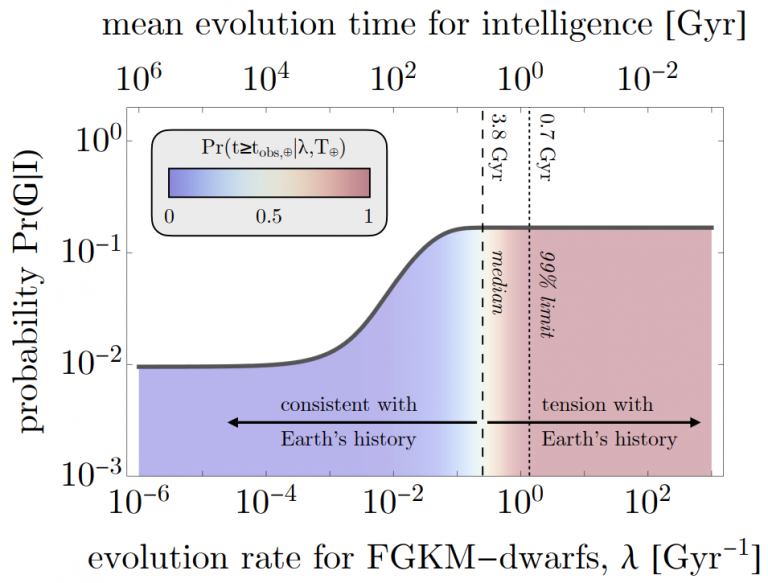
The authors make note of a few caveats for each outcome. For Resolution I, Figure \(\PageIndex{1}\), a fast emergence/evolution of life would lead to us being less of an outlier (1-in-10) and resolve the Red Sky Paradox, but should result in a universe teeming with intelligent life and so seems at odds with the apparent Fermi Paradox. The probability may fall between 1% and 10% (10-2 and 10-1 on the y-axis), though the former seems more consistent with the slow development of intelligent life that occurred on Earth, as shown by the bluer colors in the figure. A slower emergence rate is more consistent with the billions of years it took intelligent life to develop on Earth, but with the 1-in-100 outlier outcome seems to go against the Copernican Principle that we are not special but just a tiny drop in a vast sea.
Alternatively, Resolution II has good theoretical support due to existing concerns about less-than-habitable conditions that may arise around m-dwarfs (e.g., frequent tidal locking, high stellar activity, etc.). Resolution III has similarly good support since the pre-main sequence for m-dwarfs seems to be at least several times less than the main sequence lifetime of FGK-stars, giving a smaller time window for life to develop. Resolution IV could also be relevant, as the occurrence rates of Earth-sized worlds around different star types are hotly debated, not to mention that Earth-sized doesn't necessarily mean habitable and doesn't include other bodies of interest like exomoons.
Narrowing things down
Of course, these options are not mutually exclusive and a combination of them could be responsible. Fortunately, observational astronomy may be able to test some of these possibilities in the near future. For example, frequently finding runaway greenhouse worlds around M-dwarfs would support Resolution III, whereas a paucity of Earth-like planets around late M-dwarfs would support Resolution IV.
Ultimately, this sort of probability study, in combination with incoming observational results, can help us to best direct future observations with the highest chance of finding evidence of life in the universe.
For more details on this work, check out the excellent summary video, linked in the For Further Exploration section below.
Attributions
This page was adapted from "Shouldn't we be orbiting a red dwarf?" in Astrobites originally written by Anthony Maue, and published under CC BY-NC 4.0.
Hear directly from the author of Red Sky Paradox in this video.