

2.8: Appendix
- Page ID
- 138910
\( \newcommand{\vecs}[1]{\overset { \scriptstyle \rightharpoonup} {\mathbf{#1}} } \)
\( \newcommand{\vecd}[1]{\overset{-\!-\!\rightharpoonup}{\vphantom{a}\smash {#1}}} \)
\( \newcommand{\dsum}{\displaystyle\sum\limits} \)
\( \newcommand{\dint}{\displaystyle\int\limits} \)
\( \newcommand{\dlim}{\displaystyle\lim\limits} \)
\( \newcommand{\id}{\mathrm{id}}\) \( \newcommand{\Span}{\mathrm{span}}\)
( \newcommand{\kernel}{\mathrm{null}\,}\) \( \newcommand{\range}{\mathrm{range}\,}\)
\( \newcommand{\RealPart}{\mathrm{Re}}\) \( \newcommand{\ImaginaryPart}{\mathrm{Im}}\)
\( \newcommand{\Argument}{\mathrm{Arg}}\) \( \newcommand{\norm}[1]{\| #1 \|}\)
\( \newcommand{\inner}[2]{\langle #1, #2 \rangle}\)
\( \newcommand{\Span}{\mathrm{span}}\)
\( \newcommand{\id}{\mathrm{id}}\)
\( \newcommand{\Span}{\mathrm{span}}\)
\( \newcommand{\kernel}{\mathrm{null}\,}\)
\( \newcommand{\range}{\mathrm{range}\,}\)
\( \newcommand{\RealPart}{\mathrm{Re}}\)
\( \newcommand{\ImaginaryPart}{\mathrm{Im}}\)
\( \newcommand{\Argument}{\mathrm{Arg}}\)
\( \newcommand{\norm}[1]{\| #1 \|}\)
\( \newcommand{\inner}[2]{\langle #1, #2 \rangle}\)
\( \newcommand{\Span}{\mathrm{span}}\) \( \newcommand{\AA}{\unicode[.8,0]{x212B}}\)
\( \newcommand{\vectorA}[1]{\vec{#1}} % arrow\)
\( \newcommand{\vectorAt}[1]{\vec{\text{#1}}} % arrow\)
\( \newcommand{\vectorB}[1]{\overset { \scriptstyle \rightharpoonup} {\mathbf{#1}} } \)
\( \newcommand{\vectorC}[1]{\textbf{#1}} \)
\( \newcommand{\vectorD}[1]{\overrightarrow{#1}} \)
\( \newcommand{\vectorDt}[1]{\overrightarrow{\text{#1}}} \)
\( \newcommand{\vectE}[1]{\overset{-\!-\!\rightharpoonup}{\vphantom{a}\smash{\mathbf {#1}}}} \)
\( \newcommand{\vecs}[1]{\overset { \scriptstyle \rightharpoonup} {\mathbf{#1}} } \)
\(\newcommand{\longvect}{\overrightarrow}\)
\( \newcommand{\vecd}[1]{\overset{-\!-\!\rightharpoonup}{\vphantom{a}\smash {#1}}} \)
\(\newcommand{\ket}[1]{\left| #1 \right>}\)
\(\newcommand{\bra}[1]{\left< #1 \right|}\)
\(\newcommand{\braket}[2]{\left< #1 \vphantom{#2} \right| \left. #2 \vphantom{#1} \right>}\)
\(\newcommand{\braopket}[3]{\left< #1 \vphantom{#2}\vphantom{#3} \right| #2 \vphantom{#1}\vphantom{#3} \left| #3 \vphantom{#1}\vphantom{#2} \right>}\)
\(\newcommand{\qmvec}[1]{\mathbf{\vec{#1}}}\)
\(\newcommand{\op}[1]{\hat{\mathbf{#1}}}\)
\(\newcommand{\expect}[1]{\langle #1 \rangle}\)
\(\newcommand{\dfn}[1]{\emph{\textbf{#1}}}\)
|
Links to related material |
|
|---|---|
| Snells law and refraction Refraction at a plane interface. Derivation of Snell's law. Experimental determination of refractive index. Examples. |
 |
| Newton's prisms Dispersing white light into component colours, then recombinging them. |
 |
| Mirages and the Green Flash Refraction from air with a thermally induced density gradient. Inferior mirages. 'Floating islands. The green flash. |
 |
| Dispersion and chromatic aberration The refractive index varies with wavelength, therefore so does the focal length of a simple lens, giving chromatic dispersion in the image. |
 |
| Total internal reflection No refraction if the angle of incidence exceeds the critical angle. |
 |
| Optical fibres and cladding Total internal reflection in an optical fiber. Adding cladding reduces pulse broadening. |
|
| Chromatic dispersion, rainbows and Alexander's dark band Dispersion on refraction produces rainbows. One internal reflection gives the primary (40°) rainbow, two gives the secondary (50°) bow. |
 |
| Colour of the sky Scattering varies strongly with wavelength. Scattered light gives the blue of the sky, and the unscattered light gives the red or orange of a sunset. |
 |
| Mirrors and images Plane mirrors and virtual images. Inverted images. Real images in a concave mirror. Parabolic reflectors. Fermat's principle. Focusing with mirrors. Aberration. The mirror equation. Convex mirrors. Distortion. |
 |
| Lenses and images Focussing and forming images with lenses. How to draw ray diagrams. Relating object and image distance to focal length (theory and experiment). |
 |
| Microscopes and magnifiers The magnifier or simple microscope. The compound microscope and ray diagrams. |
 |
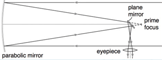
| Reflecting Newtonian telescope Parabolic reflector and the Newtonian or reflecting telescope. |
 |
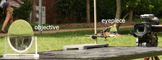
| Refracting telescope Refracting telescope: two converging lenses produces a virtual, inverted image. |
 |
| Acoustic telescope Parabolic reflector for sound. Compare with Newtonian telescope. Wavelength limitations. |
 |
|
Geometrical Optics Experiments |
 |