

0.2: Physics
- Page ID
- 133961
\( \newcommand{\vecs}[1]{\overset { \scriptstyle \rightharpoonup} {\mathbf{#1}} } \)
\( \newcommand{\vecd}[1]{\overset{-\!-\!\rightharpoonup}{\vphantom{a}\smash {#1}}} \)
\( \newcommand{\dsum}{\displaystyle\sum\limits} \)
\( \newcommand{\dint}{\displaystyle\int\limits} \)
\( \newcommand{\dlim}{\displaystyle\lim\limits} \)
\( \newcommand{\id}{\mathrm{id}}\) \( \newcommand{\Span}{\mathrm{span}}\)
( \newcommand{\kernel}{\mathrm{null}\,}\) \( \newcommand{\range}{\mathrm{range}\,}\)
\( \newcommand{\RealPart}{\mathrm{Re}}\) \( \newcommand{\ImaginaryPart}{\mathrm{Im}}\)
\( \newcommand{\Argument}{\mathrm{Arg}}\) \( \newcommand{\norm}[1]{\| #1 \|}\)
\( \newcommand{\inner}[2]{\langle #1, #2 \rangle}\)
\( \newcommand{\Span}{\mathrm{span}}\)
\( \newcommand{\id}{\mathrm{id}}\)
\( \newcommand{\Span}{\mathrm{span}}\)
\( \newcommand{\kernel}{\mathrm{null}\,}\)
\( \newcommand{\range}{\mathrm{range}\,}\)
\( \newcommand{\RealPart}{\mathrm{Re}}\)
\( \newcommand{\ImaginaryPart}{\mathrm{Im}}\)
\( \newcommand{\Argument}{\mathrm{Arg}}\)
\( \newcommand{\norm}[1]{\| #1 \|}\)
\( \newcommand{\inner}[2]{\langle #1, #2 \rangle}\)
\( \newcommand{\Span}{\mathrm{span}}\) \( \newcommand{\AA}{\unicode[.8,0]{x212B}}\)
\( \newcommand{\vectorA}[1]{\vec{#1}} % arrow\)
\( \newcommand{\vectorAt}[1]{\vec{\text{#1}}} % arrow\)
\( \newcommand{\vectorB}[1]{\overset { \scriptstyle \rightharpoonup} {\mathbf{#1}} } \)
\( \newcommand{\vectorC}[1]{\textbf{#1}} \)
\( \newcommand{\vectorD}[1]{\overrightarrow{#1}} \)
\( \newcommand{\vectorDt}[1]{\overrightarrow{\text{#1}}} \)
\( \newcommand{\vectE}[1]{\overset{-\!-\!\rightharpoonup}{\vphantom{a}\smash{\mathbf {#1}}}} \)
\( \newcommand{\vecs}[1]{\overset { \scriptstyle \rightharpoonup} {\mathbf{#1}} } \)
\(\newcommand{\longvect}{\overrightarrow}\)
\( \newcommand{\vecd}[1]{\overset{-\!-\!\rightharpoonup}{\vphantom{a}\smash {#1}}} \)
\(\newcommand{\ket}[1]{\left| #1 \right>}\)
\(\newcommand{\bra}[1]{\left< #1 \right|}\)
\(\newcommand{\braket}[2]{\left< #1 \vphantom{#2} \right| \left. #2 \vphantom{#1} \right>}\)
\(\newcommand{\braopket}[3]{\left< #1 \vphantom{#2}\vphantom{#3} \right| #2 \vphantom{#1}\vphantom{#3} \left| #3 \vphantom{#1}\vphantom{#2} \right>}\)
\(\newcommand{\qmvec}[1]{\mathbf{\vec{#1}}}\)
\(\newcommand{\op}[1]{\hat{\mathbf{#1}}}\)
\(\newcommand{\expect}[1]{\langle #1 \rangle}\)
\(\newcommand{\dfn}[1]{\emph{\textbf{#1}}}\)
Physics Defined
The word physics comes from Greek,??? meaning nature.
What is your first reaction when you hear the word “physics”? Did you imagine working through difficult equations or memorizing formulas that seem to have no real use in life outside the physics classroom? Many people come to the subject of physics with a bit of fear. But as you begin your exploration of this broad-ranging subject, you may soon come to realize that physics plays a much larger role in your life than you first thought, no matter your life goals or career choice.
For example, take a look at the image above. This image is of the Andromeda Galaxy, which contains billions of individual stars, huge clouds of gas, and dust. Two smaller galaxies are also visible as bright blue spots in the background. At a staggering 2.5 million light years from the Earth, this galaxy is the nearest one to our own galaxy (which is called the Milky Way). The stars and planets that make up Andromeda might seem to be the furthest thing from most people’s regular, everyday lives. But Andromeda is a great starting point to think about the forces that hold together the universe. The forces that cause Andromeda to act as it does are the same forces we contend with here on Earth, whether we are planning to send a rocket into space or simply raise the walls for a new home. The same gravity that causes the stars of Andromeda to rotate and revolve also causes water to flow over hydroelectric dams here on Earth. Tonight, take a moment to look up at the stars. The forces out there are the same as the ones here on Earth. Through a study of physics, you may gain a greater understanding of the interconnectedness of everything we can see and know in this universe.
Think now about all of the technological devices that you use on a regular basis. Computers, smart phones, GPS systems, MP3 players, and satellite radio might come to mind. Next, think about the most exciting modern technologies that you have heard about in the news, such as trains that levitate above tracks, “invisibility cloaks” that bend light around them, and microscopic robots that fight cancer cells in our bodies. All of these groundbreaking advancements, commonplace or unbelievable, rely on the principles of physics. Aside from playing a significant role in technology, professionals such as engineers, pilots, physicians, physical therapists, electricians, and computer programmers apply physics concepts in their daily work. For example, a pilot must understand how wind forces affect a flight path and a physical therapist must understand how the muscles in the body experience forces as they move and bend. As you will learn in this text, physics principles are propelling new, exciting technologies, and these principles are applied in a wide range of careers.
The physical universe is enormously complex in its detail. Every day, each of us observes a great variety of objects and phenomena. Over the centuries, the curiosity of the human race has led us collectively to explore and catalog a tremendous wealth of information. From the flight of birds to the colors of flowers, from lightning to gravity, from quarks to clusters of galaxies, from the flow of time to the mystery of the creation of the universe, we have asked questions and assembled huge arrays of facts. In the face of all these details, we have discovered that a surprisingly small and unified set of physical laws can explain what we observe. As humans, we make generalizations and seek order. We have found that nature is remarkably cooperative—it exhibits the underlying order and simplicity we so value.
It is the underlying order of nature that makes science in general, and physics in particular, so enjoyable to study. For example, what do a bag of chips and a car battery have in common? Both contain energy that can be converted to other forms. The law of conservation of energy (which says that energy can change form but is never lost) ties together such topics as food calories, batteries, heat, light, and watch springs. Understanding this law makes it easier to learn about the various forms energy takes and how they relate to one another. Apparently unrelated topics are connected through broadly applicable physical laws, permitting an understanding beyond just the memorization of lists of facts.
The unifying aspect of physical laws and the basic simplicity of nature form the underlying themes of this text. In learning to apply these laws, you will, of course, study the most important topics in physics. More importantly, you will gain analytical abilities that will enable you to apply these laws far beyond the scope of what can be included in a single book. These analytical skills will help you to excel academically, and they will also help you to think critically in any professional career you choose to pursue. This module discusses the realm of physics (to define what physics is), some applications of physics (to illustrate its relevance to other disciplines), and more precisely what constitutes a physical law (to illuminate the importance of experimentation to theory).
Science and the Realm of Physics
Science consists of the theories and laws that are the general truths of nature as well as the body of knowledge they encompass. Scientists are continually trying to expand this body of knowledge and to perfect the expression of the laws that describe it. Physics is concerned with describing the interactions of energy, matter, space, and time, and it is especially interested in what fundamental mechanisms underlie every phenomenon. The concern for describing the basic phenomena in nature essentially defines the realm of physics.
Physics aims to describe the function of everything around us, from the movement of tiny charged particles to the motion of people, cars, and spaceships. In fact, almost everything around you can be described quite accurately by the laws of physics. Consider a smart phone (Figure \(\PageIndex{2}\)). Physics describes how electricity interacts with the various circuits inside the device. This knowledge helps engineers select the appropriate materials and circuit layout when building the smart phone. Next, consider a GPS system. Physics describes the relationship between the speed of an object, the distance over which it travels, and the time it takes to travel that distance. When you use a GPS device in a vehicle, it utilizes these physics equations to determine the travel time from one location to another.
Units for Physics
Moving Objects?
Objects are in motion everywhere we look. Everything from a tennis game to a space-probe flyby of the planet Neptune involves motion. When you are resting, your heart moves blood through your veins. And even in inanimate objects, there is continuous motion in the vibrations of atoms and molecules. Questions about motion are interesting in and of themselves: How long will it take for a space probe to get to Mars? But an understanding of motion is also key to understanding other concepts in physics. An understanding of acceleration, for example, is crucial to the study of force.
Our formal study of physics begins with kinematics which is defined as the study of motion without considering its causes. The word “kinematics” comes from a Greek term meaning motion and is related to other English words such as “cinema” (movies) and “kinesiology” (the study of human motion). In one-dimensional kinematics we will study only the motion of a football, for example, without worrying about what forces cause or change its motion. Such considerations come in other chapters. In this chapter, we examine the simplest type of motion—namely, motion along a straight line, or one-dimensional motion.
Position
In order to describe the motion of an object, you must first be able to describe its position—where it is at any particular time. More precisely, you need to specify its position relative to a convenient reference frame. Earth is often used as a reference frame, and we often describe the position of an object as it relates to stationary objects in that reference frame. For example, a rocket launch would be described in terms of the position of the rocket with respect to the Earth as a whole, while a professor’s position could be described in terms of where she is in relation to the nearby white board. (See Figure \(\PageIndex{2}\).) In other cases, we use reference frames that are not stationary but are in motion relative to the Earth. To describe the position of a person in an airplane, for example, we use the airplane, not the Earth, as the reference frame. (See Figure \(\PageIndex{3}\).)
Displacement
If an object moves relative to a reference frame (for example, if a professor moves to the right relative to a white board or a passenger moves toward the rear of an airplane), then the object’s position changes. This change in position is known as displacement. The word “displacement” implies that an object has moved, or has been displaced.
Displacement is the change in position of an object:
where \(\Delta x\) is displacement, \(x_{\mathrm{f}}\) is the final position, and \(x_{0}\) is the initial position.
Always solve for displacement by subtracting initial position \(x_{0}\) from final position \(x_{f}\).
Note that the SI unit for displacement is the meter (m), but sometimes kilometers, miles, feet, and other units of length are used. Keep in mind that when units other than the meter are used in a problem, you may need to convert them into meters to complete the calculation.
Note that displacement has a direction as well as a magnitude. The professor’s displacement is 2.0 m to the right, and the airline passenger’s displacement is 4.0 m toward the rear. In one-dimensional motion, direction can be specified with a plus or minus sign. When you begin a problem, you should select which direction is positive (usually that will be to the right or up, but you are free to select positive as being any direction). The professor’s initial position is \(x_{0}=1.5 \mathrm{~m}\) and her final position is \(x_{\mathrm{f}}=3.5 \mathrm{~m}\). Thus her displacement is
In this coordinate system, motion to the right is positive, whereas motion to the left is negative. Similarly, the airplane passenger’s initial position is \(x_{0}=6.0 \mathrm{~m}\) and his final position is \(x_{\mathrm{f}}=2.0 \mathrm{~m}\), so his displacement is
His displacement is negative because his motion is toward the rear of the plane, or in the negative \(x\) direction in our coordinate system.
Distance
Although displacement is described in terms of direction, distance is not. Distance is defined to be the magnitude or size of displacement between two positions. Note that the distance between two positions is not the same as the distance traveled between them.Distance traveled is the total length of the path traveled between two positions. Distance has no direction and, thus, no sign. For example, the distance the professor walks is 2.0 m. The distance the airplane passenger walks is 4.0 m.
MISCONCEPTION ALERT: DISTANCE TRAVELED VS. MAGNITUDE OF DISPLACEMENT
It is important to note that the distance traveled, however, can be greater than the magnitude of the displacement (by magnitude, we mean just the size of the displacement without regard to its direction; that is, just a number with a unit). For example, the professor could pace back and forth many times, perhaps walking a distance of 150 m during a lecture, yet still end up only 2.0 m to the right of her starting point. In this case her displacement would be +2.0 m, the magnitude of her displacement would be 2.0 m, but the distance she traveled would be 150 m. In kinematics we nearly always deal with displacement and magnitude of displacement, and almost never with distance traveled. One way to think about this is to assume you marked the start of the motion and the end of the motion. The displacement is simply the difference in the position of the two marks and is independent of the path taken in traveling between the two marks. The distance traveled, however, is the total length of the path taken between the two marks.
What is the difference between distance and displacement? Whereas displacement is defined by both direction and magnitude, distance is defined only by magnitude. Displacement is an example of a vector quantity. Distance is an example of a scalar quantity. A vector is any quantity with both magnitude and direction. Other examples of vectors include a velocity of 90 km/h east and a force of 500 newtons straight down.
The direction of a vector in one-dimensional motion is given simply by a plus (+) or minus (−) sign. Vectors are represented graphically by arrows. An arrow used to represent a vector has a length proportional to the vector’s magnitude (e.g., the larger the magnitude, the longer the length of the vector) and points in the same direction as the vector.
Some physical quantities, like distance, either have no direction or none is specified. A scalar is any quantity that has a magnitude, but no direction. For example, a 20ºC temperature, the 250 kilocalories (250 Calories) of energy in a candy bar, a 90 km/h speed limit, a person’s 1.8 m height, and a distance of 2.0 m are all scalars—quantities with no specified direction. Note, however, that a scalar can be negative, such as a& −20ºC temperature. In this case, the minus sign indicates a point on a scale rather than a direction. Scalars are never represented by arrows.
Time
The most fundamental physical quantities are defined by how they are measured. This is the case with time. Every measurement of time involves measuring a change in some physical quantity. It may be a number on a digital clock, a heartbeat, or the position of the Sun in the sky. In physics, the definition of time is simple—time is change, or the interval over which change occurs. It is impossible to know that time has passed unless something changes.
The amount of time or change is calibrated by comparison with a standard. The SI unit for time is the second, abbreviated s. We might, for example, observe that a certain pendulum makes one full swing every 0.75 s. We could then use the pendulum to measure time by counting its swings or, of course, by connecting the pendulum to a clock mechanism that registers time on a dial. This allows us to not only measure the amount of time, but also to determine a sequence of events.
How does time relate to motion? We are usually interested in elapsed time for a particular motion, such as how long it takes an airplane passenger to get from his seat to the back of the plane. To find elapsed time, we note the time at the beginning and end of the motion and subtract the two. For example, a lecture may start at 11:00 A.M. and end at 11:50 A.M., so that the elapsed time would be 50 min. Elapsed time is the difference between the ending time and beginning time,
where is the change in time or elapsed time,\(t_{\mathrm{f}}\) is the time at the end of the motion, and \(t_{0}\) is the time at the beginning of the motion.
Position and Time
Demonstration of how to read a chart
- title
- x and y axes and labels - check for scale - linear or exponential
- Look at shape and change of curve
Figure \(\PageIndex{1}\) describe figure

The relationship between any two properties of a system can be represented graphically by a two-dimensional data plot. Such a graph has two axes: a horizontal one corresponding to the independent variable, or the variable whose value is being controlled (x), and a vertical axis corresponding to the dependent variable, or the variable whose value is being observed or measured (y).
When the value of y is changing as a function of x (that is, different values of x correspond to different values of y), a graph of this change can be plotted or sketched. The graph can be produced by using specific values for (x,y) data pairs.
Speed
In everyday language, most people use the terms “speed” and “velocity” interchangeably. In physics, however, they do not have the same meaning and they are distinct concepts. One major difference is that speed has no direction. Thus speed is a scalar. Just as we need to distinguish between instantaneous velocity and average velocity, we also need to distinguish between instantaneous speed and average speed.
Instantaneous speed is the magnitude of instantaneous velocity. For example, suppose the airplane passenger at one instant had an instantaneous velocity of −3.0 m/s (the minus meaning toward the rear of the plane). At that same time his instantaneous speed was 3.0 m/s. Or suppose that at one time during a shopping trip your instantaneous velocity is 40 km/h due north. Your instantaneous speed at that instant would be 40 km/h—the same magnitude but without a direction. Average speed, however, is very different from average velocity.Average speed is the distance traveled divided by elapsed time.
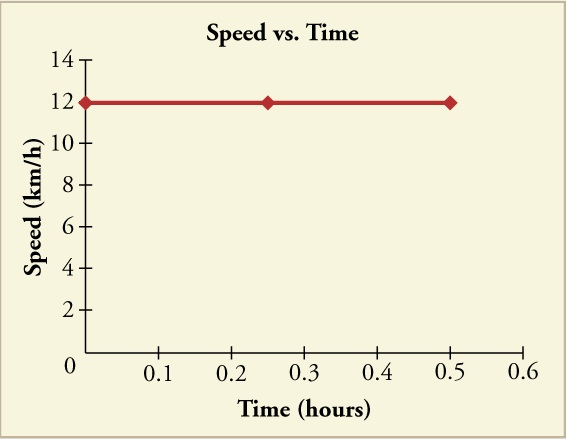
We have noted that distance traveled can be greater than displacement. So average speed can be greater than average velocity, which is displacement divided by time. For example, if you drive to a store and return home in half an hour, and your car’s odometer shows the total distance traveled was 6 km, then your average speed was 12 km/h. Your average velocity, however, was zero, because your displacement for the round trip is zero. (Displacement is change in position and, thus, is zero for a round trip.) Thus average speed is not simply the magnitude of average velocity. Figure \(\PageIndex{2}\)
Another way of visualizing the motion of an object is to use a graph. A plot of position or of velocity as a function of time can be very useful. For example, for this trip to the store, the position, velocity, and speed-vs.-time. (Note that these graphs depict a very simplified model of the trip. We are assuming that speed is constant during the trip, which is unrealistic given that we’ll probably stop at the store. But for simplicity’s sake, we will model it with no stops or changes in speed. We are also assuming that the route between the store and the house is a perfectly straight line.)
Velocity
Your notion of velocity is probably the same as its scientific definition. You know that if you have a large displacement in a small amount of time you have a large velocity, and that velocity has units of distance divided by time, such as miles per hour or kilometers per hour. Figure \(\PageIndex{3}\)
Definition: AVERAGE VELOCITY
Average velocity is displacement (change in position) divided by the time of travel,
where\(\bar{v}\) is the average(indicated by the bar over the v) velocity, is the change in position (or displacement), and \(x_{\mathrm{f}}\) and \(x_{\mathrm{0}}\) are the final and beginning positions at times \(t_{\mathrm{f}}\) and \(t_{\mathrm{0}}\), respectively.
Notice that this definition indicates that velocity is a vector because displacement is a vector. It has both magnitude and direction. The SI unit for velocity is meters per second or m/s, but many other units, such as km/h, mi/h (also written as mph), and cm/s, are in common use. Suppose, for example, an airplane passenger took 5 seconds to move −4 m (the negative sign indicates that displacement is toward the back of the plane). His average velocity would be
The minus sign indicates the average velocity is also toward the rear of the plane.
The average velocity of an object does not tell us anything about what happens to it between the starting point and ending point, however. For example, we cannot tell from average velocity whether the airplane passenger stops momentarily or backs up before he goes to the back of the plane. To get more details, we must consider smaller segments of the trip over smaller time intervals.
The smaller the time intervals considered in a motion, the more detailed the information. When we carry this process to its logical conclusion, we are left with an infinitesimally small interval. Over such an interval, the average velocity becomes the instantaneous velocity or the velocity at a specific instant. A car’s speedometer, for example, shows the magnitude (but not the direction) of the instantaneous velocity of the car. (Police give tickets based on instantaneous velocity, but when calculating how long it will take to get from one place to another on a road trip, you need to use average velocity.)Instantaneous velocity \(v\)is the average velocity at a specific instant in time (or over an infinitesimally small time interval).

Acceleration
In everyday conversation, to accelerate means to speed up. The accelerator in a car can in fact cause it to speed up. The greater the acceleration, the greater the change in velocity over a given time. The formal definition of acceleration is consistent with these notions, but more inclusive.
Definition: AVERAGE ACCELERATION
Average Acceleration is the rate at which velocity changes,
where \(\bar{a}\) is average acceleration, \(v\) is velocity, and \(t\) is time. (The bar over the \(a\) means average acceleration.) Because acceleration is velocity in m/s divided by time in s, the SI units for acceleration are \(\mathrm{m} / \mathrm{s}^{2}\), meters per second squared or meters per second per second, which literally means by how many meters per second the velocity changes every second.
Recall that velocity is a vector—it has both magnitude and direction. This means that a change in velocity can be a change in magnitude (or speed), but it can also be a change in direction. For example, if a car turns a corner at constant speed, it is accelerating because its direction is changing. The quicker you turn, the greater the acceleration. So there is an acceleration when velocity changes either in magnitude (an increase or decrease in speed) or in direction, or both.
ACCELERATION AS A VECTOR
Acceleration is a vector in the same direction as the change in velocity, v. Since velocity is a vector, it can change either in magnitude or in direction. Acceleration is therefore a change in either speed or direction, or both.Keep in mind that although acceleration is in the direction of the change in velocity, it is not always in the direction of motion. If acceleration is in a direction opposite to the direction of motion, the object slows down.
Centripetal Acceleration
We defined acceleration as a change in velocity, either in its magnitude or in its direction, or both. When an object moves along a circular path, the direction of its velocity changes constantly, so there is always an associated acceleration, even if the speed of the object is constant. You experience this acceleration yourself when you turn a corner in your car. What you notice is a sideways acceleration because you and the car are changing direction. The sharper the curve and the greater your speed, the more noticeable this acceleration will become. In this section we briefly examine the direction and magnitude of that acceleration.
Imagine an object moving in a circular path at constant speed, called uniform circular motion. The direction of the instantaneous velocity is shown at two points along the path. Acceleration is in the direction of the change in velocity, which points directly toward the center of rotation (the center of the circular path). This pointing is shown with the vector diagram in the figure. We call the acceleration of an object moving in uniform circular motion (resulting from a net external force) the centripetal acceleration(\(a_{\mathrm{c}}\)); centripetal means “toward the center” or “center seeking.”
The direction of centripetal acceleration is toward the center of curvature, but what is its magnitude? If we use the geometry shown in Figure \(\PageIndex{1}\) along with some kinematics equations, we can obtain (detailed derivation skipped)
\[a_{\mathrm{c}}=\frac{v^{2}}{r}, \label{Equation1} \]
which is the acceleration of an object in a circle of radius \(r\) at a speed \(v\). Verify for yourself that \(a_{\mathrm{c}}\) has unit of \(\mathrm{m} / \mathrm{s}^{2}\), as expected for acceleration.
We see in Equation \(\eqref{Equation1}\) that centripetal acceleration is greater at high speeds and in sharp curves (smaller radius), as you have noticed when driving a car. But it is a bit surprising that \(a_{\mathrm{c}}\) is proportional to speed squared, implying, for example, that it is four times as hard to take a curve at 100 km/h than at 50 km/h. A sharp corner has a small radius, so that \(a_{\mathrm{c}}\) is greater for tighter turns, as you have probably noticed.
- Centripetal acceleration \(a_{\mathrm{c}}\) is the acceleration experienced while in uniform circular motion. It always points toward the center of rotation. It is perpendicular to the linear velocity \(v\) and has the magnitude
\[a_{\mathrm{c}}=\frac{v^{2}}{r}. \nonumber\]
- The unit of centripetal acceleration is \(\mathrm{m} / \mathrm{s}^{2}\).
Start newton here
Newton
As a young man in college, Newton became interested in natural philosophy, as science was then called. He worked out some of his first ideas on machines and optics during the plague years of 1665 and 1666, when students were sent home from college. Newton, a moody and often difficult man, continued to work on his ideas in private, even inventing new mathematical tools to help him deal with the complexities involved. Eventually, his friend Edmund Halley (profiled in Comets and Asteroids: Debris of the Solar System) prevailed on him to collect and publish the results of his remarkable investigations on motion and gravity. The result was a volume that set out the underlying system of the physical world, Philosophiae Naturalis Principia Mathematica. The Principia, as the book is generally known, was published at Halley’s expense in 1687.
At the very beginning of the Principia, Newton proposes three laws that would govern the motions of all objects:
- Newton’s first law: Every object will continue to be in a state of rest or move at a constant speed in a straight line unless it is compelled to change by an outside force.
- Newton’s second law: The change of motion of a body is proportional to and in the direction of the force acting on it.
- Newton’s third law: For every action there is an equal and opposite reaction (or: the mutual actions of two bodies upon each other are always equal and act in opposite directions).
In the original Latin, the three laws contain only 59 words, but those few words set the stage for modern science. Let us examine them more carefully.
Interpretation of Newton’s Laws
Newton’s first law is a restatement of one of Galileo’s discoveries, called the conservation of momentum. The law states that in the absence of any outside influence, there is a measure of a body’s motion, called its momentum, that remains unchanged. You may have heard the term momentum used in everyday expressions, such as “This bill in Congress has a lot of momentum; it’s going to be hard to stop.”
Newton’s first law is sometimes called the law of inertia, where inertia is the tendency of objects (and legislatures) to keep doing what they are already doing. In other words, a stationary object stays put, and a moving object keeps moving unless some force intervenes.
Let’s define the precise meaning of momentum—it depends on three factors: (1) speed—how fast a body moves (zero if it is stationary), (2) the direction of its motion, and (3) its mass—a measure of the amount of matter in a body, which we will discuss later. Scientists use the term velocity to describe the speed and direction of motion. For example, 20 kilometers per hour due south is velocity, whereas 20 kilometers per hour just by itself is speed. Momentum then can be defined as an object’s mass times its velocity.
It’s not so easy to see this rule in action in the everyday world because of the many forces acting on a body at any one time. One important force is friction, which generally slows things down. If you roll a ball along the sidewalk, it eventually comes to a stop because the sidewalk exerts a rubbing force on the ball. But in the space between the stars, where there is so little matter that friction is insignificant, objects can in fact continue to move (to coast) indefinitely.
The momentum of a body can change only under the action of an outside influence. Newton’s second law expresses force in terms of its ability to change momentum with time. A force (a push or a pull) has both size and direction. When a force is applied to a body, the momentum changes in the direction of the applied force. This means that a force is required to change either the speed or the direction of a body, or both—that is, to start it moving, to speed it up, to slow it down, to stop it, or to change its direction.
As you learned in Observing the Sky: The Birth of Astronomy, the rate of change in an object’s velocity is called acceleration. Newton showed that the acceleration of a body was proportional to the force being applied to it. Suppose that after a long period of reading, you push an astronomy book away from you on a long, smooth table. (We use a smooth table so we can ignore friction.) If you push the book steadily, it will continue to speed up as long as you are pushing it. The harder you push the book, the larger its acceleration will be. How much a force will accelerate an object is also determined by the object’s mass. If you kept pushing a pen with the same force with which you pushed the textbook, the pen—having less mass—would be accelerated to a greater speed.
Newton’s third law is perhaps the most profound of the rules he discovered. Basically, it is a generalization of the first law, but it also gives us a way to define mass. If we consider a system of two or more objects isolated from outside influences, Newton’s first law says that the total momentum of the objects should remain constant. Therefore, any change of momentum within the system must be balanced by another change that is equal and opposite so that the momentum of the entire system is not changed.
This means that forces in nature do not occur alone: we find that in each situation there is always a pair of forces that are equal to and opposite each other. If a force is exerted on an object, it must be exerted by something else, and the object will exert an equal and opposite force back on that something. We can look at a simple example to demonstrate this.
Suppose that a daredevil astronomy student—and avid skateboarder—wants to jump from his second-story dorm window onto his board below (we don’t recommend trying this!). The force pulling him down after jumping (as we will see in the next section) is the force of gravity between him and Earth. Both he and Earth must experience the same total change of momentum because of the influence of these mutual forces. So, both the student and Earth are accelerated by each other’s pull. However, the student does much more of the moving. Because Earth has enormously greater mass, it can experience the same change of momentum by accelerating only a very small amount. Things fall toward Earth all the time, but the acceleration of our planet as a result is far too small to be measured.
A more obvious example of the mutual nature of forces between objects is familiar to all who have batted a baseball. The recoil you feel as you swing your bat shows that the ball exerts a force on it during the impact, just as the bat does on the ball. Similarly, when a rifle you are bracing on your shoulder is discharged, the force pushing the bullet out of the muzzle is equal to the force pushing backward upon the gun and your shoulder.
This is the principle behind jet engines and rockets: the force that discharges the exhaust gases from the rear of the rocket is accompanied by the force that pushes the rocket forward. The exhaust gases need not push against air or Earth; a rocket actually operates best in a vacuum.
Mass in terms of intertia
The property of a body to remain at rest or to remain in motion with constant velocity is called inertia. Newton’s first law is often called the law of inertia. As we know from experience, some objects have more inertia than others. It is obviously more difficult to change the motion of a large boulder than that of a basketball, for example. The inertia of an object is measured by its mass. Roughly speaking, mass is a measure of the amount of “stuff” (or matter) in something. The quantity or amount of matter in an object is determined by the numbers of atoms and molecules of various types it contains. Unlike weight, mass does not vary with location. The mass of an object is the same on Earth, in orbit, or on the surface of the Moon. In practice, it is very difficult to count and identify all of the atoms and molecules in an object, so masses are not often determined in this manner. Operationally, the masses of objects are determined by comparison with the standard kilogram.
Force
Dynamics is the study of the forces that cause objects and systems to move. To understand this, we need a working definition of force. Our intuitive definition of force—that is, a push or a pull—is a good place to start. We know that a push or pull has both magnitude and direction (therefore, it is a vector quantity) and can vary considerably in each regard. For example, a cannon exerts a strong force on a cannonball that is launched into the air. In contrast, Earth exerts only a tiny downward pull on a flea.
Dynamics is the study of the forces that cause objects and systems to move. To understand this, we need a working definition of force. Our intuitive definition of force—that is, a push or a pull—is a good place to start. We know that a push or pull has both magnitude and direction (therefore, it is a vector quantity) and can vary considerably in each regard. For example, a cannon exerts a strong force on a cannonball that is launched into the air. In contrast, Earth exerts only a tiny downward pull on a flea.
A more quantitative definition of force can be based on some standard force, just as distance is measured in units relative to a standard distance. One possibility is to stretch a spring a certain fixed distance, and use the force it exerts to pull itself back to its relaxed shape—called a restoring force—as a standard. The magnitude of all other forces can be stated as multiples of this standard unit of force. Many other possibilities exist for standard forces. Some alternative definitions of force will be given later in this chapter.
Newton’s Law of Motion
Experience suggests that an object at rest will remain at rest if left alone, and that an object in motion tends to slow down and stop unless some effort is made to keep it moving. What Newton’s first law of motion states, however, is the following:
NEWTON’S FIRST LAW OF MOTION
A body at rest remains at rest, or, if in motion, remains in motion at a constant velocity unless acted on by a net external force.
Note the repeated use of the verb “remains.” We can think of this law as preserving the status quo of motion.
Rather than contradicting our experience,Newton’s first law of motion states that there must be a cause (which is a net external force) for there to be any change in velocity (either a change in magnitude or direction). We will define net external force in the next section. An object sliding across a table or floor slows down due to the net force of friction acting on the object. If friction disappeared, would the object still slow down?
The idea of cause and effect is crucial in accurately describing what happens in various situations. For example, consider what happens to an object sliding along a rough horizontal surface. The object quickly grinds to a halt. If we spray the surface with talcum powder to make the surface smoother, the object slides farther. If we make the surface even smoother by rubbing lubricating oil on it, the object slides farther yet. Extrapolating to a frictionless surface, we can imagine the object sliding in a straight line indefinitely. Friction is thus the cause of the slowing (consistent with Newton’s first law). The object would not slow down at all if friction were completely eliminated. Consider an air hockey table. When the air is turned off, the puck slides only a short distance before friction slows it to a stop. However, when the air is turned on, it creates a nearly frictionless surface, and the puck glides long distances without slowing down. Additionally, if we know enough about the friction, we can accurately predict how quickly the object will slow down. Friction is an external force.
Newton’s first law is completely general and can be applied to anything from an object sliding on a table to a satellite in orbit to blood pumped from the heart. Experiments have thoroughly verified that any change in velocity (speed or direction) must be caused by an external force. The idea of generally applicable or universal laws is important not only here—it is a basic feature of all laws of physics. Identifying these laws is like recognizing patterns in nature from which further patterns can be discovered. The genius of Galileo, who first developed the idea for the first law, and Newton, who clarified it, was to ask the fundamental question, “What is the cause?” Thinking in terms of cause and effect is a worldview fundamentally different from the typical ancient Greek approach when questions such as “Why does a tiger have stripes?” would have been answered in Aristotelian fashion, “That is the nature of the beast.” True perhaps, but not a useful insight.
In Isaac Newton's book, Philosophiae Naturalis Principia Mathematica (1687), he proposed three laws that would govern the motions of all objects:
- Newton’s first law: Every object will continue to be in a state of rest or move at a constant speed in a straight line unless it is compelled to change by an outside force.
- Newton’s second law: The change of motion of a body is proportional to and in the direction of the force acting on it.
- Newton’s third law: For every action there is an equal and opposite reaction (or: the mutual actions of two bodies upon each other are always equal and act in opposite directions).
Newton’s First Law of Motion
An object remains at rest or in motion at a constant velocity unless acted upon by an outside force. A force is any influence that can change the speed or direction of motion of an object.
Newton’s Second Law of Motion
First, what do we mean by a change in motion? The answer is that a change in motion is equivalent to a change in velocity. A change in velocity means, by definition, that there is an acceleration. Newton’s first law says that a net external force causes a change in motion; thus, we see that a net external force causes acceleration.
The acceleration of a system is directly proportional to and in the same direction as the net external force acting on the system, and inversely proportional to its mass.
In equation form, Newton’s second law of motion is
\[\boldsymbol{a}=\frac{\boldsymbol{F}_{\text {net }}}{m} \nonumber \]
This is often written in the more familiar form
\[\boldsymbol{F}_{\text {net }}=m \boldsymbol{a}, \nonumber \]
with the vector notation indicating that the net external force is in the same direction as acceleration. When only the magnitude of force and acceleration are considered, this equation is simply (note the lack of vector notations)
\[F_{\text {net }}=m a . \nonumber \]
The relationship between acceleration of an object, force placed on the object, and the object’s mass.
Newton’s Second Law of Motion is stated as:
F = ma
Where:
- F is force
- m is the mass
- a is acceleration
Units in the Metric System:
- Mass is kilograms, kg
- Acceleration is meters per second squared; m/s 2
- f = kg-m/s 2 = Newton (N)
An object’s weight is the force with which the object is attracted by a body’s gravitational pull.
F = ma w = mg
Where:
- w is the object’s weight
- m is the mass
- g is acceleration due to gravity, 9. 8 m/s 2 (metric system) or 32 ft/s 2 (English system)
Units of Force
\(F_{\text {net }}=m a\) is used to define the units of force in terms of the three basic units for mass, length, and time. The SI unit of force is called the newton (abbreviated N) and 1 N is the force needed to accelerate a system of mass 1 kg at the rate of \(1 \mathrm{~m} / \mathrm{s}^{2}\). Putting these together,
\[1 \mathrm{~N}=1 \mathrm{~kg} \cdot \mathrm{m} / \mathrm{s}^{2}. \nonumber \]
While almost the entire world uses the newton for the unit of force, in the United States the most familiar unit of force is the pound (lb), where 1 N = 0.225 lb.
Newton’s Third Law of Motion
Define Momentum
Equations for momentum mention collissions Because of Newton's third law, when two objects in a system interact with each other, it does not change the total momentum of the system. In the absence of an external force (that is, force due to an object outside of the system, so that we can ignore the impulse due to the reaction force), the total momentum of the system is constant, or conserved. We call this the conservation of momentum principle.
When one object exerts a force on a second object, the second object exerts an equal force in the opposite direction on the first object. This is sometimes called the Action–Reaction Law. Examples include a rocket “blasting off” (action is force of the combustion/flame, reaction is the rocket moving in the opposite direction of the flame) and a book pushing against a table (a force); the table pushes back (opposite and equal force).
Whenever one body exerts a force on another—the first also experiences a force (equal in magnitude and opposite in direction). Numerous common experiences, such as stubbing a toe or throwing a ball, confirm this. It is precisely stated in Newton’s third law of motion.
NEWTON’S THIRD LAW OF MOTION
Whenever one body exerts a force on a second body, the first body experiences a force by the second body that is equal in magnitude and opposite in direction to the force that it itself exerts. This law represents a certain symmetry in nature: Forces always occur in pairs, and one body cannot exert a force on another without experiencing a force itself. We sometimes refer to this law loosely as “action-reaction,” where the force exerted is the action and the force experienced as a consequence is the reaction. Newton’s third law has practical uses in analyzing the origin of forces and understanding which forces are external to a system.
We can readily see Newton’s third law at work by taking a look at how people move about. Consider a swimmer pushing off from the side of a pool. She pushes against the pool wall with her feet and accelerates in the direction opposite to that of her push. The wall has exerted an equal and opposite force back on the swimmer. You might think that two equal and opposite forces would cancel, but they do not because they act on different bodies. In this case, there are two bodies to consider: the swimmer and the wall. If we define the swimmer as the system of interest, as in the figure, then \(\boldsymbol{F}_{\text {wall on feet }}\) is an external force on this system and affects its motion. The swimmer moves in the direction of \(\boldsymbol{F}_{\text {wall on feet }}\). In contrast, the force \(\boldsymbol{F}_{\text {feet on wall }}\) acts on the wall and not on our system of interest. Thus \(\boldsymbol{F}_{\text {feet on wall }}\) does not affect the motion of the system and does not counteract \(\boldsymbol{F}_{\text {wall on feet }}\). Note that the swimmer pushes the wall in the direction opposite to that in which she wishes to move. The reaction force by the wall on her pushes her in the desired direction.
Other examples of Newton’s third law are easy to find. As a professor paces in front of a whiteboard, she exerts a force backward on the floor. The floor exerts a reaction force forward on the professor that causes her to accelerate forward. Similarly, a car accelerates because the ground pushes forward on the drive wheels in reaction to the drive wheels pushing backward on the ground. You can see evidence of the wheels pushing backward when tires spin on a gravel road and throw rocks backward. In another example, rockets move forward by expelling gas backward at high velocity. This means the rocket exerts a large backward force on the gas in the rocket combustion chamber, and the gas therefore exerts a large reaction force forward on the rocket. This reaction force is called thrust. It is a common misconception that rockets propel themselves by pushing on the ground or on the air behind them. The rockets propel themselves by pushing their own exhaust gases, and that is how they work even in a vacuum. Helicopters create lift by pushing air down, thereby experiencing an upward reaction force. Birds and airplanes also fly by exerting force on air in a direction opposite to that of whatever force they need. For example, the wings of a bird force air downward and backward in order to get lift and move forward. An octopus propels itself in the water by ejecting water through a funnel from its body, similar to a jet ski. In a situation similar to Sancho’s, professional cage fighters experience reaction forces when they punch, sometimes breaking their hand by hitting an opponent’s body.
The phrases "action" and "reaction" in reference to the pair of forces described by Newton's third law often leads to unfortunate misunderstandings regarding the nature of the reaction force. Because of the common English usage of the word "reaction" (root word: react)—for example, in film, "reaction shot" means a shot of actors' faces as they react to an event that just happened—many students intuitively guess that there is a cause-and-effect relationship between "action force" and "reaction force."
There is no such relationship. Newton's third law describes symmetry in forces. Action force and reaction force are symmetric—they occur simultaneously; they are two sides of one and the same interaction. Action force does not cause reaction force, no more than the head of a coin causes the tail of the coin (they merely occur together, always). Here's a quick check to see if you understood the pairing of action force and reaction force correctly: try swapping the labels. That is, if you originally called A "action force" and B "reaction force", try calling B "action force" and A "reaction force." Does this re-labeling make some sense? If not, chances are, you have mis-identified the pair of action force and reaction force. (Here, a little weirdness is O.K., but if it feels like complete nonsense to swap the labels—like reversal of a cause-and-effect relationship—that tells you you used "reaction" in the common English usage, not how the word is used in Newton's third law.)
Angular Momentum
A concept that is a bit more complex, but important for understanding many astronomical objects, is angular momentum, which is a measure of the rotation of a body as it revolves around some fixed point (an example is a planet orbiting the Sun). The angular momentum of an object is defined as the product of its mass, its velocity, and its distance from the fixed point around which it revolves.
If these three quantities remain constant—that is, if the motion of a particular object takes place at a constant velocity at a fixed distance from the spin center—then the angular momentum is also a constant. Kepler’s second law is a consequence of the conservation of angular momentum. As a planet approaches the Sun on its elliptical orbit and the distance to the spin center decreases, the planet speeds up to conserve the angular momentum. Similarly, when the planet is farther from the Sun, it moves more slowly.
The conservation of angular momentum is illustrated by figure skaters, who bring their arms and legs in to spin more rapidly, and extend their arms and legs to slow down (Figure 3.8). You can duplicate this yourself on a well-oiled swivel stool by starting yourself spinning slowly with your arms extended and then pulling your arms in. Another example of the conservation of angular momentum is a shrinking cloud of dust or a star collapsing on itself (both are situations that you will learn about as you read on). As material moves to a lesser distance from the spin center, the speed of the material increases to conserve angular momentum.
Why does Earth keep on spinning? What started it spinning to begin with? And how does an ice skater manage to spin faster and faster simply by pulling her arms in? Why does she not have to exert a torque to spin faster? Questions like these have answers based in angular momentum, the rotational analog to linear momentum.
By now the pattern is clear—every rotational phenomenon has a direct translational analog. It seems quite reasonable, then, to define angular momentum \(L\) as
\[L=I \omega. \nonumber \]
This equation is an analog to the definition of linear momentum as \(p=m v\). Units for linear momentum are \(\mathrm{kg} \cdot \mathrm{m} / \mathrm{s}\) while units for angular momentum are \(\mathrm{kg} \cdot \mathrm{m}^{2} / \mathrm{s}\). As we would expect, an object that has a large moment of inertia \(I\), such as Earth, has a very large angular momentum. An object that has a large angular velocity \(\omega\), such as a centrifuge, also has a rather large angular momentum.
Conservation of Angular Momentum
We can now understand why Earth keeps on spinning. As we saw in the previous example, \(\Delta L=(\operatorname{net} \tau) \Delta t\). This equation means that, to change angular momentum, a torque must act over some period of time. Because Earth has a large angular momentum, a large torque acting over a long time is needed to change its rate of spin. So what external torques are there? Tidal friction exerts torque that is slowing Earth’s rotation, but tens of millions of years must pass before the change is very significant. Recent research indicates the length of the day was 18 h some 900 million years ago. Only the tides exert significant retarding torques on Earth, and so it will continue to spin, although ever more slowly, for many billions of years.
What we have here is, in fact, another conservation law. If the net torque is zero, then angular momentum is constant or conserved. We can see this rigorously by considering \(\text { net } \tau=\frac{\Delta L}{\Delta t}\) for the situation in which the net torque is zero. In that case,
\[\operatorname{net} \tau=0 \nonumber \]
implying that
\[\frac{\Delta L}{\Delta t}=0. \nonumber \]
If the change in angular momentum \(\Delta L\) is zero, then the angular momentum is constant; thus,
\[L=\text { constant }(\text { net } \tau=0) \nonumber \]
or
\[L=L^{\prime}(\operatorname{net} \tau=0) . \nonumber \]
These expressions are the law of conservation of angular momentum. Conservation laws are as scarce as they are important.
An example of conservation of angular momentum is seen in in which an ice skater is executing a spin. The net torque on her is very close to zero, because there is relatively little friction between her skates and the ice and because the friction is exerted very close to the pivot point. (Both \(F\) and \(R\) are small, and so \(\tau\) is negligibly small.) Consequently, she can spin for quite some time. She can do something else, too. She can increase her rate of spin by pulling her arms and legs in. Why does pulling her arms and legs in increase her rate of spin? The answer is that her angular momentum is constant, so that
\[L=L^{\prime}. \nonumber \]
Expressing this equation in terms of the moment of inertia,
\[I \omega=I^{\prime} \omega^{\prime}, \nonumber \]
where the primed quantities refer to conditions after she has pulled in her arms and reduced her moment of inertia. Because \(I^{\prime}\) is smaller, the angular velocity \(\omega^{\prime}\) must increase to keep the angular momentum constant. The change can be dramatic, as the following example shows.
Newton’s Law of Universal Gravitation
Every object in the Universe attracts every other object with a force proportional to both of their masses and inversely proportional to the square of the distance between them.
The gravitational force is relatively simple. It is always attractive, and it depends only on the masses involved and the distance between them. Stated in modern language, Newton’s universal law of gravitation states that every particle in the universe attracts every other particle with a force along a line joining them. The force is directly proportional to the product of their masses and inversely proportional to the square of the distance between them.
The relationship is stated as:
Where:
- F is the Gravitational force
- G is the Gravitational Constant; 6. 67 x 10-11 N-m 2 /kg 2
- m1 is the first object’s mass
- m2 is the second object’s mass
- R is the distance between the two objects
This is often called an Inverse Square Relationship, where the greater the distance between the two objects, the smaller the force between these two objects – squared. If the first distance was 1 meter and the second distance was two meters, the variation in the force would be ¼ at the second distance.
Newton’s first law is a restatement of one of Galileo’s discoveries, called the conservation of momentum. The law states that in the absence of any outside influence, there is a measure of a body’s motion, called its momentum, that remains unchanged. You may have heard the term momentum used in everyday expressions, such as “This bill in Congress has a lot of momentum; it’s going to be hard to stop.”
Newton’s first law is sometimes called the law of inertia, where inertia is the tendency of objects (and legislatures) to keep doing what they are already doing. In other words, a stationary object stays put, and a moving object keeps moving unless some force intervenes.
Let’s define the precise meaning of momentum—which depends on three factors: (1) speed—how fast a body moves (zero if it is stationary), (2) the direction of its motion, and (3) its mass—a measure of the amount of matter in a body, which we will discuss later. Scientists use the term velocity to describe the speed and direction of motion. For example, 20 kilometers per hour due south is velocity, whereas 20 kilometers per hour just by itself is speed. Momentum then can be defined as an object’s mass times its velocity.
It’s not so easy to see this rule in action in the everyday world because of the many forces acting on a body at any one time. One important force is friction, which generally slows things down. If you roll a ball along the sidewalk, it eventually comes to a stop because the sidewalk exerts a rubbing force on the ball. But in the space between the stars, where there is so little matter that friction is insignificant, objects can in fact continue to move (to coast) indefinitely.
The momentum of a body can change only under the action of an outside influence. Newton’s second law expresses force in terms of its ability to change momentum with time. A force (a push or a pull) has both size and direction. When a force is applied to a body, the momentum changes in the direction of the applied force. This means that a force is required to change either the speed or the direction of a body, or both. That is, a force is needed to start it moving, speed it up, slow it down, stop it, or change its direction.
As you learned in Observing the Sky: The Birth of Astronomy, the rate of change in an object’s velocity is called acceleration. Newton showed that the acceleration of a body was proportional to the force being applied to it. Suppose that after a long period of reading, you push an astronomy book away from you on a long, smooth table. (We use a smooth table so we can ignore friction.) If you push the book steadily, it will continue to speed up as long as you are pushing it. The harder you push the book, the larger its acceleration will be. How much a force will accelerate an object is also determined by the object’s mass. If you pushed a pen with the same force as you pushed the textbook, the pen—having less mass—would be accelerated to a greater speed.
Newton’s third law is perhaps the most profound of the rules he discovered. Basically, it is a generalization of the first law, but it also provides a way to define mass. If we consider a system of two or more objects isolated from outside influences, Newton’s first law says that the total momentum of the objects should remain constant. Therefore, any change of momentum within the system must be balanced by another change that is equal and opposite so that the momentum of the entire system is not changed.
This means that forces in nature do not occur alone: we find that in each situation there is always a pair of forces that are equal to and opposite each other. If a force is exerted on an object, it must be exerted by something else, and the object will exert an equal and opposite force back on that something. We can look at a simple example to demonstrate this.
Suppose that a daredevil astronomy student—and avid skateboarder—wants to jump from his second-story dorm window onto his board below (we don’t recommend trying this!). The force pulling him down after jumping (as we will see in the next section) is the force of gravity between him and Earth. Both he and Earth must experience the same total change of momentum because of the influence of these mutual forces. So, both the student and Earth are accelerated by each other’s pull. However, the student does much more of the moving. Because Earth has enormously greater mass, it can experience the same change of momentum by accelerating only a very small amount. Things fall toward Earth all the time, but the acceleration of our planet as a result is far too small to be measured.
A more obvious example of the mutual nature of forces between objects is familiar to all who have batted a baseball. The recoil you feel as you swing your bat shows that the ball exerts a force on it during the impact, just as the bat does on the ball. Similarly, when a rifle you are bracing on your shoulder is discharged, the force pushing the bullet out of the muzzle is equal to the force pushing backward upon the gun and your shoulder.
This is the principle behind jet engines and rockets: the force that discharges the exhaust gases from the rear of the rocket is accompanied by the force that pushes the rocket forward. The exhaust gases need not push against air or Earth; a rocket actually operates best in a vacuum.
Gravity
The bodies we are dealing with tend to be large. To simplify the situation we assume that the body acts as if its entire mass is concentrated at one specific point called the center of mass (CM). For two bodies having masses \(m\) and \(M\) with a distance \(r\) between their centers of mass, the equation for Newton’s universal law of gravitation is
\[F=G \frac{m M}{r^{2}}, \nonumber \]
where \(F\) is the magnitude of the gravitational force and \(G\) is a proportionality factor called the gravitational constant. \(G\) is a universal gravitational constant—that is, it is thought to be the same everywhere in the universe. It has been measured experimentally to be
\[G=6.673 \times 10^{-11} \frac{\mathrm{N} \cdot \mathrm{m}^{2}}{\mathrm{~kg}^{2}} \nonumber \]
in SI units. Note that the units of \(G\) are such that a force in newtons is obtained from \(F=G \frac{m M}{r^{2}}\), when considering masses in kilograms and distance in meters. For example, two 1.000 kg masses separated by 1.000 m will experience a gravitational attraction of \(6.673 \times 10^{-11} \mathrm{~N}\). This is an extraordinarily small force. The small magnitude of the gravitational force is consistent with everyday experience. We are unaware that even large objects like mountains exert gravitational forces on us. In fact, our body weight is the force of attraction of the entire Earth on us with a mass of \(5.98 \times 10^{24} \mathrm{~kg}\).
Recall that the acceleration due to gravity \(g\) is about \(9.80 \mathrm{~m} / \mathrm{s}^{2}\) on Earth. We can now determine why this is so. The weight of an object mg is the gravitational force between it and Earth. Substituting mg for \(F\) in Newton’s universal law of gravitation gives
\[m g=G \frac{m M}{r^{2}}, \nonumber \]
where \(M\) is the mass of the object, \(M\) is the mass of Earth, and \(r\) is the distance to the center of Earth (the distance between the centers of mass of the object and Earth). . The mass \(M\) of the object cancels, leaving an equation for \(g\):
\[g=G \frac{M}{r^{2}}. \nonumber \]
Substituting known values for Earth’s mass and radius (to three significant figures),
\[g=\left(6.67 \times 10^{-11} \frac{\mathrm{N} \cdot \mathrm{m}^{2}}{\mathrm{~kg}^{2}}\right) \times \frac{5.98 \times 10^{24} \mathrm{~kg}}{\left(6.38 \times 10^{6} \mathrm{~m}\right)^{2}}, \nonumber\]
and we obtain a value for the acceleration of a falling body:
\[g=9.80 \mathrm{~m} / \mathrm{s}^{2}. \nonumber \]
The most remarkable and unexpected fact about falling objects is that, if air resistance and friction are negligible, then in a given location all objects fall toward the center of Earth with the same constant acceleration, independent of their mass. This experimentally determined fact is unexpected, because we are so accustomed to the effects of air resistance and friction that we expect light objects to fall slower than heavy ones.
In the real world, air resistance can cause a lighter object to fall slower than a heavier object of the same size. A tennis ball will reach the ground after a hard baseball dropped at the same time. (It might be difficult to observe the difference if the height is not large.) Air resistance opposes the motion of an object through the air, while friction between objects—such as between clothes and a laundry chute or between a stone and a pool into which it is dropped—also opposes motion between them. For the ideal situations of these first few chapters, an object falling without air resistance or friction is defined to be in free-fall.
The force of gravity causes objects to fall toward the center of Earth. The acceleration of free-falling objects is therefore called the acceleration due to gravity. The acceleration due to gravity is constant, which means we can apply the kinematics equations to any falling object where air resistance and friction are negligible. This opens a broad class of interesting situations to us. The acceleration due to gravity is so important that its magnitude is given its own symbol, \(g\). It is constant at any given location on Earth and has the average value
\[g=9.80 \mathrm{~m} / \mathrm{s}^{2}. \nonumber \]
Although \(g\) varies from \(9.78 \mathrm{~m} / \mathrm{s}^{2}\) to \(9.83 \mathrm{~m} / \mathrm{s}^{2}\), depending on latitude, altitude, underlying geological formations, and local topography, the average value of \(9.80 \mathrm{~m} / \mathrm{s}^{2}\) will be used in this text unless otherwise specified. The direction of the acceleration due to gravity is downward (towards the center of Earth). In fact, its direction defines what we call vertical. Note that whether the acceleration \(a\) in the kinematic equations has the value \(+g\) or \(−g\) depends on how we define our coordinate system. If we define the upward direction as positive, then \(a=-g=-9.80 \mathrm{~m} / \mathrm{s}^{2}\), and if we define the downward direction as positive, then \(a=g=9.80 \mathrm{~m} / \mathrm{s}^{2}\). In certain examples and homework exercises, slightly inaccurate but more convenient value of \(g \simeq 10 \mathrm{~m} / \mathrm{s}^{2}\) will be used with appropriate specifications.
Newton’s laws of motion show that objects at rest will stay at rest and those in motion will continue moving uniformly in a straight line unless acted upon by a force. Thus, it is the straight line that defines the most natural state of motion. But the planets move in ellipses, not straight lines; therefore, some force must be bending their paths. That force, Newton proposed, was gravity.
In Newton’s time, gravity was something associated with Earth alone. Everyday experience shows us that Earth exerts a gravitational force upon objects, which we perceive as its surface. If you drop something, it accelerates toward Earth's surface as it falls. Newton’s insight was that Earth’s gravity might extend as far as the Moon and produce the force required to curve the Moon’s path from a straight line and keep it in Earth's orbit. He further hypothesized that gravity is not limited to Earth, but that there is a general force of attraction between all material bodies. If so, the attractive force between the Sun and each of the planets could keep them in their orbits. (This may seem part of our everyday thinking today, but it was a remarkable insight in Newton’s time.)
Once Newton boldly hypothesized that there was a universal attraction among all bodies everywhere in space, he had to determine the exact nature of the attraction. The precise mathematical description of that gravitational force had to dictate that the planets move exactly as Kepler had described them to (as expressed in Kepler’s three laws). Also, that gravitational force had to predict the correct behavior of falling bodies on Earth, as observed by Galileo. How must the force of gravity depend on distance in order for these conditions to be met?
The answer to this question required mathematical tools that had not yet been developed, but this did not deter Isaac Newton, who invented what we today call calculus to deal with this problem. Eventually he was able to conclude that the magnitude of the force of gravity must decrease with increasing distance between the Sun and a planet (or between any two objects) in proportion to the inverse square of their separation. In other words, if a planet were twice as far from the Sun, the force would be , or as large. Put the planet three times farther away, and the force is , or as large.
Newton also concluded that the gravitational attraction between two bodies must be proportional to their masses. The more mass an object has, the stronger the pull of its gravitational force. The gravitational attraction between any two objects is therefore given by one of the most famous equations in all of science:
where Fgravity is the gravitational force between two objects, M1 and M2 are the masses of the two objects, and R is their separation. G is a constant number known as the universal gravitational constant, and the equation itself symbolically summarizes Newton’s universal law of gravitation. With such a force and the laws of motion, Newton was able to show mathematically that the only orbits permitted were exactly those described by Kepler’s laws.
Newton’s universal law of gravitation works for the planets, but is it really universal? The gravitational theory should also predict the observed acceleration of the Moon toward Earth as it orbits Earth, as well as of any object (say, an apple) dropped near Earth’s surface. The falling of an apple is something we can measure quite easily, but can we use it to predict the motions of the Moon, for example?
Recall that according to Newton’s second law, forces cause acceleration. Newton’s universal law of gravitation says that the force acting upon (and therefore the acceleration of) an object toward Earth should be inversely proportional to the square of its distance from the center of Earth. Objects like apples at the surface of Earth, at a distance of one Earth-radius from the center of Earth, are observed to accelerate downward at 9.8 meters per second per second .
Weight and the Gravitational Force
When an object is dropped, it accelerates toward the center of Earth. Newton’s second law states that a net force on an object is responsible for its acceleration. If air resistance is negligible, the net force on a falling object is the gravitational force, commonly called its weight, \(w\). Weight can be denoted as a vector \(w\) because it has a direction; down is, by definition, the direction of gravity, so \(w\) is directed downward. The magnitude of weight is denoted as \(w\). Galileo was instrumental in showing that, in the absence of air resistance, all objects fall with the same acceleration \(g\). Using Galileo’s result and Newton’s second law, we can derive an equation for the magnitude of weight.
Consider an object with mass \(m\) falling downward toward Earth. It experiences only the downward force of gravity, which has magnitude \(w\). Newton’s second law states that the magnitude of the net external force on an object is \(F_{\text {net }}=m a \).
Since the object experiences only the downward force of gravity, \(F_{\text {net }}=w\). We know that the acceleration of an object due to gravity is \(g\), or \(a=g\). Substituting these into Newton’s second law gives
Definition: WEIGHT
This is the equation for weight—the gravitational force on a mass \(m\):
\[w=m g. \nonumber \]
Since \(g=9.80 \mathrm{~m} / \mathrm{s}^{2}\) on Earth, the weight of a 1.0 kg object on Earth is 9.8 N, as we see:
\[w=m g=(1.0 \mathrm{~kg})\left(9.80 \mathrm{~m} / \mathrm{s}^{2}\right)=9.8 \mathrm{~N}. \nonumber \]
When the net external force on an object is its weight, we say that it is in free-fall. That is, the only force acting on the object is the force of gravity. In the real world, when objects fall downward toward Earth, they are never truly in free-fall because there is always some upward force from the air acting on the object.
The acceleration due to gravity \(g\) varies slightly over the surface of Earth, so that the weight of an object depends on location and is not an intrinsic property of the object. Weight varies dramatically if one leaves Earth. On the Moon, for example, the acceleration due to gravity is only \(1.67 \mathrm{~m} / \mathrm{s}^{2}\). A 1.0-kg mass thus has a weight of 9.8 N on Earth and only about 1.7 N on the Moon.
The broadest definition of weight in this sense is that the weight of an object is the gravitational force on it from the nearest large body, such as Earth, the Moon, the Sun, and so on. This is the most common and useful definition of weight in physics. It differs dramatically, however, from the definition of weight used by NASA and the popular media in relation to space travel and exploration. When they speak of “weightlessness” and “microgravity,” they are really referring to the phenomenon we call “free-fall” in physics. We shall use the above definition of weight, and we will make careful distinctions between free-fall and actual weightlessness.
It is important to be aware that weight and mass are very different physical quantities, although they are closely related. Mass is the quantity of matter (how much “stuff”) and does not vary, whereas weight is the gravitational force and does vary depending on gravity. It is tempting to equate the two, since most of our examples take place on Earth, where the weight of an object only varies a little with the location of the object. Furthermore, the terms mass and weight are used interchangeably in everyday language; for example, our medical records often show our “weight” in kilograms, but never in the correct units of newtons.
COMMON MISCONCEPTIONS: MASS VS. WEIGHT
Mass and weight are often used interchangeably in everyday language. However, in science, these terms are distinctly different from one another. Mass is a measure of how much matter is in an object. The typical measure of mass is the kilogram (or the “slug” in English units). Weight, on the other hand, is a measure of the force of gravity acting on an object. Weight is equal to the mass of an object (\(m\)) multiplied by the acceleration due to gravity (\(g\)). Like any other force, weight is measured in terms of newtons (or pounds in English units). This interchangeable use is why you might have heard an expression such as, “1 kilogram is 2.2 pounds.” The correct statement is “1 kilogram mass weighs 2.2 pounds on Earth.”
Assuming the mass of an object is kept intact, it will remain the same, regardless of its location. However, because weight depends on the acceleration due to gravity, the weight of an object can change when the object enters into a region with stronger or weaker gravity. For example, the acceleration due to gravity on the Moon is \(1.67 \mathrm{~m} / \mathrm{s}^{2}\) (which is much less than the acceleration due to gravity on Earth, \(9.80 \mathrm{~m} / \mathrm{s}^{2}\)). If you measured your weight on Earth and then measured your weight on the Moon, you would find that you “weigh” much less, even though you do not look any skinnier. This is because the force of gravity is weaker on the Moon. In fact, when people say that they are “losing weight,” they really mean that they are losing “mass” (which in turn causes them to weigh less).
It is this force of gravity on the surface of Earth that gives us our sense of weight. Unlike your mass, which would remain the same on any planet or moon, your weight depends on the local force of gravity. So you would weigh less on Mars and the Moon than on Earth, even though there is no change in your mass. (Which means you would still have to go easy on the desserts in the college cafeteria when you got back!)
The Moon is 60 Earth radii away from the center of Earth. If gravity (and the acceleration it causes) gets weaker with distance squared, the acceleration the Moon experiences should be a lot less than for the apple. The acceleration should be (or 3600 times less—about ). This is precisely the observed acceleration of the Moon in its orbit. (As we shall see, the Moon does not fall to Earth with this acceleration, but falls around Earth.) Imagine the thrill Newton must have felt to realize he had discovered, and verified, a law that holds for Earth, apples, the Moon, and, as far as he knew, everything in the universe.
Gravity is a “built-in” property of mass. Whenever there are masses in the universe, they will interact via the force of gravitational attraction. The more mass there is, the greater the force of attraction. Here on Earth, the largest concentration of mass is, of course, the planet we stand on, and its pull dominates the gravitational interactions we experience. But everything with mass attracts everything else with mass anywhere in the universe.
Newton’s law also implies that gravity never becomes zero. It quickly gets weaker with distance, but it continues to act to some degree no matter how far away you get. The pull of the Sun is stronger at Mercury than at Pluto, but it can be felt far beyond Pluto, where astronomers have good evidence that it continuously makes enormous numbers of smaller icy bodies move around huge orbits. And the Sun’s gravitational pull joins with the pull of billions of others stars to create the gravitational pull of our Milky Way Galaxy. That force, in turn, can make other smaller galaxies orbit around the Milky Way, and so on.
Why is it then, you may ask, that the astronauts aboard the Space Shuttle appear to have no gravitational forces acting on them when we see images on television of the astronauts and objects floating in the spacecraft? After all, the astronauts in the shuttle are only a few hundred kilometers above the surface of Earth, which is not a significant distance compared to the size of Earth, so gravity is certainly not a great deal weaker that much farther away. The astronauts feel “weightless” (meaning that they don’t feel the gravitational force acting on them) for the same reason that passengers in an elevator whose cable has broken or in an airplane whose engines no longer work feel weightless: they are falling
When falling, they are in free fall and accelerate at the same rate as everything around them, including their spacecraft or a camera with which they are taking photographs of Earth. When doing so, astronauts experience no additional forces and therefore feel “weightless.” Unlike the falling elevator passengers, however, the astronauts are falling around Earth, not to Earth; as a result they will continue to fall and are said to be “in orbit” around Earth (see the next section for more about orbits).
Recall that the path of an object under the influence of gravity through space is called its orbit, whether that object is a spacecraft, planet, star, or galaxy. An orbit, once determined, allows the future positions of the object to be calculated.Two points in any orbit in our solar system have been given special names. The place where the planet is closest to the Sun (helios in Greek) and moves the fastest is called the perihelion of its orbit, and the place where it is farthest away and moves the most slowly is the aphelion. For the Moon or a satellite orbiting Earth (gee in Greek), the corresponding terms are perigee and apogee. (In this book, we use the word moon for a natural object that goes around a planet and the word satellite to mean a human-made object that revolves around a planet.)Falling objects form an interesting class of motion problems. For example, we can estimate the depth of a vertical mine shaft by dropping a rock into it and listening for the rock to hit the bottom. By applying the kinematics developed so far to falling objects, we can examine some interesting situations and learn much about gravity in the process.
Gravity
The most remarkable and unexpected fact about falling objects is that, if air resistance and friction are negligible, then in a given location all objects fall toward the center of Earth with the same constant acceleration, independent of their mass. This experimentally determined fact is unexpected, because we are so accustomed to the effects of air resistance and friction that we expect light objects to fall slower than heavy ones.
In the real world, air resistance can cause a lighter object to fall slower than a heavier object of the same size. A tennis ball will reach the ground after a hard baseball dropped at the same time. (It might be difficult to observe the difference if the height is not large.) Air resistance opposes the motion of an object through the air, while friction between objects—such as between clothes and a laundry chute or between a stone and a pool into which it is dropped—also opposes motion between them. For the ideal situations of these first few chapters, an object falling without air resistance or friction is defined to be in free-fall.
The force of gravity causes objects to fall toward the center of Earth. The acceleration of free-falling objects is therefore called the acceleration due to gravity. The acceleration due to gravity is constant, which means we can apply the kinematics equations to any falling object where air resistance and friction are negligible. This opens a broad class of interesting situations to us. The acceleration due to gravity is so important that its magnitude is given its own symbol, \(g\). It is constant at any given location on Earth and has the average value
\[g=9.80 \mathrm{~m} / \mathrm{s}^{2}. \nonumber \]
Although \(g\) varies from \(9.78 \mathrm{~m} / \mathrm{s}^{2}\) to \(9.83 \mathrm{~m} / \mathrm{s}^{2}\), depending on latitude, altitude, underlying geological formations, and local topography, the average value of \(9.80 \mathrm{~m} / \mathrm{s}^{2}\) will be used in this text unless otherwise specified. The direction of the acceleration due to gravity is downward (towards the center of Earth). In fact, its direction defines what we call vertical. Note that whether the acceleration \(a\) in the kinematic equations has the value \(+g\) or \(−g\) depends on how we define our coordinate system. If we define the upward direction as positive, then \(a=-g=-9.80 \mathrm{~m} / \mathrm{s}^{2}\), and if we define the downward direction as positive, then \(a=g=9.80 \mathrm{~m} / \mathrm{s}^{2}\). In certain examples and
What is Energy?
Energy is one of the most fundamental and universal concepts of physical science, but one that is remarkably difficult to define in way that is meaningful to most people. This perhaps reflects the fact that energy is not a “thing” that exists by itself, but is rather an attribute of matter (and also of electromagnetic radiation) that can manifest itself in various ways. It can be observed and measured only indirectly through its effects on matter that acquires, loses, or possesses it. Energy can take many forms: mechanical, chemical, electrical, radiation (light), and thermal. You also know that energy is conserved; it can be passed from one object or place to another, but it can never simply disappear.
In the 17th Century, the great mathematician Gottfried Leibniz (1646-1716) suggested the distinction between vis viva ("live energy") and vis mortua ("dead energy"), which later became known as kinetic energy and potential energy. Except for radiant energy that is transmitted through an electromagnetic field, most practical forms of energy we encounter are of two kinds: kinetic and potential.
- Kinetic energy is associated with the motion of an object; a body with a mass, m, and moving at a velocity, v, possesses the kinetic energy \( \frac{1}{2} mv^2\). This "v-squared" part is important; if you double your speed, you consume four times as much fuel (glucose for the runner, gasoline or electricity for your car.
- Potential energy is energy a body has by virtue of its location in a force field— a gravitational, electrical, or magnetic field. For example, if an object of mass m is raised off the floor to a height h, its potential energy increases by mgh, where g is a proportionality constant known as the acceleration of gravity. Similarly, the potential energy of a particle having an electric charge q depends on its location in an electrostatic field.
Kinetic and potential energy are freely interconvertible
Pick up a book and hold it above the table top; you have just increased its potential energy in the force field of the earth's gravity. Now let it drop. Its newly-acquired potential energy begins to re-appear as kinetic energy as it accelerates downward at a velocity increasing by 9.8 m/sec every second (9.8 m sec–2 or 32 ft sec–2). At the instant it strikes the surface, the potential energy you gave supplied to the book has now been entirely converted into kinetic energy.
And what happens to that kinetic energy after the book stops moving? It is still there, but you can no longer see its effect; it has now become dispersed as thermal kinetic energy ("heat") into the molecules of the book, the table top, and, ultimately, into the surroundings, including the air.
The more you think about it, the more examples of kinetic-potential conversion you will find in everyday life. In many other instances, however, the energy of an object can be seen to repeatedly alternate between potential and kinetic forms. Left alone, the process continues indefinitely until friction has dissipated the energy into the surroundings.
Energy's graveyard: Thermal energy
Energy is conserved: it can neither be created nor destroyed. But it can, and eventually always will, disappear from our view and into the microscopic world of individual molecular particles. All molecules are in a continual state of motion, and they therefore possess kinetic energy. But unlike the motion of a massive body such as a baseball or a car that is moving along a defined trajectory, the motions of individual atoms or molecules are random and chaotic, forever changing in magnitude and direction as they collide with each other or (as in the case of a gas) with the walls of the container.
The sum total of all of this microscopic-scale randomized kinetic energy within a body is given a special name, thermal energy. Although we cannot directly see thermal energy in action, we can certainly feel it; as we will see further, it correlates directly with the temperature of an object.
Conservation of Total Energy
Energy, as we have noted, is conserved, making it one of the most important physical quantities in nature. The law of conservation of energy can be stated as follows:
Total energy is constant in any process. It may change in form or be transferred from one system to another, but the total remains the same.
We have explored some forms of energy and some ways it can be transferred from one system to another, in the case of work done by conservative forces transforming between potential energy and kinetic energy. Together, these make up the mechanical energy (KE+PE), and the mechanical energy is not always conserved, because it can be transformed into other forms of energy through work done by non-conservative forces. Here, we list some of the many forms energy can take.
Some of the Many Forms of Energy
Here are some of the many forms of energy. You probably have heard of some of these before; many of these will be covered in later chapters, but let us detail a few here. Electrical energy is a common form that is converted to many other forms and does work in a wide range of practical situations. Fuels, such as gasoline and food, carry chemical energy that can be transferred to a system through oxidation. Chemical fuel can also produce electrical energy, such as in batteries. Batteries can in turn produce light, which is a very pure form of energy. Most energy sources on Earth are in fact stored energy from the energy we receive from the Sun. We sometimes refer to this as radiant energy, or electromagnetic radiation, which includes visible light, infrared, and ultraviolet radiation. Nuclear energy comes from processes that convert measurable amounts of mass into energy. Nuclear energy is transformed into the energy of sunlight, into electrical energy in power plants, and into the energy of the heat transfer and blast in weapons. Atoms and molecules inside all objects are in random motion. This internal mechanical energy from the random motions is called thermal energy, because it is related to the temperature of the object. These and all other forms of energy can be converted into one another and can do work.
Transformation of Energy
The transformation of energy from one form into others is happening all the time. The chemical energy in food is converted into thermal energy through metabolism; light energy is converted into chemical energy through photosynthesis. In a larger example, the chemical energy contained in coal is converted into thermal energy as it burns to turn water into steam in a boiler. This thermal energy in the steam in turn is converted to mechanical energy as it spins a turbine, which is connected to a generator to produce electrical energy. (In all of these examples, not all of the initial energy is converted into the forms mentioned. This important point is discussed later in this section.) example solar cells
Watts
Just a word about the units we are using. A watt (W) is a unit of power, which is energy used or given off per unit time. It is measured in joules per second (J/s). You know from your everyday experience that it is not just how much energy you expend, but how long you take to do it. (Burning 10 Calories in 10 minutes requires a very different kind of exercise than burning those 10 Calories in an hour.) Watts tell you the rate at which energy is being used; for example, a 100-watt bulb uses 100 joules (J) of energy every second.
And how big is a joule? A 73-kilogram (160-pound) astronomy instructor running at about 4.4 meters per second (10 miles per hour) because he is late for class has a motion energy of about 700 joules.
Energy scales are always arbitrary
You might at first think that a book sitting on the table has zero kinetic energy since it is not moving. In truth, however, the earth itself is moving; it is spinning on its axis, it is orbiting the sun, and the sun itself is moving away from the other stars in the general expansion of the universe. Since these motions are normally of no interest to us, we are free to adopt an arbitrary scale in which the velocity of the book is measured with respect to the table; on this so-called laboratory coordinate system, the kinetic energy of the book can be considered zero.
We do the same thing with potential energy. If we define the height of the table top as the zero of potential energy, then an object having a mass \(m\) suspended at a height h above the table top will have a potential energy of mgh. Now let the object fall; as it accelerates in the earth's gravitational field, its potential energy changes into kinetic energy. An instant before it strikes the table top, this transformation is complete and the kinetic energy \(\frac{1}{2}mv^2\) is identical with the original mgh. As the object comes to rest, its kinetic energy appears as heat (in both the object itself and in the table top) as the kinetic energy becomes randomized as thermal energy.
Energy units
Energy is measured in terms of its ability to perform work or to transfer heat. Mechanical work is done when a force f displaces an object by a distance d:
\[W = f\cdot d\]
The basic unit of energy is the joule. One joule is the amount of work done when a force of 1 newton acts over a distance of 1 m; thus 1 J = 1 N-m. One newton is the amount of force required to accelerate a 1 - kg mass by 1 meter per second in one second - 1 m sec–2, so the basic dimensions of the joule are kg m2 s–2. The other two units of energy that are in wide use are the calorie and the BTU (British thermal unit). These are defined in terms of the heating effect on water. For the moment, we will confine our attention to joule and calorie.
Heat and work are both measured in energy units, but they do not constitute energy itself. As we will explain below, they refer to processes by which energy is transferred to or from something— a block of metal, a motor, or a cup of water.
Heat
When a warmer body is brought into contact with a cooler body, thermal energy flows from the warmer one to the cooler until their two temperatures are identical. The warmer body loses a quantity of thermal energy ΔE, and the cooler body acquires the same amount of energy. We describe this process by saying that "ΔE joules of heat has passed from the warmer body to the cooler one." It is important, however, to understand that Heat is the transfer of energy due to a difference in temperature.
Heat does NOT flow
We often refer to a "flow" of heat, recalling the 18th-century notion that heat was an actual substance called “caloric” that could flow like a liquid. This is a misnomer; heat is a process and is not something that can be contained or stored in a body. It is important that you understand this, because the use of the term in our ordinary conversation ("the heat is terrible today") tends to make us forget this distinction.
There are basically three mechanisms by which heat can be transferred: conduction, radiation, and convection. The latter process occurs when the two different temperatures cause different parts of a fluid to have different densities.
Work
Work is the transfer of energy by any process other than heat.
Work, like energy, can take various forms: mechanical, electrical, gravitational, etc. All have in common the fact that they are the product of two factors, an intensity term and a capacity term. For example, the simplest form of mechanical work arises when an object moves a certain distance against an opposing force. Electrical work is done when a body having a certain charge moves through a potential difference.
Performance of work involves a transformation of energy; thus when a book drops to the floor, gravitational work is done (a mass moves through a gravitational potential difference), and the potential energy the book had before it was dropped is converted into kinetic energy which is ultimately dispersed as thermal energy.
Mechanical work is the product of the force exerted on a body and the distance it is moved: 1 N-m = 1 J.
Heat and work are best thought of as processes by which energy is exchanged, rather than as energy itself. That is, heat “exists” only when it is flowing, work “exists” only when it is being done.
When two bodies are placed in thermal contact and energy flows from the warmer body to the cooler one,we call the process “heat”. A transfer of energy to or from a system by any means other than heat is called “work”.
So you can think of heat and work as just different ways of accomplishing the same thing: the transfer of energy from one place or object to another.
To make sure you understand this, suppose you are given two identical containers of water at 25°C. Into one container you place an electrical immersion heater until the water has absorbed 100 joules of heat. The second container you stir vigorously until 100 J of work has been performed on it. At the end, both samples of water will have been warmed to the same temperature and will contain the same increased quantity of thermal energy. There is no way you can tell which contains "more work" or "more heat".
Further Exploration
- For more about Isaac Newton’s life and work, check out this timeline page with snapshots from his career, produced by the British Broadcasting Corporation (BBC).
- You can play with a simple animation demonstrating the relationship between the concepts of density, mass, and volume, and find out why objects like wood float in water. Put in simulation?? move to math and measurements
- You might like to try a simulation that lets you move the Sun, Earth, Moon, and space station to see the effects of changing their distances on their gravitational forces and orbital paths. You can even turn off gravity and see what happens. Move to orbits?
- Force and Motion - Phet sim