

1.5: Waves, particles, rays
- Page ID
- 128440
\( \newcommand{\vecs}[1]{\overset { \scriptstyle \rightharpoonup} {\mathbf{#1}} } \)
\( \newcommand{\vecd}[1]{\overset{-\!-\!\rightharpoonup}{\vphantom{a}\smash {#1}}} \)
\( \newcommand{\dsum}{\displaystyle\sum\limits} \)
\( \newcommand{\dint}{\displaystyle\int\limits} \)
\( \newcommand{\dlim}{\displaystyle\lim\limits} \)
\( \newcommand{\id}{\mathrm{id}}\) \( \newcommand{\Span}{\mathrm{span}}\)
( \newcommand{\kernel}{\mathrm{null}\,}\) \( \newcommand{\range}{\mathrm{range}\,}\)
\( \newcommand{\RealPart}{\mathrm{Re}}\) \( \newcommand{\ImaginaryPart}{\mathrm{Im}}\)
\( \newcommand{\Argument}{\mathrm{Arg}}\) \( \newcommand{\norm}[1]{\| #1 \|}\)
\( \newcommand{\inner}[2]{\langle #1, #2 \rangle}\)
\( \newcommand{\Span}{\mathrm{span}}\)
\( \newcommand{\id}{\mathrm{id}}\)
\( \newcommand{\Span}{\mathrm{span}}\)
\( \newcommand{\kernel}{\mathrm{null}\,}\)
\( \newcommand{\range}{\mathrm{range}\,}\)
\( \newcommand{\RealPart}{\mathrm{Re}}\)
\( \newcommand{\ImaginaryPart}{\mathrm{Im}}\)
\( \newcommand{\Argument}{\mathrm{Arg}}\)
\( \newcommand{\norm}[1]{\| #1 \|}\)
\( \newcommand{\inner}[2]{\langle #1, #2 \rangle}\)
\( \newcommand{\Span}{\mathrm{span}}\) \( \newcommand{\AA}{\unicode[.8,0]{x212B}}\)
\( \newcommand{\vectorA}[1]{\vec{#1}} % arrow\)
\( \newcommand{\vectorAt}[1]{\vec{\text{#1}}} % arrow\)
\( \newcommand{\vectorB}[1]{\overset { \scriptstyle \rightharpoonup} {\mathbf{#1}} } \)
\( \newcommand{\vectorC}[1]{\textbf{#1}} \)
\( \newcommand{\vectorD}[1]{\overrightarrow{#1}} \)
\( \newcommand{\vectorDt}[1]{\overrightarrow{\text{#1}}} \)
\( \newcommand{\vectE}[1]{\overset{-\!-\!\rightharpoonup}{\vphantom{a}\smash{\mathbf {#1}}}} \)
\( \newcommand{\vecs}[1]{\overset { \scriptstyle \rightharpoonup} {\mathbf{#1}} } \)
\(\newcommand{\longvect}{\overrightarrow}\)
\( \newcommand{\vecd}[1]{\overset{-\!-\!\rightharpoonup}{\vphantom{a}\smash {#1}}} \)
\(\newcommand{\ket}[1]{\left| #1 \right>}\)
\(\newcommand{\bra}[1]{\left< #1 \right|}\)
\(\newcommand{\braket}[2]{\left< #1 \vphantom{#2} \right| \left. #2 \vphantom{#1} \right>}\)
\(\newcommand{\braopket}[3]{\left< #1 \vphantom{#2}\vphantom{#3} \right| #2 \vphantom{#1}\vphantom{#3} \left| #3 \vphantom{#1}\vphantom{#2} \right>}\)
\(\newcommand{\qmvec}[1]{\mathbf{\vec{#1}}}\)
\(\newcommand{\op}[1]{\hat{\mathbf{#1}}}\)
\(\newcommand{\expect}[1]{\langle #1 \rangle}\)
\(\newcommand{\dfn}[1]{\emph{\textbf{#1}}}\)
If they are much larger than a wavelength, objects cast clear shadows and we can describe the behaviour of light with ray optics. A ray is an idealised narrow beam of light. In a later chapter, we use geometrical optics to explain lenses, telescopes and microscopes. In contrast, if the wavelength is comparable with or greater than the size of objects, waves diffract around the objects and we can observe interference.
- Long wavelengths diffract around objects,
- Short wavelengths make shadows.
| Links to related material | |
|---|---|
| Why vision? Why vision? Why the importance of the 400 to 700 nm band? Why so little UV and IR vision? Why no bio-radar? How does vision compare with hearing? |
 |
| Colour mixing Additive colour mixing by projection. Additive colour mixing on RGB monitors and phones. Newton's colour wheel. Subtractive primaries and subtractive colour mixing. Details of the experiments from the multimedia chapter. |
|
| Electromagnetic transverse waves The direction of the electric and magnetic fields: transverse or longitudinal. Experiments with UHF radio. Polarised light and polarizing sun glasses. Details of the experiments from the multimedia chapter. |
 |
| Molecules and photons Quantisation of light - and of water! Light and photons. Photon energy depends on wavelength. Black body radiation. |
 |
| Newton's prisms Light and prisms: refaction, dispersion and recombination. |
 |
| Shadows:particles and waves Light shadows and particle shadows: the particle model for light. Wave shadows and their dependence on wavelength. Diffraction and wavelength. Comparison of sound and light. |
 |
| Speed of light A simple measurement of the speed of light by time of flight. Pulsed laser, beam splitter and mirrors, detectors, oscilloscope. Details of the experiment from the multimedia chapter. |
 |
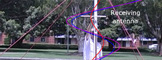
| Speed of Radio Waves Measuring the speed of radio waves using standing waves in UHF. Oscillator, dipole transmitting and receiving antennae, oscilloscope. Reflections from a conductor, standing waves, nodes. Details of the experiment from the multimedia chapter |
 |
|
Young's experiment - water waves and light |
 |
 |
