
2.8.12: Reflecting Newtonian telescope
- Page ID
- 138922
\( \newcommand{\vecs}[1]{\overset { \scriptstyle \rightharpoonup} {\mathbf{#1}} } \)
\( \newcommand{\vecd}[1]{\overset{-\!-\!\rightharpoonup}{\vphantom{a}\smash {#1}}} \)
\( \newcommand{\dsum}{\displaystyle\sum\limits} \)
\( \newcommand{\dint}{\displaystyle\int\limits} \)
\( \newcommand{\dlim}{\displaystyle\lim\limits} \)
\( \newcommand{\id}{\mathrm{id}}\) \( \newcommand{\Span}{\mathrm{span}}\)
( \newcommand{\kernel}{\mathrm{null}\,}\) \( \newcommand{\range}{\mathrm{range}\,}\)
\( \newcommand{\RealPart}{\mathrm{Re}}\) \( \newcommand{\ImaginaryPart}{\mathrm{Im}}\)
\( \newcommand{\Argument}{\mathrm{Arg}}\) \( \newcommand{\norm}[1]{\| #1 \|}\)
\( \newcommand{\inner}[2]{\langle #1, #2 \rangle}\)
\( \newcommand{\Span}{\mathrm{span}}\)
\( \newcommand{\id}{\mathrm{id}}\)
\( \newcommand{\Span}{\mathrm{span}}\)
\( \newcommand{\kernel}{\mathrm{null}\,}\)
\( \newcommand{\range}{\mathrm{range}\,}\)
\( \newcommand{\RealPart}{\mathrm{Re}}\)
\( \newcommand{\ImaginaryPart}{\mathrm{Im}}\)
\( \newcommand{\Argument}{\mathrm{Arg}}\)
\( \newcommand{\norm}[1]{\| #1 \|}\)
\( \newcommand{\inner}[2]{\langle #1, #2 \rangle}\)
\( \newcommand{\Span}{\mathrm{span}}\) \( \newcommand{\AA}{\unicode[.8,0]{x212B}}\)
\( \newcommand{\vectorA}[1]{\vec{#1}} % arrow\)
\( \newcommand{\vectorAt}[1]{\vec{\text{#1}}} % arrow\)
\( \newcommand{\vectorB}[1]{\overset { \scriptstyle \rightharpoonup} {\mathbf{#1}} } \)
\( \newcommand{\vectorC}[1]{\textbf{#1}} \)
\( \newcommand{\vectorD}[1]{\overrightarrow{#1}} \)
\( \newcommand{\vectorDt}[1]{\overrightarrow{\text{#1}}} \)
\( \newcommand{\vectE}[1]{\overset{-\!-\!\rightharpoonup}{\vphantom{a}\smash{\mathbf {#1}}}} \)
\( \newcommand{\vecs}[1]{\overset { \scriptstyle \rightharpoonup} {\mathbf{#1}} } \)
\(\newcommand{\longvect}{\overrightarrow}\)
\( \newcommand{\vecd}[1]{\overset{-\!-\!\rightharpoonup}{\vphantom{a}\smash {#1}}} \)
\(\newcommand{\ket}[1]{\left| #1 \right>}\)
\(\newcommand{\bra}[1]{\left< #1 \right|}\)
\(\newcommand{\braket}[2]{\left< #1 \vphantom{#2} \right| \left. #2 \vphantom{#1} \right>}\)
\(\newcommand{\braopket}[3]{\left< #1 \vphantom{#2}\vphantom{#3} \right| #2 \vphantom{#1}\vphantom{#3} \left| #3 \vphantom{#1}\vphantom{#2} \right>}\)
\(\newcommand{\qmvec}[1]{\mathbf{\vec{#1}}}\)
\(\newcommand{\op}[1]{\hat{\mathbf{#1}}}\)
\(\newcommand{\expect}[1]{\langle #1 \rangle}\)
\(\newcommand{\dfn}[1]{\emph{\textbf{#1}}}\)
A Newtonian telescoope uses a parabolic mirror rather than a lens to gather light, and is thus relatively immune to chromatic aberration. Here we make one out of some simple (but low quality) components to illustrate the principles. This page supports the multimedia tutorial Geometrical Optics.
- Newtonian telescope: simple experiment
- Newtonian telescope: schematic
- Looking down the scope: magnification
- Links and further information
Newtonian telescope: simple experiment
For the Physclips section on optical instruments, we borrowed a large, relatively cheap concave mirror. It is spherical rather than parabolic. Or rather, it is approximately spherical, because we have seen in Mirrors and images that the image of the sun produced by this mirror is not even circular, as it would be with spherical aberration. Before we go further, let's look at the schematic. |
||
Newtonian telescope: schematic
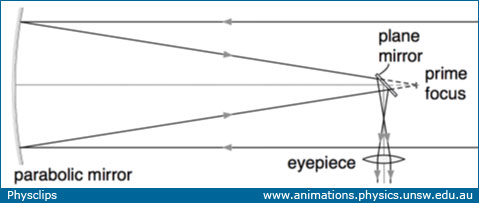
After discovering chromatic dispersion in prisms (see Newton's prisms), Newton realised one of the limitations of refracting telescopes that used homogeneous lenses. (Modern refracting instruments use achromatic lenses.) He then developed the technique of mirror grinding so that he could invent a telescope in which most of the focussing came from a mirror and thus depended only on geometry, not refractive index. Rather than having the operator put his/her head in the scope, a small plane mirror directs the optic axis to the side of the scope, where there is often an eyepiece.
|
||
Looking down the telescope: magnification
In this clip, the camera is originally pointed down the corridor, focussed on infinity. We then rotate to to look through the eyepiece and mirrors of the telescope, so as to see the scene with the magnification of the telescope. Note the magnification and inversion of the image. Note also that, in spite of the magnification, the image (end of film) is brighter than the original object (beginning of film). This is because the large mirror gathers a lot of light. The magification of telescopes allows us to see fine detail in images, but the light gathering of large telescopes allows us to see (or, more often, to photograph) very faint objects. |